
The kitchen clock read 11:47 when I heard it — the soft, deliberate slide of paper across the threshold. Not the mail slot. The bottom of the door. Someone had come to the apartment and bent down and pushed something through, and by the time I turned from the sink, the envelope was already lying there on the mat like it had always belonged.
Black. No stamp. My name in that same heavy handwriting I'd seen on Anna's summons — block letters, pressed hard enough to leave grooves in the paper.
M-A-R-T-H-A.
My hands were wet from the dish I'd been rinsing. I dried them on my jeans before I picked it up.
"Anna." My voice came out strange, too high. "Anna, there's something—"
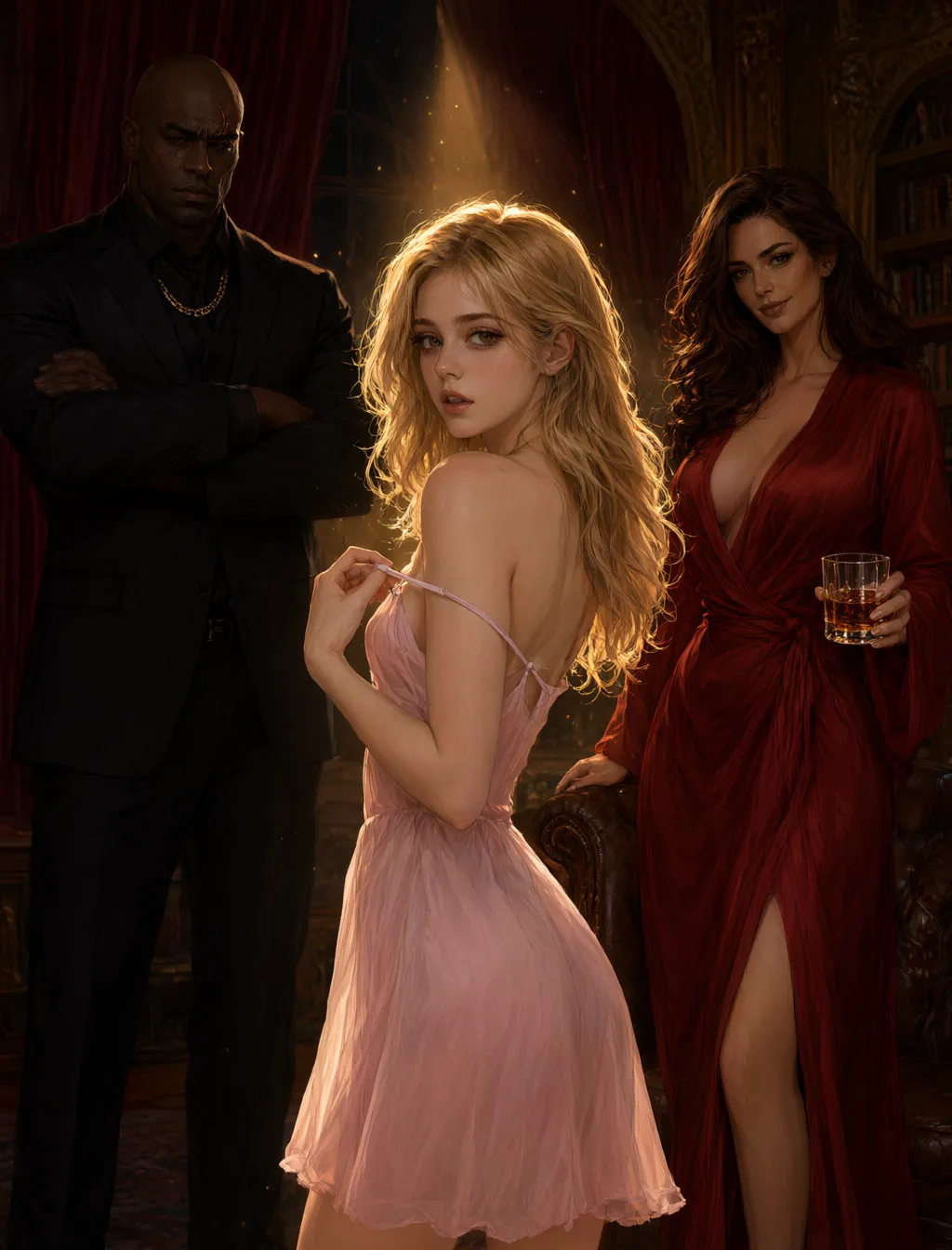
Her bedroom door opened before I finished. She stood in the doorway in her red silk robe, hair loose around her shoulders, and I watched her eyes go from sleepy to sharp in the second it took her to see what I was holding.
"Don't open it."
She crossed the kitchen in four strides, her bare feet silent on the tile. Up close, I could smell her — the lavender lotion she used at night, the faint trace of brandy on her breath. Her hand closed over mine, and I felt how cold her fingers were.
"Anna—"
"Give it to me."
I didn't let go. "It's addressed to me."
Her jaw tightened. For a long moment we stood there, both of us holding the envelope, the paper creasing between our fingers. The coffee machine beeped, finished with its cycle, and neither of us moved to acknowledge it.
"They've never sent one to you," she said finally. Her voice was quiet, careful — the voice she used when she was trying to keep something out of it.
"They've never had a reason to."
I pulled the envelope free of her grip and slid my thumb under the flap before she could stop me.
The card inside was thick, cream-colored, the kind of stationery that costs more than my textbooks. The handwriting was the same as the envelope — heavy, deliberate, each letter pressed into the paper like it was being branded there.
Martha. Tonight. Eight o'clock. The estate. Don't make us come to you.
No signature. No please. Just the words, and the weight of everything they didn't say.
I read it twice. The second time, the words felt different — not a threat, but something closer to an invitation. A door already opening.
Anna took the card from my hand. I let her. Her eyes moved over the words, and I watched the color drain from her face, watched her grip tighten until the cream paper bent.
"No." She said it to herself, not to me. "No, no, no."
"Anna—"
"They said they'd give us time." She was shaking her head, the card crumpling in her fist. "Marcus said—he promised—"
"What did he promise?"
She looked at me then, and for the first time in weeks, I saw the woman underneath the mask. The one who'd spent fourteen years learning to smile with her teeth clenched. The one who'd locked her bedroom door before going to the estate, who'd come home with bruises on her collarbone and a story about surrender.
She was terrified. Not of the men — of what they'd do to me.
"They want you tonight," she whispered.
The words hung in the air between us, heavy as smoke. I'd known, somehow — known from the moment I saw my name on that envelope — but hearing her say it made it real in a way the card hadn't.
Marcus knew I'd seen them. Marcus knew I knew. And now Marcus had decided it was time to collect.
"I'll go," I said.
The words came out before I'd decided to say them. They felt like a key turning in a lock I didn't know I carried — something inside me shifting, clicking into place.
Anna's head snapped up. "No."
"Anna—"
"I said no." Her voice cracked. "Martha, you don't understand what you're asking for. You don't know what they're like when they—"
"Then tell me."
She stopped. Stared at me.
"Tell me what they're like," I said again. "Tell me what happened at the estate. Tell me everything you've been hiding from me since I found you in that room."
The kitchen was silent except for the hum of the refrigerator and the drip of the faucet I hadn't fully turned off. Anna stood frozen, the crumpled card in her fist, her chest rising and falling too fast.
"You're nineteen years old," she said finally.
"I know how old I am."
"You're a college student. You have a whole life ahead of you. You don't—you can't just throw that away because—"
"Because I want to protect you?"
"Because you feel guilty!" The words burst out of her, raw and sharp. "Because you found out what I do and you think you have to fix it, think you have to sacrifice yourself to make up for—"
"That's not why."
"Then why?"
I didn't have an answer. Not one I could say out loud. How could I explain the thing I'd felt when I read that card — the flip in my stomach that wasn't fear, the way my skin had flushed, the image that had flashed through my mind of Marcus's hands on me, Luther's gray eyes watching, John's gold tooth glinting as he grinned?
I couldn't tell her that. I barely understood it myself.
"They'll hurt you," Anna said, softer now. "Not the way you think. Not just physically. They'll get inside your head. They'll make you want things you never knew you could want, and then they'll make you feel like you're dirty for wanting them."
"You said surrender became clarity."
She flinched.
"You told me that," I pressed. "You said you stopped fighting and let yourself be exactly what you are. You said—"
"That was me." Her voice was barely a whisper. "That was my choice, made over years. You don't get to just—"
"I'm not you."
"No." She laughed, a broken sound. "You're worse. You're me before I learned to lie to myself."
The words hit like a slap. I felt them land, felt the sting spread across my face, felt the heat rise in my cheeks.
"I'm not lying to myself," I said.
"Then what are you doing?"
I opened my mouth. Closed it. The truth sat on my tongue, heavy and unfamiliar, and I didn't know how to say it without sounding like a fool or a victim or both.
"I want to know," I said finally. "I want to know what it feels like. To be seen like that. To be wanted like that."
Anna's face crumpled. For a second, I thought she was going to cry. Instead, she crossed to the table, pulled out a chair, and sat down heavily, the card still crushed in her hand.
"Sit down, Martha."
I sat across from her. The marble was cold against my forearms. The coffee machine had stopped beeping, and the only sound was the drip of the faucet and Anna's breathing, slow and deliberate, like she was forcing herself to stay calm.
"Marcus is the one who writes the cards," she said. "He has beautiful handwriting — did you notice that? A man who's broken jaws with his bare hands, and he writes like a poet." She smoothed the crumpled card against the table. "He's the one who decides. Luther executes. John — John makes it feel like a party, like it's all in good fun, and by the time you realize it isn't, you're already in too deep."
"You said you don't love him."
"I don't."
"But you stay."
"I stay because leaving would cost more than staying." She looked at me, and her eyes were old — older than her face, older than her body, older than the red silk robe and the expensive lotion and the careful way she held herself. "I stay because they own me, Martha. Not legally. Not on paper. But in every way that matters, I belong to them, and I've made peace with that."
"And you want that for me?"
"No." The word came out sharp. "God, no. I want you to go to college. I want you to fall in love with someone your own age, someone who'll treat you like a person instead of a—" She stopped. Swallowed. "I want you to have the life I didn't get to have."
"But I don't want that life."
The words hung in the air. Anna stared at me, and I watched her try to find the lie in them, watched her search my face for the girl she'd raised, the girl who'd cried in her arms, the girl who'd promised not to tell anyone what she'd seen.
That girl was still there. But she wasn't the only one anymore.
"You don't know what you're saying," Anna whispered.
"Maybe not." I reached across the table and took her hand. Her fingers were cold, trembling. "But I know I can't sit here while you go to that estate alone. I know I can't pretend I didn't feel something when I read that card. And I know—" I squeezed her hand. "I know that if I don't go, they'll come to us. And I'd rather walk in through the front door than have them break it down."
Anna was quiet for a long moment. Then she laughed — a low, broken sound that wasn't quite a laugh, wasn't quite a sob.
"You sound like me," she said. "When I was your age. Before I learned to be afraid."
"Is that a bad thing?"
"I don't know." She pulled her hand free and stood, crossing to the window. The night was black outside, the city lights smearing across the glass. "I don't know what's bad anymore. I've been doing this so long I've forgotten what normal feels like."
"Maybe there is no normal."
She turned to look at me. The kitchen light caught her face, and for a moment she looked younger — almost the age I was now, before the years and the men and the secrets had worn her down.
"If I let you do this," she said slowly, "you have to promise me something."
"What?"
"You have to promise me you'll tell me if it's too much. If you want to stop, if you want to leave — you tell me, and I'll get you out. No matter what they say, no matter what they threaten. I'll get you out."
I wanted to promise her. I opened my mouth to promise her. But the words stuck in my throat, because I knew — with a certainty that terrified me — that I wouldn't be able to keep that promise. That once I walked into that estate, once I let Marcus touch me, once I crossed whatever line was waiting for me there, I wouldn't want to leave.
"Martha." Anna's voice was sharp. "Promise me."
"I promise," I said.
The lie tasted like copper on my tongue.
Anna nodded slowly. She crossed back to the table and picked up the crumpled card, smoothing it flat with her palm.
"Eight o'clock," she said. "We have nine hours."
"We?"
"You think I'm letting you go alone?" She laughed, and this time there was something almost like warmth in it. "No, baby girl. If we're doing this, we're doing it together. The way we've done everything since you found out."
She reached across the table and took my hand again, her grip firm now, steady.
"But if we're going to do this," she said, "we're going to do it right."
I didn't ask what she meant. I didn't have to. I could see it in her eyes — the same look she'd had when she'd found me crying in my room after the nightclub, when she'd held me and told me everything would be okay. The look of a mother who would do anything to protect her daughter, even if protecting her meant walking her straight into the lion's den.
Even if it meant teaching her to be a lion too.
"Go shower," Anna said, releasing my hand. "Wash your hair. Shave your legs. All of it."
I stood, my legs unsteady beneath me. "What are you going to do?"
She was already crossing to the hallway closet, pulling out the garment bag she kept in the back, the one I'd never seen her open.
"I'm going to find you something to wear."