
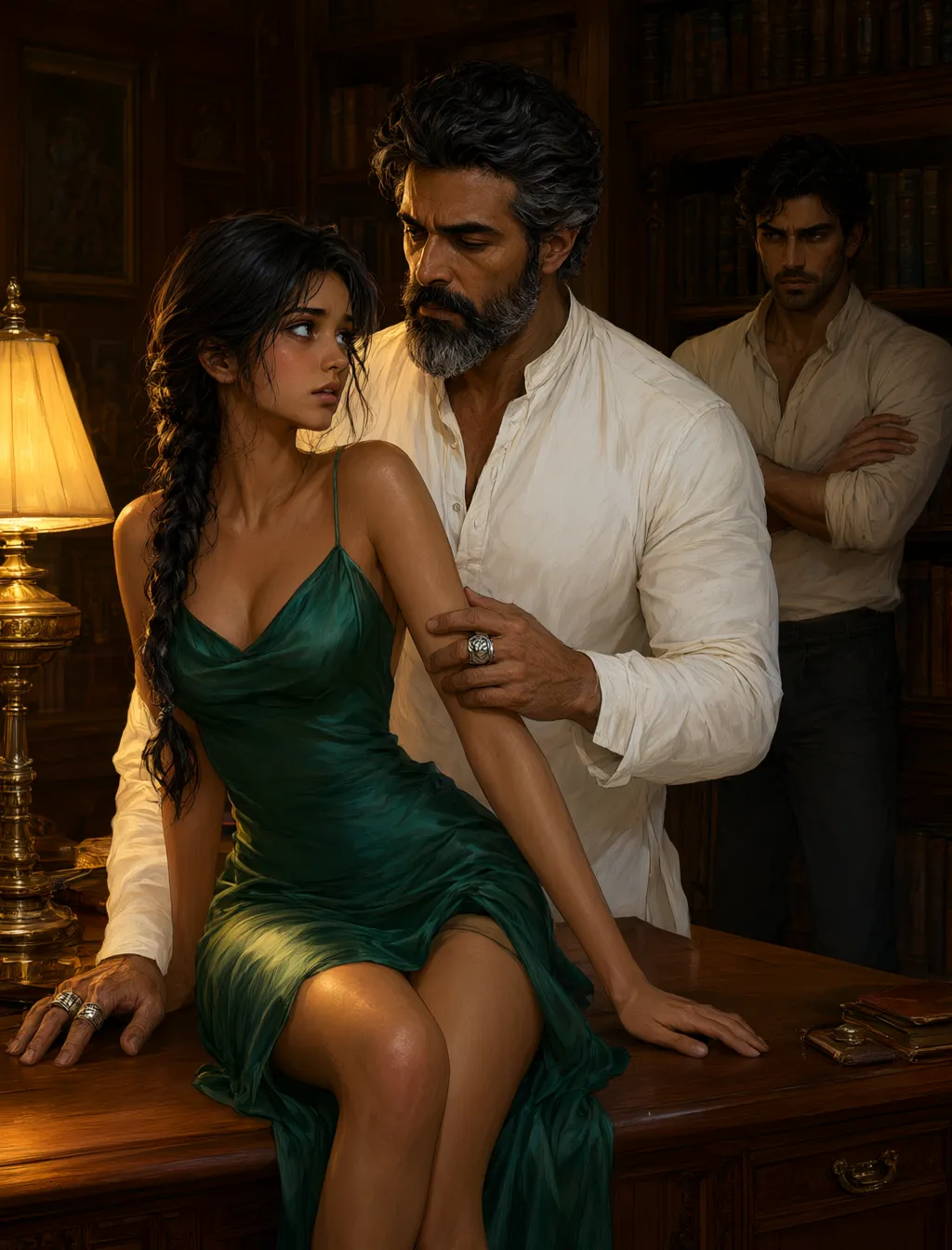
The dining room was long and low-ceilinged, and the table ran almost its whole length, dark teak polished until the lamplight lay on it like water. Meera stood at the doorway a moment, her bare feet finding the cool stone of the threshold, and the smell reached her before anything else — roasted lamb, thick and fatty, and under it the sharp bite of whiskey, and under that the faint sourness of a room where men had eaten for years without a woman in it.
"Sit," Arjun said, and pointed with his chin at the chair on his right.
She went and sat. The wood was cold and hard under her thighs, and the wetness his father had left on her inner thigh pressed against the seat and did not dry. She kept her knees together and her hands in her lap and her eyes down on the plate that was already set there, a plain steel thali with a small hill of rice and two pieces of lamb and a folded roti on the rim, and she did not touch any of it.
At the head of the table, Vikram Singh Rathore sat with his back to the wall and the whole room in front of him. He had a glass of whiskey at his right hand, half full, and his black eyes went from her face to her hands to her lap and back again, slow, the way a man counts cattle. He did not speak. He did not need to.
Across from her, Veer sat with his elbows on the table, and he was the only one of the three who was smiling. He was twenty-six and thin in a way that made his shoulders look sharp, and his eyes were lighter than his brothers', and they stayed on her mouth the way his father's did, and then lower, and then back up. He did not blink much.
Rohan was at the far end, past the empty chair that must have belonged to him, and he had not looked at her since she sat down. He was pushing rice around his plate with his thumb, and his big farmer's hands looked wrong on the fine steel, and once, when Arjun shifted in his chair, Rohan's jaw moved like he was going to say something, and then did not.
"Eat," Arjun said again, and this time his hand landed on the back of her neck.
His palm was dry and hot and it covered the whole nape of her, thumb on one side of her throat and fingers on the other, and he pushed her forward — not hard, just enough that she had to drop her head toward the plate or feel the strain in her neck. She picked up the spoon. Her braid, still loose where he had dropped it in the corridor, slid forward over her shoulder and hung down into the steam.
"The braid," he said, and his thumb moved once against her pulse. "Fix it."
She set the spoon down and gathered her hair with both hands and braided it quick, the way she had done it a thousand times at home on the floor by the fire, her mother's voice in the room behind her. She did not have a tie. She held the tail of it in her fist and looked at Arjun and he looked back at her, and then he took his hand off her neck and reached into his shirt pocket and pulled out a rubber band and dropped it on the table by her plate, and she picked it up and bound her hair and put her hands back in her lap.
"Now eat."
She picked up the spoon again and took the first bite of rice, and her hand was steady, which surprised her, and the rice was hot and salted and she had not eaten since morning and her body wanted it before her mind could argue, and she swallowed and took another.
Under the table, Veer's foot found her ankle.
She stopped chewing. The foot was bare — he had come to the table without shoes — and it was warm and dry and it rested against the bone of her ankle for a moment, the way an animal rests before it moves, and then it slid up. Up the inside of her calf, slow, the sole of his foot dragging over her skin, past the hollow behind her knee, and stopped there, and pressed.
"You're not eating," Veer said, pleasant, like he was asking about the weather.
She put the next bite in her mouth. The lamb was soft and fell apart against her tongue, and she chewed it, and Veer's foot stayed behind her knee, and his eyes never left her face, and she understood that he was waiting to see what she would do — whether she would pull her leg away, whether she would look at his father, whether she would say anything at all. So she did nothing. She ate the lamb and she kept her face down and she let his foot stay where it was, and the wetness on her thigh under her, and the cold of the chair, and the smell of the whiskey all pressed in around her at once.
At the head of the table, Vikram lifted his glass and drank and set it down. His eyes were on her mouth. She felt them there, the way she had felt them on the back of her neck in his room, and she knew he was watching the way she chewed, the way she swallowed, the way her tongue came out to catch a grain of rice at the corner of her lip. He had bought her. He had already had her. And he was still watching her mouth as if the mouth were the part he had not yet decided about.
"Slowly," Arjun said. "No one's taking it from you."
"Yes," she said. It was the first word she had spoken since she sat down, and it came out small and dry, and she hated the sound of it.
His hand came back to her neck. This time it stayed. He ate with his other hand, one-handed, fork and knife working the lamb off the bone, and his thumb rubbed a slow circle at the base of her skull where the braid started, and every time she took too long between bites the pressure of his palm increased, just a little, just enough to remind her. She ate at his pace. She ate until her plate was half empty and her stomach had stopped being a fist.
Across the table, Rohan set his fork down with a small click.
"She's eating," he said. "Leave her be."
The hand on Meera's neck did not move, but the thumb stopped its circle. "You going to feed her, then?" Arjun said, not looking at his brother. "You going to wipe her mouth too?"
"I'm saying she's eating."
"And I'm saying you can take your plate and go if you don't like the way I hold my property."
The room went quiet. Veer's foot slid down from behind her knee, back down her calf, and rested against her ankle again, and he was still smiling, watching his brothers the way a man watches a fight he has no stake in. Vikram did not look up from his glass. He drank, and set it down, and the sound of the glass on the teak was the only sound in the room.
Rohan looked at his father. His father did not look at him. Rohan picked up his fork and pushed the rice around his plate again, and said nothing more, and his honey-brown eyes went to Meera's face for one second — one — and then away, and she saw in that second that he was ashamed, and that the shame was not for her, and that he would not do anything with it.
"Enough," Vikram said. His voice was low and it did not rise and it did not need to. "Arjun. Let her finish."
Arjun's hand came off neck. He did not apologize and he did not look at his father. He picked up his own glass and drank and wiped his mouth with the back of his wrist, and then, without looking at her, he said, "Eat the rest. All of it."
She ate the rest. Her hands had started to shake a little, and she hid it by keeping them low, the spoon close to the plate, and she took small bites so the shaking would not show, and the lamb was cold by the time she got to the last piece and she ate it anyway. Veer's foot stayed against her ankle. Every so often he would press it, a slow squeeze, and then release, and once he dragged it up her calf again and back down, and she kept her eyes on her plate and her mouth moving and did not react, and she could feel him enjoying that she did not react.
Vikram watched her the whole time. He did not eat. He drank his whiskey and he watched her mouth take the food and her throat move when she swallowed and her tongue come out for the last of the rice, and when she set the spoon down on the empty plate, he set his glass down on the teak with a small, deliberate sound, and the sound went through the room like a finger through water.
"Come here," he said.
Nobody moved. Arjun's jaw worked once. Veer's foot went still against her ankle, and his smile got smaller and sharper, and he leaned back in his chair and folded his arms. Rohan sat with his hands flat on the table on either side of his plate, and he did not look at her, and he did not look at his father, and his knuckles had gone pale.
The chair scraped when she pushed it back. She stood, and the room tilted a little — the whiskey smell, the lamb, the low ceiling, the four men arranged around the table like the points of something — and she walked down the length of the teak with her bare feet quiet on the stone and her braid tight against her back, and she stopped at his right hand and stood there, and waited, with her eyes on the whiskey glass and not on his face, because she did not know yet what to call him and had decided not to guess.
He let her stand there. The room had gone so still she could hear the ceiling fan turning somewhere beyond the doorway, and a pressure cooker ticking down in the kitchen, and beneath her own ribs her heart working like a caught bird. Vikram turned his glass a quarter-turn on the teak, watching the whiskey climb the side and slide back, and then he lifted his free hand and closed it around her wrist.
"Sit," he said, and pulled her down.
Not onto the chair beside him — onto his lap. He drew her across his thighs with the same unhurried strength he had used to open the blue door, and her knees landed on either side of his leg and her back came up against his chest, and his arm settled across her waist like a bar of iron laid down. She caught the table edge with one hand to keep from folding forward into the plates. Her braid fell over his forearm. Up close he smelled of whiskey and sandalwood soap and the smoke of the room he had taken her in.
"Papa—" Arjun started.
"You had your hand on her neck all through dinner," Vikram said, unhurried, into the space over Meera's shoulder. "Now I have her on my knees. Finish your food."
Arjun finished his food. He did it sullenly, elbows on the table, watching her the way a dog watches a bone it has been told to leave. Veer ate too, and watched openly, chin propped on his fist, and every time she shifted on his father's thigh his eyes came down to the place where her sari had rucked up against Vikram's knee. Rohan did not eat at all. He sat with his hands flat on the table, and his jaw was set, and he looked at the wall behind his father's head as though something were written there.
Vikram's hand moved. It went from her waist to her knee, and then under the hem of the sari, and rested flat on the bare inside of her thigh — the thigh he had left wet. His palm was hot and dry and it covered the whole slope of her, and his thumb found the wetness there and smeared it slowly, once, down to the hollow of her knee and back up.
"Still wet," he said, low, so that only she could hear it, though the whole room could see his hand under the cloth. "Good."
She kept her eyes on the whiskey glass. Her body did not know what to do with itself — her back had gone straight as a stave against his chest, and her thighs had tightened around his leg without her telling them to, and she could feel her own pulse in the place his thumb was working. She thought of the girls at the tank behind the temple, the ones who were whispered about, and she thought: this is how it starts. And then she thought nothing, because his thumb had found the crease of her and pressed, and a small sound came up her throat that she swallowed back down before it reached her mouth.
"She liked that," Veer said, delighted, and set down his fork. "Papa, she liked it."
"Eat your food, Veer."
Veer ate his food. But he had moved his chair, scraping it along the stone, so that he sat closer to his father's end of the table now, and his foot found her ankle again where it hung beside the chair, and this time it did not climb. It just rested there, warm and proprietary, and pressed, and pressed again, as if to say: I am here, and I have not gone anywhere, and after Papa there is me.
The whiskey glass was empty. Vikram reached past her with his free hand and set it down on the far side of the plate, out of her reach, and then both his hands were on her — one at her waist, one under the sari — and she understood that the meal was over, that the whole long gauntlet of it had been only the whetstone, and that she was the thing being sharpened. She looked at the table one last time. The chairs were arranged like a sentence she had not been taught to read: Vikram at the head with the wall behind him and the door in his sightline; Arjun at his right hand, the hand that had held her neck; Veer across, where he could watch; Rohan at the far end, the farthest he could get without leaving. Three sides of her, and the fourth side was the wall.
"Arjun," he said. "The room with the blue door. Put her in it. And then come back — we have the accounts to settle, you and I."
Arjun stood so fast his chair grated. He came around the table and stood over her, and his father's hands came off her and let her go, and she slid down from Vikram's lap onto her own feet, and the stone floor was cold and her legs were not entirely steady under her. Arjun took her by the upper arm — the grip of a man moving a sack of grain — and turned her toward the door.
"Tomorrow," Veer said from the table, still smiling, still watching her back. "I have not had my turn."
Arjun walked her out through the doorway and into the corridor, and behind them the low voices started up — Vikram's, and Rohan's, quieter, and then the sound of a chair pushed back hard. She did not turn around. The blue door was at the end of the corridor, and the corridor was dark, and somewhere in the house a gecko called once and stopped, and she walked toward the door she had been promised, her arm in Arjun's hand, her braid coming loose again at the nape of her neck.