
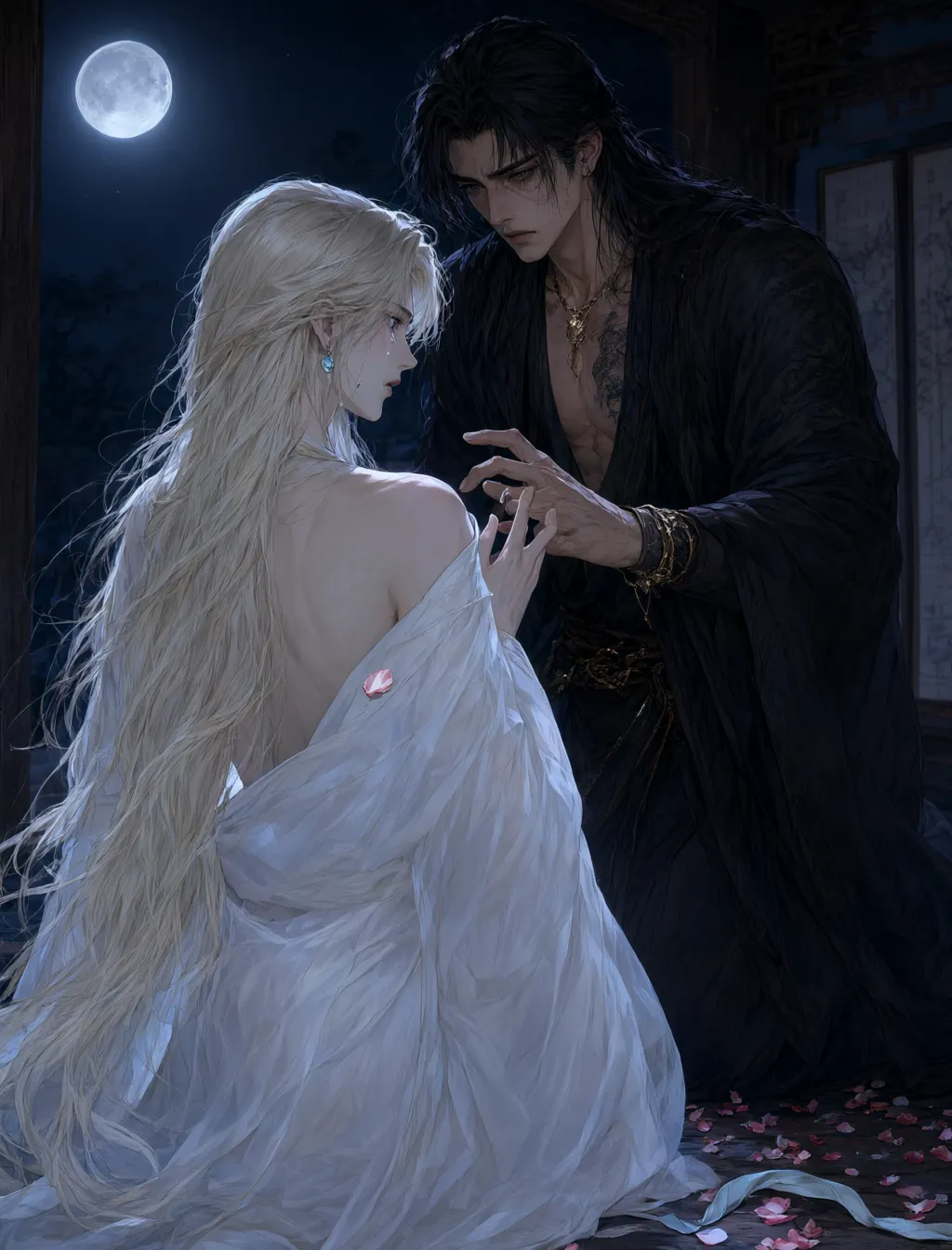
Moonlight bleached the worn floorboards of the pavilion, pooling silver at the edges of each plank. Wei Qiang stood in the doorway, one hand braced against the frame, his black hanfu damp at the hem from the garden mist that clung to everything tonight. The humid air pressed against his skin thick and warm, carrying the scent of cedar from the railings and the faint metallic tang of lake water below.
Jiao Liu danced in the center of the space, his white robes billowing with each turn, sleeves catching the moonlight like wings woven from silk and shadow. His fingers traced the air, curving and curling as if pulling music from the silence itself, and for a moment the world held its breath around him. His voice rose then—a low, melodic hum that threaded through the night, a song without words that settled somewhere deep in Wei's chest.
Jiao's body moved with a grace that hurt to watch. He flowed from one position to the next, each step deliberate, each sweep of his arm a gesture of devotion. Then he turned, his profile cutting against the pale glow, and Wei saw it.
The bones of his wrist. Pressing sharp against the white silk sleeve. Three ridges, clear and distinct, as if the fabric were a thin veil over a skeleton.
Wei counted them. One. Two. Three. Each one a small wound in his chest.
Jiao's blue eyes found his then—those winter-sky eyes that had once held so much light, now pale and translucent as morning frost. A smile flickered across Jiao's lips, soft and familiar, the same smile he always wore when he knew Wei was watching. But the next note of his song faltered. Just a fraction of a breath. A catch that would have gone unnoticed by anyone who hadn't memorized the cadence of Jiao's voice, who hadn't spent countless nights listening to him hum in the dark.
Wei's grip tightened on the doorframe. His knuckles went white, the urge to step forward and stop this—this fragile, beautiful offering—warring with the knowledge that Jiao gave this gift every night. That he poured himself into this dance, this song, this moment, because it was how he said I love you when words weren't enough.
To interrupt would be to refuse the gift.
To refuse the gift would break something between them.
So Wei stayed, his jaw tight, his chest a cage of held breaths, and watched.
Jiao's turn slowed, his arms spreading wide as his voice deepened, the melody sinking into a lower register. His hair, that long fall of moonlight silk, spun around him with each movement, brushing the floorboards before lifting again. The white hanfu—once a perfect fit, once draped and tailored to his slender frame—now pooled around him as if the robe itself were trying to hold him together. The fabric at his waist folded in loose layers where it used to pull taut.
Wei noticed. Of course he noticed. He noticed everything.
How Jiao's fingers trembled slightly when he held them extended a beat too long. How his collarbones carved shadows beneath the robe's neckline. How the hollow at his throat seemed deeper tonight, a small valley where skin met bone. How his breath came faster now, the song accelerating as if Jiao was racing against his own lungs.
Wei's hand dropped from the doorframe.
He took one step forward—not into the light, just far enough that his silhouette shifted in the open doorway. He didn't speak. He didn't call out. But Jiao's eyes found him again, and the song faltered a second time. A stutter. A missed note that hung in the air like a tear in silk.
Jiao recovered, his voice smoothing over the gap, but the strain was audible now—a thinness to the tone, a quiver at the edges. He spun once more, his robes flaring, and as he completed the turn his balance swayed. Just a hair. A tilt that he corrected instantly, but Wei saw it. The way his foot dragged against the floor. The way his hand shot out to catch the empty air before he controlled it, making the motion part of the dance.
It wasn't part of the dance.
Wei knew the difference between choreography and survival.
Jiao's arms lowered slowly, his song fading into a soft hum, then into silence. He stood in the center of the pavilion, chest rising and falling too fast, his winter-blue eyes fixed on the floorboards as if the grain held answers. A single strand of white-blonde hair had escaped his ribbon, falling across his cheek.
The lake lapped against the pavilion's pillars. The cedar scent rose. The silence stretched.
Wei crossed the space in three strides, his boots soft against the wood. He stopped an arm's length from Jiao, not touching, not crowding, but close enough that the heat of Jiao's exerted body reached him. Close enough to see the fine tremor in his shoulders.
Jiao looked up. That smile again—gentle, deflecting, a wall of silk and warmth. "You're here." His voice was breathy, a little rough from the singing. "I didn't hear you arrive."
"You never do." Wei's voice came out lower than he intended, rough with the worry he couldn't disguise. "You were beautiful, Liu. You are always beautiful."
A faint blush touched Jiao's high cheekbones, barely visible in the moonlight. He ducked his head, a small, shy movement that made him look younger, more fragile. "I wanted it to be perfect tonight. The moon is so full."
"It was perfect."
Jiao's smile widened, but his eyelids fluttered, and he swayed slightly on his feet. The sway was subtle—a shift of weight, a brief unsteadiness—but Wei saw it the same way he saw every ridge of bone, every faltering note, every trembling finger.
He reached out before he thought about it, his hand closing around Jiao's upper arm. The touch was gentle, barely a grip, but Jiao's breath hitched, and his body leaned into the contact as if starved for it. The silk of his sleeve was cool against Wei's palm, but beneath it Jiao's arm felt thin. Too thin. The bones sharp against his fingers.
"When did you last eat?" The question came out unbidden, rough-edged, and Wei saw Jiao's expression close like a fan snapping shut.
"I ate at midday. A bowl of congee. It was good."
"A bowl of congee." Wei's jaw tightened. "That was eight hours ago."
"I'm not hungry, Wei." Jiao's voice had that edge now, the patient, tired tone of someone who has had this conversation before and knows exactly where it ends. "I'm fine. I danced well tonight, didn't I? My breath only faltered at the end. I felt strong."
"You swayed."
"It was part of the—"
"Don't." The word came out sharper than Wei intended, and Jiao flinched. Not visibly—he was too practiced for that—but his shoulders tensed, his chin lifting just a fraction. Defiance wrapped in grace.
Wei let out a breath, forcing his grip to loosen, forcing his voice to soften. "Don't tell me it was part of the dance. I know the difference, Liu. I have watched you dance for two years. I know every turn, every gesture, every silence you leave between notes. You swayed because you are exhausted. Because you haven't eaten enough to carry you through a single song, let alone a full performance."
Jiao looked away, his gaze drifting to the lake, the moon's reflection broken into silver shards by the water's movement. "You worry too much."
"I worry exactly the right amount."
Jiao laughed then—a soft, melodic sound that used to fill the pavilion with light. Now it sounded thin, like wind through dry leaves. He turned back to Wei, and his hand rose, fingers brushing against Wei's jaw. The touch was light, almost apologetic. "I am not your responsibility to fix, my prince."
"You are not a responsibility. You are the person I love. There is a difference."
Jiao's fingers stilled. Something flickered across his face—surprise, perhaps, or pain—before he smoothed it away. "I know. I know, Wei." He let his hand fall, stepping back, putting space between them. "But I cannot be watched every moment. I cannot be followed and measured and weighed. I am still myself. I am still here."
"You are thinner than you were a month ago."
"It is the season. I always lose my appetite in the—"
"It is not the season. I can see your ribs, Liu."
The words hung between them, heavy and raw. Jiao's hands dropped to his sides. His chest rose with a deep, slow breath, and when he spoke again, his voice was barely a whisper. "You do not understand."
"Then help me understand." Wei stepped closer, not touching now, his hands hanging loose at his sides. "Tell me what is happening. Tell me why you do this."
Jiao shook his head, a small, tight movement. "It is not something I can explain in a sentence. It is not something I fully understand myself."
"Then let me be here while you try."
"You are always here." Jiao's laugh again, this one bitter, brittle. "That is the problem. You are always here, watching, worrying, and I cannot—I cannot be the thing you worry over. I am supposed to be the one who brings you joy. The dancer, the musician, the one who makes your nights beautiful. Not the sick thing you have to save."
The words cracked the air between them. Jiao's eyes widened, as if he hadn't meant to say that, as if the confession had slipped out before he could catch it.
Wei's heart dropped. He reached out again, this time taking Jiao's hand—the bones of those fingers, the cool skin, the way Jiao's grip was too weak to hold back. "You do bring me joy. Every day. Every night. Your dance, your voice, the way you look at me in the morning—that is joy. But joy and worry are not enemies, Liu. I can hold both. I can love your beauty and fear for your health at the same time."
Jiao's lower lip trembled. He bit it, hard, and looked away. His hand was limp in Wei's grip, not pulling away but not holding on either. "You deserve someone whole."
"I did not choose you because you were whole. I chose you because you are you. And I will keep choosing you. Every day. Every meal you skip. Every dance that takes more than you have to give. I will still be here."
A tear slipped down Jiao's cheek, catching the moonlight like a bead of silver. He didn't wipe it away. "I am tired, Wei."
"Then sit."
Wei guided him to the edge of the pavilion, where a low bench sat against the railing. Jiao lowered himself slowly, his hands pressing into his thighs as if to steady himself. His white robes pooled around him, and in the moonlight he looked like a figure carved from ice, beautiful and fragile and melting away.
Wei knelt before him, his black robes spreading across the floor, and took both of Jiao's hands in his. He pressed his thumbs to the insides of Jiao's wrists—the bones he had counted, the pulse that beat too fast, the skin so thin he could almost see the veins underneath.
"I will send for some tea and a small plate."
"Wei—"
"A few bites. Dried fruit. A piece of bread. That is all I ask." He looked up, meeting Jiao's eyes, letting him see the fear he usually kept hidden. "Please. For me."
Jiao's gaze wavered. His hands turned under Wei's, palms open, a gesture of surrender or exhaustion. "A few bites."
Wei nodded, his throat tight. He released one of Jiao's hands and turned toward the darkened garden path, calling softly for a servant who had been stationed within earshot all evening. A figure emerged from the shadows, bowed, and vanished toward the kitchens.
When Wei turned back, Jiao was watching him with an expression he couldn't read—something between gratitude and grief. He had drawn his sleeves around himself, pulling the white silk close like a cocoon, his shoulders hunched slightly against the night air. His hair curtained his face, the strand that had escaped now joined by several more, loose and silver-white.
Wei rose and sat beside him on the bench, not so close that their shoulders touched, but near enough that Jiao could lean on him if he chose. The lake below them shimmered. A frog called, low and rhythmic, from the reeds.
Jiao spoke after a long moment, his voice so quiet the water almost swallowed it. "I do not know how to stop."
Wei's breath caught. This was the first time Jiao had ever admitted it. The first time he had acknowledged the thing living inside him, the hunger that he fed instead of his own body, the invisible grip that held him tighter than any embrace.
"Then we learn together," Wei said. "Slowly. Day by day. I will not push you faster than you can go. But I will not stop asking. I will not stop noticing. I will not stop loving you through every single bite."
Jiao let out a shaky exhale, and his head tipped, coming to rest against Wei's shoulder. The weight was so light—so frighteningly light—and Wei felt his own eyes sting.
He didn't move. Didn't speak. He just sat there, the moon above them, the lake below, the scent of cedar rising in the warm night air. And when the servant returned with a tray—a small pot of jasmine tea, a bowl of dried apricots, a piece of flatbread still warm—Wei took the tray himself, setting it on the bench between them.
He picked up a single apricot, the flesh dark and sweet-smelling, and held it out. "Start with one."
Jiao looked at the offering. His hand rose slowly, and his fingers closed around the fruit. The trembling was faint but visible.
He brought it to his lips. Bit down. Chewed. Swallowed.
A small victory, no larger than a breath, no heavier than a dried apricot. But Wei took it, held it close, and let hope flicker inside his chest like a candle in a storm.
Jiao's hand found his again, their fingers lacing together on the bench between the tray. Neither spoke. The moon continued its slow arc across the sky. And somewhere in the garden, a nightingale began to sing.
Jiao's fingers tightened around the apricot pit, the small hard nub pressing into his palm like a secret he couldn't swallow. His thumb traced its ridged surface once, twice, a slow repetitive motion that seemed to anchor him to the bench. The nightingale's song wove through the silence, each note a thread of silver in the dark.
Wei felt the shift beside him—the subtle tension that traveled from Jiao's hand up through his arm, a wire pulled taut beneath the white silk. He said nothing. His thumb stroked the inside of Jiao's wrist, a question asked in touch, not words.
Jiao's breath came out uneven, catching at the edges. His gaze stayed fixed on the lake, on the broken moon dancing across the water's surface, and when he spoke his voice was so quiet the nightingale nearly swallowed it whole. "Wei."
A pause. The word hung between them, fragile as frost.
"Will you still love me—" Jiao's throat worked, his fingers curling tighter around the pit until the ridges bit into his skin. "When there is nothing left?"
The question landed like a stone dropped into deep water. The ripples spread outward, touching everything—the pavilion, the lake, the empty spaces between their shoulders. Wei's hand stilled on Jiao's wrist. The nightingale paused mid-phrase, as if listening, then resumed its song from a different branch.
Wei turned on the bench, his body angling toward Jiao, his knee brushing against the white hanfu pooled around Jiao's thigh. He didn't speak immediately. He let the question sit, let it breathe, let Jiao feel the weight of it being heard and not dismissed.
"Look at me," Wei said softly. Not a command. An invitation.
Jiao's chest rose and fell. His head turned slowly, winter-blue eyes meeting black, and in that gaze Wei saw everything Jiao had been hiding—the terror, the exhaustion, the small fierce hope that had survived despite everything. His eyes were wet, the moonlight catching the sheen on his lower lashes, but no tears fell.
"Yes," Wei said. "I will."
Jiao's lips parted. A tremor ran through him, visible even through the layers of silk and air between them. "You cannot know that. Not truly. You cannot know what nothing means until—until it is already gone."
"Then I will learn what it means when we arrive there together." Wei reached up, his hand moving slowly, giving Jiao every chance to turn away. But Jiao didn't move. His fingers brushed Jiao's cheek, featherlight, tracing the curve of his cheekbone, the hollow beneath it. "I have watched you become thinner. I have watched your color fade, your breath shorten, your dances grow more desperate. And I have loved you through every single change. I do not love a version of you that is fixed and safe. I love you, Liu. The you that is here, right now, with an apricot pit in your hand and a question that breaks my heart."
Jiao's jaw tightened. His hand opened, the pit lying in his palm, a small dark bead against his pale skin. "This is all I could eat tonight. One fruit. A single bite." His voice cracked. "I wanted to eat more. I wanted to finish the bread, to drink the tea, to make you smile. But my body—" He stopped, pressing his lips together. "My body would not let me. It closed itself against the food like a door I have no key for."
Wei's hand slid from Jiao's cheek to his shoulder, cupping the sharp curve where bone met joint. "Then we find another door. Or we open this one together, a crack at a time."
"You make it sound so simple."
"It is not simple. It is terrifying. But it is not impossible."
Jiao let out a breath that was almost a laugh, but there was no humor in it. He turned the pit over in his fingers, studying it as if it held the answers to questions he hadn't yet learned to ask. "I have been thin my whole life. Always the slender one, the delicate one, the dancer built of air and moonlight. It was praised. It was beautiful. I was beautiful." His voice dropped. "I do not know who I am if I am not this."
Wei's fingers tightened on Jiao's shoulder, a gentle pressure, grounding. "You are the person who hums in the dark when you think I am asleep. You are the one who paints lyrics in the air with your hands when you cannot find the words. You are the dancer who once spun so fast I thought you might lift off the ground and never come back down. That is who you are. Not a number of bites. Not the shape of your wrists."
A tear finally fell, tracing a silver line down Jiao's cheek. He didn't wipe it away. It hung on his jaw for a moment before falling onto his white robe, a dark spot spreading on the silk. "What if I cannot find my way back? What if the door does not open, no matter how many cracks we make?"
"Then we sit on this side of it together."
"That is not an answer, Wei."
"It is the only answer I have."
Jiao stared at him. The nightingale had fallen silent, the garden holding its breath. The lake lapped against the pillars, a soft liquid rhythm that seemed to wait.
And then Jiao moved. He shifted on the bench, his body turning, and before Wei could react, Jiao's arms were around him—thin arms, trembling arms, wrapping around Wei's neck with a desperate strength that belied his frailty. His face pressed into Wei's shoulder, his breath hot and uneven against the black silk of Wei's collar. The pit fell from his fingers, landing on the floorboards with a small hollow click, rolling once before stopping.
Wei's arms closed around him immediately, pulling him close, cradling the fragile weight of him against his chest. Jiao felt smaller than he had a week ago, smaller than he had any right to be, the bones of his back sharp ridges beneath Wei's palms. Wei held him like something precious, something breakable, something he had already decided to protect even if it cost him everything.
"I am so tired," Jiao whispered into his shoulder. "Not just tonight. Not just from the dance. I have been tired for so long, Wei. Longer than I know how to measure. Tired of fighting my own body. Tired of pretending I am fine when I am hollowing out from the inside. Tired of being the beautiful thing you have to save."
"Then stop saving yourself for a moment," Wei murmured into his hair, his lips brushing the white-blonde strands. "Let me hold the weight. Just for tonight."
Jiao's fingers curled into the fabric of Wei's robe, gripping, holding on. His shoulders shook with silent sobs that he tried to hide, his breath hitching against Wei's neck. The tears soaked into the black silk, warm and evidence of a grief Jiao had been carrying alone for too long.
Wei did not shush him. Did not tell him it would be alright. Did not offer false comfort. He simply held him, one hand cradling the back of Jiao's head, the other pressed flat against his spine, fingers spread wide as if he could shield Jiao from the emptiness inside him by sheer presence alone.
The moon climbed higher, casting longer shadows across the pavilion floor. The tea grew cold in its pot, the flatbread stiffening on the tray. A breeze stirred the reeds below, carrying the scent of wet earth and night-blooming jasmine.
After a long while, Jiao's breathing steadied. His grip loosened, his fingers easing their desperate hold on Wei's robe. He pulled back just enough to look at Wei's face, his eyes red-rimmed, his cheeks wet, a stray strand of pale hair plastered to his temple. He looked exhausted. He looked raw. He looked more real than Wei had seen him in months.
"Will you walk me back to my chambers?" Jiao asked, his voice hoarse. "I do not think I can make the journey alone tonight."
Wei's hand came up, brushing the stray hair from Jiao's face, tucking it behind his ear with a tenderness that made Jiao's eyes well again. "I will carry you if you need me to."
Jiao's lips curved—a real smile, small and tired, but real. "That will not be necessary. But I would like your arm to lean on."
Wei rose first, then offered his hand. Jiao took it, his fingers cold and fragile in Wei's grip, and pulled himself to his feet. He swayed once, a brief unsteadiness, and Wei's arm came around his waist, steadying him without comment.
The servant who had brought the tray had disappeared back into the shadows. The pavilion was empty now except for the two of them, the tray abandoned on the bench, the apricot pit still lying on the floorboards where it had fallen.
Wei guided Jiao toward the path that led through the garden, his arm firm around his waist, Jiao's hand resting lightly on his shoulder. They walked slowly, Jiao's steps measured, his breath even but shallow. The garden opened around them—dark shapes of camellia bushes, the silver glitter of dew on leaves, the distant spark of fireflies near the pond.
Halfway down the path, Jiao stopped. His hand tightened on Wei's shoulder.
"Wei."
"Yes?"
Jiao looked down at the path, at the pale stones underfoot, at his own bare feet—he had removed his shoes before the dance, and they were still sitting by the pavilion steps, forgotten. "I do not know if I can keep the promise I made tonight. The apricot. The few bites." His voice was barely audible. "Tomorrow, my body may win again. It has won so many times before."
Wei turned to face him fully, his hands settling on Jiao's arms, gentle but present. "Then tomorrow, I will kneel beside you again. I will offer you another apricot. And if you cannot take it, we will try something smaller. A sip of water. A single grape. The steam from a bowl of rice. There is no victory too small to count."
Jiao's eyes searched his face, as if looking for the lie, the hesitation, the crack in Wei's certainty. He found none.
"Why?" Jiao whispered. "Why do you stay? There are other dancers. Stronger ones. Ones who do not need to be coaxed into eating a single fruit."
Wei's hands slid from Jiao's arms to his face, cupping his jaw, tilting it up so their eyes met. The moon was behind him, casting his features in shadow, but his voice was clear, steady, absolute. "Because you are the only one who sings in the dark. The only one whose dance I have memorized down to the tremor of your smallest finger. The only one who has ever made me feel like my heart could live outside my body." He paused. "Do not ask me to trade that for convenience."
Jiao's breath shuddered. He stepped forward, pressing his forehead against Wei's chest, his hands coming up to rest over Wei's heart. "I do not deserve you."
"You deserve everything." Wei's arms came around him again, holding him close, his lips pressing a kiss to the crown of Jiao's hair. "And I will spend the rest of my life convincing you of that."
They stood like that for a long moment, wrapped in each other, the garden silent around them. Then Jiao pulled back, wiped his face with his sleeve, and offered Wei a smile that was still fragile, still sad, but edged with something new—a sliver of acceptance, perhaps, or the beginning of trust.
"Take me to my chambers," Jiao said softly. "And stay with me tonight. I do not want to be alone."
Wei's hand found his, lacing their fingers together. "I will stay as long as you need me."
They walked on, the path curving around a stand of bamboo, the pale light of Jiao's chambers visible through the trees. Behind them, in the moonlit pavilion, the abandoned tray held its cooling tea and untouched bread. And on the floorboards, beside the bench where two hands had laced together and a question had been asked, the apricot pit lay still—a small dark seed, holding the promise of something that had not yet grown.