
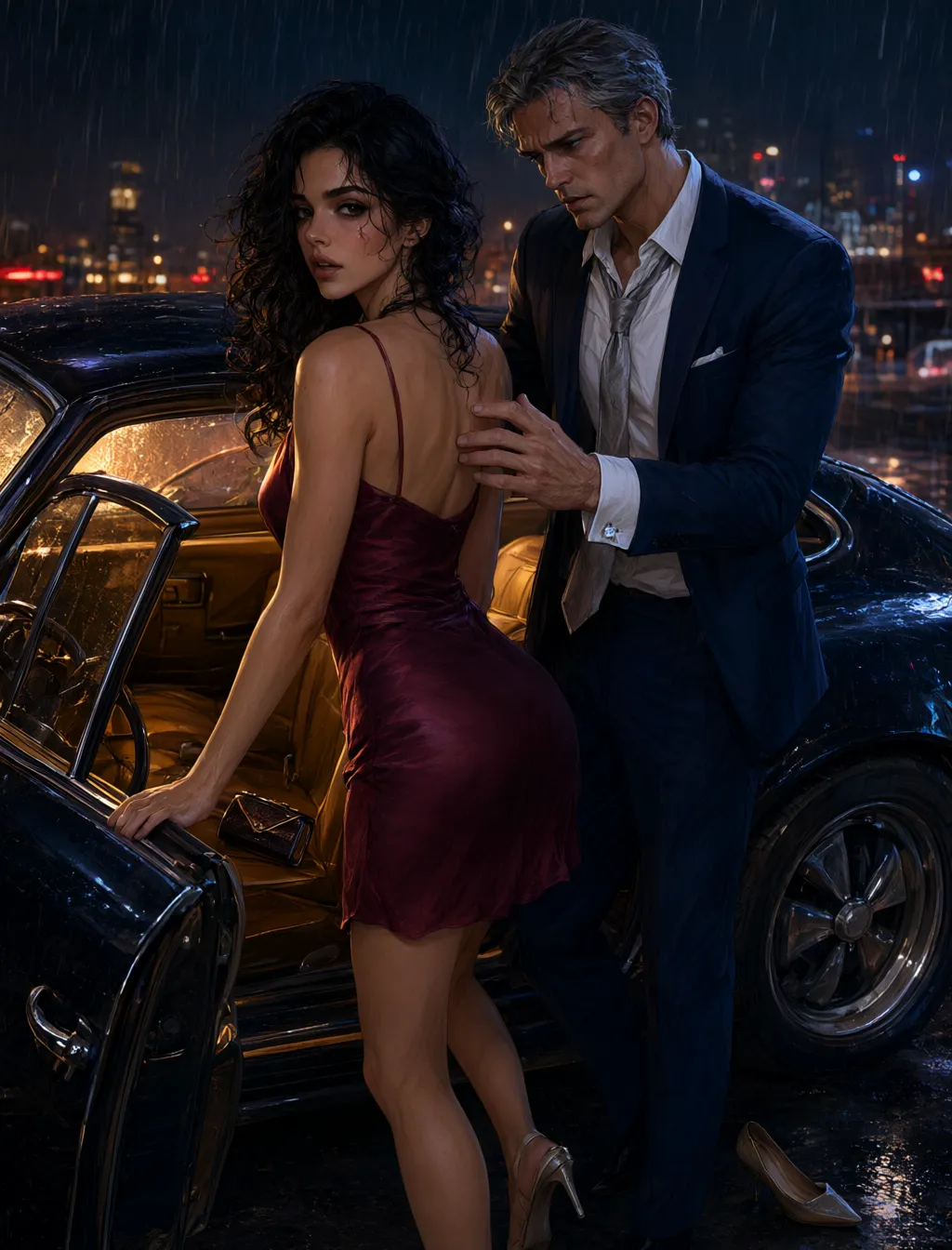
The paper slides across polished wood and stops six inches from her folded hands. No watermark. No greeting. Just her name at the top and four years of driving distilled into numbers she already knows by heart. Two speeding tickets. One expired registration. The accident on the 405 that wasn't her fault but still sits there in black ink like an accusation.
Rain streaks the windows behind him, turning the city into smeared light. He doesn't look at the storm. His gray eyes stay on her face, and she feels them like a hand pressed between her shoulder blades.
She reads the sheet twice because it buys her time to breathe. The chair creaks under her when she shifts—soft leather that costs more than her rent. Everything in this room costs more than her rent. Including the silence he's building around her like a wall.
"Elena Vasquez." His voice is lower than she expected. Not cold exactly. Measured. Like every word has been weighed before he spends it. "Twenty-four years old. One prior employer listed. No references."
She looks up. The desk lamp catches the scar above her left eyebrow—thin and pale, the one imperfection her mother used to trace with her thumb when Elena couldn't sleep. She doesn't blink. "The reference is sitting in front of you. Ask me something that isn't on the paper."
Something flickers behind his eyes. Not amusement. Not warmth. Closer to recognition—the way a man who's been cornered recognizes someone else who's been cornered. Then it's gone, sealed behind the same granite stillness.
"Why would a woman your age want to work for a man with my reputation?"
The question lands with weight. He's not asking about her qualifications. He's asking what she's willing to swallow. Her jaw tightens before she can stop it, but her voice stays even.
"I need rent. Not friends." She lets the words hang there, unsoftened. "I can drive. I can keep my mouth shut. And whatever the tabloids say about you—" She shrugs, one shoulder lifting, falling. "I've worked for worse."
He holds her stare. Three seconds. Five. The rain fills every gap he leaves, drumming hard against the glass, and she counts the beats instead of looking away. Seven. Eight. Her hands stay flat on her thighs, pressed down like she's holding herself in the chair.
Then he reaches into his jacket. The motion is smooth, practiced—a man who's pulled pens and checkbooks and ultimatums from that same pocket a thousand times. What comes out is smaller. A black key fob, unmarked, gleaming under the lamp.
He places it on the paper. Right over her name. His fingers stay there a moment too long, knuckles grazing the print, and when he pulls his hand back the fob sits in the exact center of the page like a period at the end of a sentence he hasn't spoken yet.
The key fob sits on her name like a weight she hasn't decided to carry. Black plastic. Unbranded. The kind of thing that opens something expensive enough to not need advertising. She doesn't reach for it. Not yet.
"What does it unlock?"
Her voice comes out steadier than she feels. The question hangs between them, and she watches his face the way she watches traffic—reading the gaps, the hesitation, the moment before someone commits to a lane.
Julian leans back. The leather creaks under his weight, and for a second she thinks he's going to dismiss the question entirely. The rain fills the silence, drumming hard against the glass, and she counts the beats. One. Two. Three. Her hands stay flat on her thighs, nails pressing crescents into the wool of her skirt.
"A car," he says finally. "Downstairs. Black S-Class."
Not his car. A car. The distinction lands before he adds anything else, and she knows she's supposed to ask what happened to the driver who used to sit in that seat. She doesn't. Some questions you don't ask because the answer costs more than the silence.
He tilts his head, gray eyes catching the lamplight. "You haven't touched it."
"You haven't hired me yet."
The corner of his mouth moves—not a smile, not quite. Something drier. The expression of a man who's been handed a contract with a typo he should have caught. He rests his forearms on the desk, and now there's only the paper and the fob and eighteen inches of polished wood between them.
"Most people would have grabbed it by now. Pocketed it. Asked about salary later."
"Most people don't last a week with someone like you." She lifts her chin. The scar above her eyebrow catches the light, pale and unapologetic. "I'm not most people."
His gaze drops to the scar. Lingers there. She's used to men looking at her mouth, her chest, the curve of her hip—anywhere but the imperfection. He looks at the one thing she can't hide and doesn't try to, and something in his expression shifts. Not softer. More focused. Like he's found the weak point in a structure he was told was solid.
"The job starts at six tomorrow morning." He pushes back from the desk, the motion dismissive and final. "You'll pick me up here. The address book is in the glovebox. Don't be late."
She reaches for the fob. Her fingers close around the plastic—still cool, still unmarked—and she feels the weight of it in her palm like a stone dropped into still water. When she looks up, he's already turned toward the window, his silhouette cut sharp against the rain-washed light.
The chair creaks again as she stands. Her knees protest—too long sitting still, too long holding herself in place—but she doesn't let the discomfort reach her face. She's learned to move through worse. The key fob is still in her palm, still cool, still unremarkable plastic that now means something she hasn't fully decided to name.
His back is to her. Broad shoulders cut sharp against the rain-washed window, hands clasped behind him the way men do when they're waiting for someone to leave. The dismissal is clean, practiced—a man who's ended a thousand meetings without ever saying goodbye. Most people would take the hint. Most people would pocket the fob and walk out and show up tomorrow like a good employee.
Elena doesn't move toward the door.
Her heels click against the hardwood—not loud, not soft, just present—as she crosses the space between the chair and the window. She stops three feet behind him. Close enough to see the tension in his shoulders, the way the fabric of his jacket pulls across his back. Close enough to smell the faint trace of cedar and something sharper. Whiskey, maybe. Or gin. Something a man drinks alone when the reporters have stopped calling and the silence gets too loud.
"You didn't ask me if I drink."
He doesn't turn. The rain fills the gap, drumming hard, and she watches the back of his head the way she watched his face—measuring. Waiting. His silver-tipped hair doesn't move.
"Should I have?"
"You should have asked me a lot of things. That's what interviews are for." She shifts her weight to her other hip. The fob digs into her palm, and she loosens her grip without meaning to. "You asked me what I want. You asked me about my record. You didn't ask me if I'm reliable. You didn't ask me if I know the city. You didn't ask me anything that actually matters for the job."
Now he turns. Slow, deliberate, the way a door opens on a room you weren't supposed to see. His gray eyes find hers, and this close she can see the lines at the corners—not age, exactly, but the kind of wear that comes from not sleeping when you should.
"You want me to ask you questions so you can prove something." His voice is lower now, quieter, no desk between them to absorb the weight. "You've already got the job. What else are you trying to earn?"
The question lands somewhere between her ribs. She doesn't let it show. Her chin stays up, her eyes stay level, but something in her throat tightens—the way it always does when someone sees past the armor without trying. She's not trying to earn anything. She's trying to make sure he knows she's not just the desperate girl who took the fob because rent was due. Even if that's exactly what she is.
"I'm trying to figure out," she says, "whether you just hired me because I didn't flinch. Or because you're too tired to keep looking."
His jaw tightens. The muscle at the corner flexes once, twice, and then he does something she doesn't expect. He steps closer. Not close enough to touch—there's still a foot of rain-chilled air between them—but close enough that she has to tilt her head back to hold his gaze. The cedar and whiskey scent sharpens. His breath is steady, controlled. Hers catches somewhere in her chest and stays there.
"If I wanted someone who would flinch," he says, "I would have hired someone else." He looks at the scar above her eyebrow again, the way he did across the desk. Slower this time. Heavier. "You don't flinch. That's not a negotiation tactic, Elena. That's the only qualification that matters."