
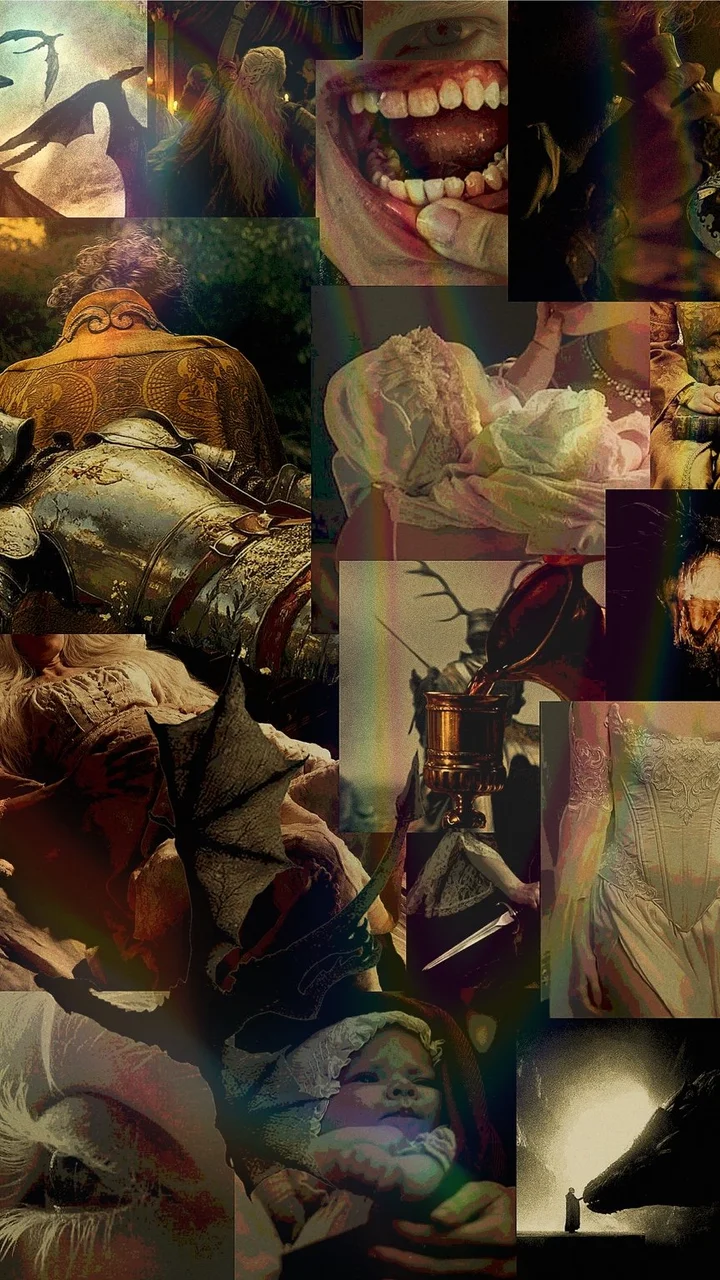
The realm was summoned to the wedding as to a war.
That was how Daeron the Good made his peaces — everyone had cause to know it by now — with the whole apparatus of conflict turned inside out: heralds instead of outriders, invitations instead of levies, and gold spent like blood. Ravens went to every seat that flew a banner. The city gates stood garlanded from the first snow onward; the markets were promised a king's feeding, an ox roasting in every square from Cobbler's to Fishmonger's on the day itself; and in the council chamber, when the master of coin turned grey over the tallies, the king had only looked at him mildly over the Myrish lenses and said the sentence that afterward ran through the court like a coin through a fair:
"Peace must be visible, my lord. Men believe their eyes and doubt their treaties. I am not buying a wedding. I am buying three hundred thousand witnesses."
So the realm came. The Reach came in force and flowers, the riverlords came quarreling, the West came gilded, the North sent Stark's own brother with a retinue of grave grey men who looked at everything and said nothing; Dorne sent a princess and three carts of oranges, which made one person at court laugh privately for reasons he declined to share. And from the south-east, up the kingsroad through the winter mud with their voices arriving a half-day before they did, came the Stormlands — not a deputation this time, not a courtship party, but the whole roaring firmament of them, Swann and Dondarrion and Caron and Errol and Fell and Estermont and Tarth, gold and black to the horizon, until the harbor pilots swore you could hear the camp outside the walls in Duskendale on a clear night, and the city, which had seen everything twice, hung out of its windows to watch them come.
The dragon-and-stag banners had been sewing since autumn — hundreds of them, the two beasts quartered together, entwined, the sight so strange at first that men stopped in the streets to squint at it. By the wedding month no one squinted. That was the king's arithmetic, and it was working, banner by banner, ox by ox: the impossible, hung up long enough, becomes the weather.
And in a locked room at the top of Maegor's Holdfast, all that winter, the impossible was being fitted to a body.
***
There were two gowns.
This was the heart of the campaign, and Aerion had conceived it the way his ancestors conceived their better wars: with a feint.
The first gown lived in the wardrobe hall for all to see, and it was perfect — perfectly correct, perfectly dull, white samite and Targaryen red, high at the throat as a septa's conscience, sleeves to the wrist, approved in committee by Septa Alerys and the High Septon's own delegate and, in a stiff quarter-hour that neither party enjoyed, by Prince Maekar. Fittings were conducted at announced times. Progress was reported. The court, denied scandal, comforted itself that the marriage had evidently gentled the creature after all, and moved its wagers to other tables.
The second gown lived behind a locked door three floors up, and only four living souls had seen it whole.
"Tighter," Aerion said.
"My prince," said the Pentoshi, around his pins, in the tone of a man who had corseted three generations of magisters' wives and thought he had seen ambition, "there is a point past which the body is no longer being dressed. It is being argued with."
"Then win the argument. Tighter."
Goodwife Harra took the laces. She had stopped protesting in the first week; she had, Aerion suspected, stopped sleeping in the second; she had entered, by midwinter, the state of grim transported artistry that overtakes builders of siege engines and cathedral roofs, for she was sixty years old and had dressed three generations of dragons and knew, with the whole of her craft, that she would never again in this life be handed such a commission: make the realm forget how to breathe.
The color had taken a month alone. Not white — white was for the decoy, white was surrender, every bride in the realm drowned in white. What Aerion wanted he could only describe by taking Harra down into the throne room at midnight with a candle and standing her in front of the great skull until she saw it: the pale of old dragonbone, ivory that had opinions, a white with fire asleep somewhere far down in it, so that by candlelight the cloth would seem faintly lit from within and by daylight it would make every other white in the sept look like linen. The Myrish factor they finally sourced it from wanted to know what great sept had commissioned altar cloth in midwinter. He was paid to stop wondering.
The cut they built in sessions that left the fitting room strewn with rejected sketches like a battlefield. Low — low past fashion, low past daring, low to the last inch the structure would bear and then, by the Pentoshi's genius and two concealed bones, one inch past it; and then, because bare skin was obvious and obvious was for lesser campaigns, the throat and shoulders veiled to the jaw in Lysene sheer so fine it was less a fabric than a rumor — sheer at the throat, sheer in long panels down both sides from ribs to hip, sheer inset in the sleeves from shoulder to wrist, so that the gown did not show so much as perpetually suggest, and the eye, given nothing it could swear to, would simply never be able to leave. "Modesty's armor turned traitor," Harra breathed, the first time the panels went in, and then looked as though she wanted to wash her mouth with soap, and then kept sewing.
And the waist. The waist was where the Pentoshi earned the fee that was going to buy his daughters manses.
"Almost unreal" was the instruction. Those words precisely. Aerion stood through the fittings by the hour, breath schooled high and small, watching in the glass as the architecture closed around him stay by stay — dragonbone-pale over dragonbone busks, laced by main strength, cinching him down and down until the line of him stopped resembling a body luck had favored and started resembling a made thing, a drawn thing, an artist's assertion, the waist of a creature from an illumination in a very old book that septons kept chained. Marra had to sit down the first time the full lacing went home. The Pentoshi walked around him twice in silence and then said something short and reverent in his own tongue that he refused to translate.
"They will say it cannot be natural," Harra said, pins in her mouth, eyes wet with craft.
"Good," said Aerion. "I am not natural. I am the blood of the dragon. Let the realm see what that costs to look at."
Because that was the campaign — he had drawn it up in the black weeks after the announcement and never once amended the objective, whatever else that strange year had amended in him. They had sold him. Gently, reasonably, before two thousand witnesses, for the price of a quiet border: very well. A sale wants a reckoning, and on the day the goods changed hands, every lord and lady and septon and king in the Seven Kingdoms was going to stand in the Great Sept of Baelor and look — look until their eyes watered and their collars strangled them and their comfortable arithmetic died in their chests — at exactly, precisely, unforgettably what had been sold. No modest bowed head for the chronicles. No decorous white surrender. They would get the dragon's price in the dragon's coin, and they would remember what they had spent for the rest of their natural lives, and their grandchildren would be sick of hearing about it.
The rubies were the last piece, and he chose them himself from the vaults, alone: a collar of them, great pigeon's-blood stones from the old Valyrian settings, re-strung close about the base of his throat so that above the pale gown and beneath the sheer they would sit like — he held them to his neck in the vault's lamplight and the image arrived whole and perfect and he smiled at it in the steel mirror like a man greeting a friend —
— like drops of blood. Like the throat had been opened, and the wound had come out jewels.
Look what you paid. Look what it bled.
"And the hair?" Harra asked, at the final fitting, when the whole impossible engine of it stood finished on its form in the locked room and the four conspirators were gathered before it in the particular silence of people who know their work will outlive them. "The septas will come at dawn with the seven oils. Seven braids for the seven vows, crowned and bound and — my prince, they will have the order in writing, there's no—"
"Loose," said Aerion.
"My prince—"
"Loose." He looked at the gown on its form, pale as the Black Dread's tooth, and touched one sheer sleeve with a fingertip, and his own voice came out quieter than he intended, from somewhere further down. "To the waist. Brushed till it burns. Not one pin, not one plait, not one drop of their oils. They may bind the rest of my life at their altar tomorrow. The hair goes into it free."
***
The families gathered in the last sennight like weather systems.
The Targaryens assembled with strained smiles, which was the house's formal wear. His uncle Rhaegel arrived from Summerhall gentle and elsewhere as ever, kissed Aerion on both cheeks, congratulated him with what appeared to be complete sincerity on his forthcoming voyage to Braavos, and could not thereafter be persuaded it was a wedding; his uncle Aerys came with nine crates of books and the air of a man attending under protest a function scheduled in the middle of a sentence; Lord Brynden Rivers attended everything and nothing, white as the gown itself, his one red eye finding Aerion across three separate halls in the course of the sennight and each time inclining his head a fraction, as one professional to another, which Aerion found more unsettling than the whole rest of the family combined. The little ones were brought up from the nursery for the occasion — Aemon, six now and solemn as a maester's owl, attached himself to Aerion's skirts at the family supper and asked, with terrible gravity, "Does it hurt to be married?"
"Constantly," Aerion told him.
Aemon nodded, filed it, and asked whether he might have Aerion's rooms.
Valarr came the evening before the wedding, alone, with a gift he insisted on giving privately: a book, very old, Valyrian, the poets of the Freehold in the original — the ones you used to declaim at me in the gardens to prove I'd mispronounced them — and inside the cover, in his careful architect's hand, no message at all, only a date in the spring and one word: Tyrosh.
"So," Aerion said.
"So." His cousin stood by the window, brown and careful and about to be spent east as Aerion was being spent south, and for a while neither of them said anything, because they were the two coins of the same purchase and there was nothing to say that the ledgers hadn't. "I came to be gracious," Valarr said at last. "I've been practicing. I'm told I'm to be carefully gracious tomorrow — Father actually used the words; there's a whole choreography, where I stand, whom I toast — the realm will be watching the man who didn't marry you for the least flicker of—" He stopped. Started over, plainer, which was his whole way. "I wanted one hour first where I needn't perform it. That's all. To say it once with the door shut: I'm glad, Aerion. Not resigned. Glad. I've watched him all season — the whole court's watched, we've talked of nothing else, you've no idea, you two are the only theatre in the realm — and whatever it is he does—" a small helpless gesture— "you laugh now. Did you know that? Truly laugh. I heard it across the fountain court a fortnight ago and didn't know the sound. Six-and-ten years, cousin, and I didn't know the sound."
Aerion looked at the book in his hands for a long moment.
"You'll write from Tyrosh," he said, at last, to the poets. "Not court letters. True ones. If she's dreadful I want particulars. If she's kind—" the chin came up, defying the sentence to make something of him— "if she's kind, I want those too, and I'll say prayers for it, and if you ever tell a living soul I said prayers for anything I will have you—"
"Fed to something," Valarr agreed. "Yes." And smiled — the pink, easy, breakable smile of the boy under the lemon trees, one last time before Tyrosh armored it — and embraced him, quick and hard, and was gone before either of them could ruin it.
And Maekar—
Maekar, that whole last sennight, wore the face the outriders' captain had once described (in the yard, to a friend, unaware his prince's son had ears in every wall): the face of a man watching his child walk toward a cliff. He appeared where duty put him. He approved what required approving, including a decoy gown. He said, in seven days, perhaps forty words to his second son, all of them logistical; and at the family supper he sat at the table's head with his iron face and watched Aerion make Aemon laugh with a story about the mews, watched with an attention so fixed and so unreadable that Rhaegel, of all people, drifting past his chair, patted him twice on the shoulder and murmured, "It's a fine ship, brother. They mostly do come back," which was either madness or the truest thing anyone said that week.
The Stormlands, meanwhile, had arrived at their lord.
Aerion had one glimpse of it, two evenings out — passing the River Wing at dusk, the doors of the great chamber open on candlelight and gold-and-black chaos, half the marcher lords of the south packed in around a trestle table roaring at something, and at the heart of the roar, Lyonel: coatless, cup in fist, head thrown back, huge and lit and home in a way King's Landing had never once let him look, his people lapping against him like the sea he missed. Ser Rolland Caron sat on the table itself with his harp, trying to be heard. Old Ser Arstan was laughing — laughing, the Selmy granite actually cracked through with it. Steffon Connington was asleep upright in a corner with a wolfhound's head in his lap.
And on a stand by the far wall, mounted and hooded and borne all the way up the winter kingsroad from the royal mews where she had lodged like an unresolved argument all season, sat a storm-grey goshawk, quiet amid the din, her head turned toward the corridor door as though listening for a step.
No one had seen him. Aerion stood a moment in the dark of the passage, outside the light.
Tomorrow, he thought — and could take the thought no further; it shed every harness he tried on it; it simply stood there in him, enormous, like the man in the candlelight, refusing to mean less than everything — and he drew back his hood and went up through the sleeping keep to his last night in the only bed he had ever owned, where the gown waited in its locked dark like a drawn blade, and a pearl-hilted dagger lay under his hand, and the wonder of the age slept not at all, and did not much mind.
***
The wedding morning came up white and burning cold, with a sky scoured clean over the bay and a light off last night's snowfall that made the whole city squint — dragonbone weather, Harra called it, unlocking the third-floor door with her heart in her mouth, and the four conspirators went to work.
The decoy gown had been sent down to the robing chamber at dawn, under guard, with ceremony. Septa Alerys and her delegation would be attending it there now, laying out the seven oils, rehearsing the plaiting order. Aerion intended to let them have a full hour's peace before the discovery; it seemed only humane, and besides, the true dressing could not be hurried.
It took all of it. The under-layers first, then the engine of the corsetry, the Pentoshi and Harra hauling in tandem — "*Tighter*" — "My prince, your ribs—" — "They're my ribs; tighter" — until the last stay shut home and the glass gave back the impossible line, the made thing, the argument won. Then the gown itself over it all like weather descending: dragonbone silk sliding cold and then warming, the sheer settling at his throat like breath, the whole pale architecture closing around him seam by seam while Marra knelt at the hem with her mouth full of pins and tears standing frankly in her eyes, and outside the barred door the first knock came, then the second, then Septa Alerys's voice climbing through outrage into something close to grief — my prince, the oils, the hour, in the Mother's name, what gown, WHICH gown — and Aerion stood in the eye of all of it watching himself become the declaration, and felt nothing he had planned to feel.
He had planned to feel triumphant. Armored. He had rehearsed this hour all winter as the arming of a champion.
What he felt, as Marra took up the brush and began the long strokes — a hundred, two hundred, the silver falling loose and shining down his back while somewhere below the whole city bells began — was younger than that, and stranger, and had no place in the campaign: he felt the way the goshawk had looked last night on her stand in the roaring room. Hooded. Listening for a step.
"The rubies," he said, and his voice came out level, which he noted with approval, as of a subordinate performing under fire.
The collar went round his throat, cold, then warm. In the glass, above the pale, beneath the sheer: drops of blood, exactly as designed. The wound made jewels. Look what you paid.
The knocking had stopped. In the quiet, Marra set the last fall of hair over his shoulder, stood back among the others, and nobody said anything at all, because there was nothing in the languages of Westeros scaled to it; and then the bolt was drawn, and the door opened, and Septa Alerys stood on the threshold with the vial of the first oil still in her hand and the six words of her prepared denunciation visibly assembled behind her teeth.
She never said them. Aerion watched her look — the full pilgrimage, throat to hem, the sheer, the cinch, the blood-drop stones, the loose bright fall of him — and watched thirty years of doctrine engage the sight and fail to find purchase anywhere on it, like frost trying to take a lit window; and at the end of it the old Reachwoman did the last thing anyone in the room expected, including, by her face, herself.
She made the sign of the star — briskly, as she did everything — and said, "Well. The Maiden was a scandal too, in the oldest songs, before the septons combed her. Go and be looked at, child, since neither the Seven nor I could ever once stop you." And then, at the door, gruff as a marcher: "I have prayed for the storm lord all season. This morning I began praying for the realm."
The passage to the sept-yard ran along the gallery, and the gallery had windows, and beyond the windows all King's Landing seethed and steamed and rang — the streets packed shoulder to shoulder under the garlands, the oxen turning in the squares, three hundred thousand witnesses buying the king's peace with their eyes — and at the head of the outer stair, alone, in black chased with dark red, plate-shouldered even today, iron beard, iron face, stood his father.
Aerion stopped three steps up. Below him, Maekar looked — at the gown; at all of it; the pale, the cinch, the sheer, the blood at the throat, the hair falling loose and unbound and unoiled in defiance of seven centuries of bridal law — and Aerion stood into the look with his chin at war-height and waited for the eruption, the last one, the one this whole engine had in some measure been built to detonate: you will not shame this house.
The silence went on past its cue.
"They'll say the hair is defiance," Maekar said at last. His voice was strange. It was aimed, as always, somewhere just past Aerion's shoulder, at the middle distance where he kept whatever he kept.
"It is."
Another silence. Down in the yard the horses were stamping, breath-smoke rising gold in the terrible bright air; the bells rolled and rolled.
"Your mother wore hers loose," said Maekar. "At our wedding. Against the order, against the oils, against her own septa's weeping — Dornish stubbornness, her father called it, and apologized to mine." The iron face did not change; nothing in it changed; only the voice had gone somewhere Aerion had never once heard it go, quiet and rusted, a door unused for twenty years. "The septas wept then too. I have never—" a stop; the jaw worked once— "in my life seen anything like her that morning. Until this one."
And he turned, before his son could assemble a single word from the wreckage — turned and offered his arm, formal, iron, correct, eyes front — and the blood of the dragon came down the last three steps in a gown built for war, and laid his hand on his father's vambrace, and was escorted to his wedding through the roaring golden streets of King's Landing wearing his dead mother's rebellion loose down his back, and neither of them said anything else at all, and the chronicles would record that the Prince of Summerhall gave his son with all correctness, and the chronicles, as usual, would not know the tenth of it.
***
Lyonel Baratheon had stood in the Great Sept of Baelor for the better part of an hour, and it had not calmed him, though he had let his household believe the stillness was calm.
The place was built to shrink men and had done its work on everyone else: seven towers of light coming down through the crystal like the attention of the gods, the marble floor a lake of it, and packed onto that lake the entire flowering of the realm — the Reach in its silks, the West in its gold, grey Northmen, Dornishmen bright as their oranges, the whole council, the White Swords, the king himself small and grey and satisfied beneath the Father's mighty likeness. And filling the eastern bays like a landslide held politely in reserve, his own: a hundred storm lords scrubbed and shining, Ser Arstan weeping already and pretending it was the incense, Steffon holding the cloak — the cloak, gold as harvest, the crowned stag couchant across it in black thread by the mile, and lining it, where only the sharp-eyed would ever catch it when the wind of walking lifted the hem, a silk the color of deep water under lightning. The Weeping Town velvet. Returned after the vows, as promised, sewn where promises are kept: on the inside.
He had thought he was ready. He had spent a season learning the weather-signs of the most dangerous creature in the Seven Kingdoms; he had stood in the doubled blast; he had taken soundings no other man alive had taken; he had — gods forgive the arrogance of it — charted him. He was as prepared as study and patience and wanting could make a man.
Then the doors opened, and the horns went up, and Aerion came into the light, and Lyonel Baratheon stopped breathing.
Not poetry. His body, which had climbed masts in gales and held a shield-line at Redgrass at seventeen, simply mislaid the trick of it — a full three heartbeats, maybe four, the crystal-struck air of the sept standing motionless in his chest while down the long lake of light came something the seven towers themselves seemed to lean toward: dragonbone-pale, impossibly drawn at the waist, blood at the throat, veiled everywhere and hidden nowhere, hair loose and burning silver to the hip, on the arm of the realm's hardest prince — a made thing, an asserted thing, beauty wielded two-handed with intent to wound, and every mouth in the greatest sept ever raised to the Seven falling open around one soundless hall-wide breath.
Beside him, distinctly, an eastern bay's worth of Stormlands forgot itself and growled — the low reflexive thunder-roll of pride his people gave a lord's new warship taking water — before Ser Arstan's hiss cut it dead.
And then the breath came back, and with it, riding the same tide, arriving in the same heartbeat and roaring in like the sea into a blown hull, came the anger.
He stood correct and enormous at the altar with his face doing what a season at court had taught it and took his own measure while the vision came on, because a man had better know precisely what he was angry at before it reached him wearing rubies.
Not the beauty. Let the septons choke; the beauty was his to be proud of, and he was, ferociously, instantly — some old First Men stratum of him was already composing the letter to Storm's End: build the hall doors wider; what's coming needs a bigger frame. Not even the scandal in itself; he'd married the scandal with his eyes open; he'd collected the scandal all season like songs.
It was the field chosen. That was the thing arriving under his breastbone with weight and heat, clarifying itself with every step the vision took: this day, of all days — the one day that was not a skirmish in the long glorious war, not a supper, not a hawking, not another round in the game they had built between them with its lines and its rules and its blood oranges — the one day that was supposed to be the founding, the ground the rest of both their lives would be built on, before the gods and the realm and a hundred lords who'd ridden the winter kingsroad for love of him — and Aerion had walked onto it as onto a battlefield. Had turned their wedding — theirs, the only one either of them would ever get — into a gauntlet thrown at the entire watching world: made the sept itself made his ballroom, the holy vows made his herald, the marriage made the frame for a declaration of war against every soul present, his own husband enrolled without asking as a prop in the pageant of look what the king gave away.
And the worst of it — the coal at the center that Lyonel would carry, banked and private, through every golden hour of the day ahead, down all the toasts and dances, to be dealt with where such coals were dealt with, behind a shut door, between the two of them, as their law provided — the worst of it was that he understood. Line by line. He had read the campaign the moment the doors opened, because he had spent a season learning the author: they sold me; the realm will look at what was sold. It was just. It was even, gods help him, magnificent. Aimed at the king, at the court, at the ledger-keepers of the world, it was a masterpiece and Lyonel would have cheered it.
But it had not been aimed only at them. It could not be, from that ground. You cannot make your wedding a weapon and keep your husband out of the wound — and the beautiful catastrophe coming up the light at him knew it; had known it at every fitting; had weighed his husband in the campaign scales all winter and spent him, spent them, without a word, because asking might have met a no, and the blood of the dragon did not risk noes.
So, thought Lyonel Baratheon, standing like a keep in the crystal light with his heart going like the sea in a bight, love and fury running the same channel so hard he could no longer have parted them with a knife. So. Tonight, then, my prince. We founded rules for this, you and I. You have crossed the oldest one on the highest ground in the realm — and you will make it right, and you will hate it, and you will be kept. Nothing has been withdrawn. Nothing is ever going to be withdrawn. That, before all these witnesses, is the whole of what I vow.
Aerion arrived at the altar in a wash of ruby light, was given over — Maekar's iron hand releasing his son's with, Lyonel alone stood near enough to see, one fractional pause, half a heartbeat's grip past the ceremony's requirement, the first and last public weakness of the Prince of Summerhall's life — and turned to face his husband beneath the Father's lifted hands.
And smiled.
Lyonel knew every smile in the arsenal by now. The letter-opener. The court frost. The knife at the feast, the true rare crack of delight over the doorstops. This one was none of them: this was new-minted for the day, brilliant and blinding and victorious, the smile of a commander watching his stratagem land, stroke upon perfect stroke, across an enemy capital — you see it, the smile said, glittering up at him through the sheer, reading his banked coal as easily as he read everything, delighted by it, counting it, filing his husband's fury as one more captured standard — you see exactly what I've done, and you can do nothing, and I have won.
The High Septon, to his lasting credit, only faltered twice.
The vows went up into the crystal — seven of them, the old words, cherish and defend, hearth and heat, sickness and health, the septon's crystal breaking the light over their joined hands into small trembling rainbows; and Aerion said his in a voice like silver struck on stone, carrying, flawless, performing even his surrender as conquest; and Lyonel said his the way he did everything, plainly, hugely, one word set down after another like courses of masonry, and watched something flicker behind the violet eyes at the plainness — the smallest hairline in the day's triumphant glaze — because performance knows always how to answer performance, and has never once known what to do with a man who simply means the thing.
Then the cloaks.
Maekar came forward and unclasped the maiden cloak — black, the three-headed dragon in ruby thread, the protection of the house that had made and priced and sold him — and bore it away over his iron arm like a folded banner from a surrendered keep; and for one moment Aerion Targaryen stood uncloaked in the center of the realm, bare-shouldered under sheer, blood at his throat, hair loose down his back, belonging to no house at all.
The sept did not breathe.
Lyonel took the gold from Steffon's shaking hands. Shook it out full — the crowned stag rampant in black across a field like harvest, and the lining flashing once, just once, deep-water-and-lightning, for the four people living who would know it — and stepped close, closer than the rite strictly wanted, into the storm of scent that had been reaching him in tides all down the ceremony, smoke and hot metal and that dark resin sweetness fighting its way up through all the fury and triumph like spring under snow — and settled his colors around the impossible waist and the bare pale shoulders, and worked the clasp, and let his hands — let them; the one liberty he would take on this ground; a man may put his hands on his own vows — rest a moment, spanning, warm, entire, on the cloaked shape of what the gods and the king and twenty years of everyone's failures had somehow, unaccountably, conspired to give into his keeping.
"With this kiss," he said, and heard his own voice come out of the keel of him, bass and carrying and not entirely governed, so that the nearest bays would talk of it for years, "I pledge my love."
The kiss was meant to be brief. The rite wants a seal, not a scandal; they had both been instructed; the septon's crystal was already lifting for the presentation.
It was brief. It was also — and this neither of them planned, and neither of them, in the years after, ever managed to describe to the other except by starting arguments — real: the one unwitnessed second of the most witnessed day in the realm. All the day's engines stopped at once. The campaign, the coal, the triumph, the fury, the sheer and the rubies and the three hundred thousand — gone, all of it, for exactly the span of a kiss: just heat, and the shock of arrival, and someone's breath breaking rank — his own, her— his, he'd claim; Aerion would claim otherwise; the argument would outlast the realm — and a grip arriving fistwise in the gold cloak at Lyonel's chest, hauling closer, one raw unscripted inch that no chronicle recorded and every soul in the first forty rows saw.
They broke apart. The sept came back — light, crystal, the High Septon declaring them before gods and men, sound arriving like surf.
Aerion's smile came back too, victorious, glittering, re-armored in the same heartbeat and hoisted like a standard for the roaring hall.
But his fist was still closed in the gold of the cloak. Lyonel looked down at it — at the white knuckles, the ruby-light, the grip its owner had visibly not yet been informed of — and made no remark at all, and turned with his husband to face the realm, and thought, under all the bells of the city beginning at once:
Aye. Won something. That much, my brat prince, we can agree on.
***
The city had its turn between the sept and the keep, and the city was the one audience Aerion had never once thought to arm for.
The procession went down from Visenya's Hill in the old open style, because the king had commanded visibility and the king was getting it: the newlyweds borne together in a gilded open car behind six white horses, the Kingsguard riding the flanks, dragon-and-stag banners going before, and the whole route from the Great Sept's marble steps to the gates of the Red Keep packed twenty deep and climbing — every window rented, every roofline fringed with apprentices, three hundred thousand purchased witnesses steaming and roaring in the terrible bright cold, fed on the king's oxen and primed on the king's ale, waiting to see what they had been bought to see.
Aerion had planned for the lords. He had built the whole engine of the day against the sept — against silks and septas and choking collars, against people whose good opinion was a currency he knew to the copper. It had genuinely never occurred to him — and he would sit with this afterward, turning it, unable to file it — to wonder what the city would do.
The city took one look at the dragon bride coming down the marble steps — dragonbone and blood-rubies, cinched past believing, hair loose and blazing in the winter sun like a banner all its own — and lost its collective mind.
Not scandal. He heard the first sound come up the hill toward the car and braced for jeers, for the septry gasp writ large — and it was a roar, and it had love in it, raw and astonished and entirely unpurchased; the smallfolk of King's Landing, who could not have told a bridal custom from a Braavosi tide-table and cared less, saw only that the realm's most storied creature had come out to be wed looking like something out of the oldest songs, the ones from before the septons combed them, and they adored it. Flowers came over the crowd-heads in ragged winter volleys — hoarded petals, dyed ribbons, sprigs of evergreen off someone's sill — and the names began, tossed and caught and swelling street by street: the dragon bride, the dragon bride — and once, from a knot of fishwives who had plainly been at the king's ale since the morning bells, a bellowed, delighted, "LOOK at him! Gods bless the storm lord — he'll NEED it!" — which set a hundred yards of Muddy Way howling, and drew, from the enormous person sharing the car, a landslide of a laugh and a raised fist of cheerful agreement that nearly took the procession's dignity off its wheels entirely.
"Wave," Lyonel said, under the roar.
"I do not wave. Queens wave. I am—"
"They stood four hours in the cold for you, some of them barefoot, and they'll tell their grandchildren about the next half mile for the rest of their lives. It costs you one hand, my prince." A beat; the storm-blue eyes slid sideways, entirely too knowing. "And they're not the lords. Nobody down there sold you anything."
Aerion waved.
Afterward — for years afterward, whenever the tale was told and it was told forever, in the Marches, in the city, in the long folk-memory of the realm — the smallfolk's version always kept the same detail the court's version always lost: that when the dragon bride finally lifted one white hand to them, somewhere past the Hook, the roar doubled, and doubled again, and the pale prince in the gilded car looked out at the boiling, blessing, adoring, unbought city with an expression no lord in the sept had gotten anywhere near all day — young, and stripped, and openly astonished — and that a girl on a fishmonger's roof threw a ribbon that carried impossibly far on the wind off the bay, scarlet, and the dragon bride caught it. Out of the air. Bare-handed, quick as a cat, before the whole screaming street — and looked at it in his fist as though it had arrived from another world, and did not let it go.
(It went home to Storm's End that spring in a drawer with a knife, an orange peel, and a book of Valyrian poets. The chronicles never knew a thing about it.)
Light snow began as the car came up Aegon's High Hill — small dry flakes wandering down out of a sky still winter-bright, catching in the loose silver like stars consenting to be worn — and Lyonel turned his scarred palm up to it and then looked over at what the snow was doing to his husband, and said nothing for the rest of the climb, which by his standards was a psalm.
At the gates of the Red Keep the king was waiting to receive them — protocol, more protocol, the day was mortared with it — small and grey between the White Swords with the satisfied city thundering at his back, and as Aerion came down from the car in the full wreckage of every bridal law of the Faith, his grandsire the king looked at the gown.
All of it. Unhurried. The pale, the cinch, the sheer, the blood at the throat; the message, entire, that had been addressed to him since the first sketch: you sold me — now the whole world has seen the price.
"You have made my peace very visible, grandson," said Daeron the Good.
"That was the intention, Your Grace." Level. Silver. Both edges out.
"Yes," the king said. "It generally is, with you." And then — before the whole court, before the Kingsguard, before three hundred thousand of his own bought witnesses — the King of the Andals, the Rhoynar, and the First Men inclined his head to his grandson. Not a nod. An inclination — deliberate, measured, the motion of a man acknowledging receipt of an invoice he intends, without dispute, to pay — and something passed between the two of them in that half-second, ledger to ledger, that no one else on the hill had the accounts to read: the bill is fair. I owed it. Well sent.
"Go in," said the king, straightening, mild as ever, gesturing them through into the roar of the feast beyond. "Both of you. The realm is watering at the mouth, the singers are tuned, and I have spent a truly remarkable amount of money on this evening." The Myrish lenses caught the snow-light; behind them, briefly, the tired eyes were warm. "Do try to enjoy what it purchased."
***
The feast was held in the Great Hall under a thousand candles and the nineteen skulls' worth of shadow that no amount of candles ever quite paid off, and it was, by every measure the realm kept, the grandest thing seen in King's Landing since the false peace of the Blackfyre years — which was, of course, the entire point, and the king moved through his bought and shining evening like a maester through a finished chronicle, touching nothing, changing nothing, reading every page.
There were seven-and-seventy dishes. There were seven singers, and six of them were Reachmen, and the seventh was a marcher knight with ginger whiskers who stood up white as the tablecloth when his moment came, because the prince had made his invitation a command in front of the entire east yard; and Ser Rolland Caron sang the song of the soldier on the Dornish border to the assembled might of the Seven Kingdoms with his big hands steady on the harp, plainly and truly, the burr of home on every vowel, and the hall went kind and quiet the way halls do; and at the high table the newest lord's-consort in the realm listened with his chin high and his eyes forward and afterward set down his cup and applauded first — first, unmistakably, setting the fashion, so that the applause when it came fell warm as harvest on the boy from Nightsong — and if the bride's eyes were over-bright through the last verse, the candles took the blame, being in no position to argue.
(Later, in the press between dances, a small brown determined girl in Blackhaven blue would be steered up by Ser Rolland to make her curtsy — spring having been moved forward on account of the royal invitation, the wedding party having simply brought her along — and Jeyne, lately of Blackhaven, would stand before the most terrifying creature in the Seven Kingdoms with her courage visibly gathered in both fists, and say, "They told me what you said in the yard, my prince. About my — about me. I came to thank you for it." And Aerion Targaryen would look down at the girl he had knifed across a hundred leagues and armored across the same distance, and say, "It wanted no thanks; it wanted amending, and it has been amended; that is arithmetic, not kindness" — and then, as she rose from her curtsy, in quite another voice, quick and low, dragon to sparrow: "He sang it better tonight, with you in the hall. Marry him before some Dornishwoman hears him. That is a command." And Jeyne of Blackhaven would carry the exchange home to the Marches like a relic in a box, and her granddaughters would be sick of hearing about it, exactly as designed.)
The salt cup made its inevitable appearance with the third remove — borne up on a cushion by old Ser Arstan himself, seawater cut with wine in the Durrandon silver, the taking of the weather, drunk by every consort Storm's End had gathered in since the Age of Heroes — and the hall's eastern half leaned in with the happy dread of men watching a beloved rite of their own devising, because the Stormlands had spent a season turning the prince's refusals into an institution, and there was money on it, there was substantial money on it, and Aerion looked into the cup, and looked at Ser Arstan, and looked — one beat, unhurried — at his husband.
"When Storm's End wants my weather," he said, silver and carrying, "it may apply to me on its own walls, at which time I shall consider teaching its hall to drink something warmer. Until then, ser, I am fire, and fire does not water down. Take it away — and pay the Dondarrion boy, he's been holding his breath since the fish."
The eastern bays came up in a roar of laughter and settling wagers, gold-and-black delight, their dragon performing their institution — Lord Swann on his feet shouting that the salt would keep, the salt had kept three thousand years, the salt was patient — and Lyonel laughed the landslide laugh with his people, cup high; and under the table, unwitnessed by the entire realm, an enormous scarred hand found a white one and pressed it, once, and got — this was new; this was hours old; the fist in the cloak had ratified something — pressed back.
The toasts came with the sweet course, and the realm sat up for one of them.
Prince Baelor's was the Hand's toast, warm and architectural, peace and posterity, applauded and forgotten in the same breath. It was the next that the hall had been waiting all day to grade: the Young Prince rising in his careful black, cup in hand, before an audience of thousands who had spent a year dining out on what he had lost and were now watching his face the way maesters watch an eclipse — for the flicker, the shadow's edge, the least proof of the wound the whole realm had decided he must carry.
They got choreography. Valarr gave it to them flawlessly — where he stood, whom he named, the measured architecture of a toast built stone by stone in exactly the register of a man at peace, gracious past all auditing — and Aerion, who had been told about the choreography by its own performer with the door shut, watched his cousin walk the rope above the realm's appetite and gave him, discreetly, the professional respect of one performer for another.
And then, at the end, one stone off the drawing.
"To my cousin," Valarr said, and turned from the hall to the high table, and for a moment the careful voice was only his own, "who was many things this year in the realm's ledgers, and never once, whatever those ledgers say, a price." The cup moved. "And to the Lord of Storm's End. The king gives you the realm's peace to keep, my lord, and the realm is grateful. My family gives you something a great deal rarer." A beat; brown eyes level down the golden hall; the first grain of iron, spent in public at last. "Guard it accordingly."
The hall heard grace and drank to it, satisfied, defrauded, none the wiser. Two people heard the true word. One of them rose — huge, unhurried, cup high, storm-blue eyes going first to the Young Prince and then, briefly, terribly, warm, to what sat beside him in dragonbone and rubies — and answered it in four words and the flat marcher iron of a man taking oath before witnesses:
"On my walls. And my life."
And the Stormlands came up off their benches roaring approval of a vow they thought was about borders, and Aerion Targaryen looked into his wine while two alphas swore him back and forth across a golden hall like a treaty of the realm, and found — filed, denied, kept — that he did not entirely mind.
They had, in fact, exchanged by then the only private words the evening would allow them, in the brief eddy after the pageant of gifts (the Reach's gold, the West's gold, Dorne's oranges and a bolt of sand-silk, the master of whisperers' offering — a Myrish looking glass of disconcerting excellence, with a card reading only For the one the realm cannot stop watching, which Aerion chose to find flattering because the alternative was to think about it). In the eddy, under the music, Lyonel had leaned the fraction that put his voice at his husband's ear alone:
"The gown."
"You've noticed it. Everyone has. That was its function."
"We will speak of it."
"Will we." Aerion had turned his head — close, at this range; sheer and rubies and the wide lilac stare, triumph absolutely intact and, under the triumph, aimed and reading, always reading. "Speak, mm. Is that the word arriving tonight, my lord?"
"Tonight," Lyonel had agreed, mild as milk, terrible as tide, and had straightened, and resumed being merry — and the wonder of the age had sat for a moment quite still amid his own accomplished masterpiece, ringed by three hundred thousand purchased witnesses, scented — he could smell it himself, and drank to drown it, and failed — of anything, anything in the world but dread.
It was another hour before his brother came for him.
Aerion saw him first across the hall — Daeron, second cup from the left of wherever he started, working his way up the high table's back with the elaborate navigational care of the profoundly drunk, running aground on chair-backs, apologizing to a candelabrum — and braced for the usual: the fond slurred nothing, the toast that lost its way, the gentle removal by whichever squire had drawn the duty. His brother reached him. Leaned in, wine-heavy, one soft hand on Aerion's bare shoulder for ballast.
And gripped.
"Aeri."
No one had called him that in fifteen years. The nursery name, Mother's name for him, dead and buried with her — and it came out of his brother now in a voice gone suddenly wrong, low and urgent and sober-eyed, the grey-lilac gaze swimming up out of the wine all at once like something surfacing, and every hair on Aerion's body stood.
"Daeron—"
"Don't. Don't talk, it's — it comes through better with the wine, that's the — that's always been the trick of it, I drink to shut the door and the door — sometimes the wine props it open instead, and tonight—" His brother's hand slid from shoulder to wrist and closed there — the grip startling, circling the same bones another hand had circled at another feast, and Aerion went very still. "Tonight it's raining in here, little brother. It has been raining all day. I have to say it now while it's — before it closes. Listen. Listen.
"I saw stags with wings." The words came quick and low and terribly clear, wine-breath and certainty, pitched under the music for one hearer in the world. "Dragon's wings — folded along their backs like — like ships carry their sails, walking down into the sea and the sea got out of their way. I saw children. Storm-dark hair. Your eyes — your eyes, Aeri, over and over and over, looking out of black-haired heads, a whole — I tried to count. Eight? Nine. Nine, but one of them—" the grip tightened; something crossed the swimming eyes like a cloud's shadow crossing water— "one was made of rain. I couldn't hold it. It went through my hands and into the ground and the ground grew — I'm sorry. I couldn't hold — that one isn't. Don't ask me. I don't know what I—
"And a hall." His brother's voice dropped further, and now it had the cadence Aerion had heard exactly twice in his life — at nine, before the ravens from the Redgrass; the register below prophecy, where the dreams stopped being pictures and started being memory that hadn't happened yet — "A great hall, antlers on the walls, fire in a hearth the size of a gate, and thrones — chairs, high seats, I walked down the hall and it kept — it went on for years, Aeri, I walked past a hundred years of them, two hundred, three, and every head that wore a crown in that hall had storm-black hair, and the fire looked out of their eyes. The old fire. Our fire. They'd forgotten our name — centuries, they'd forgotten they ever had our name — and it didn't matter, it didn't matter at all, because the fire doesn't care what it's called, the fire only cares that it burns, and it was burning, it was burning in every one of them, all the way down the hall, all the way down the years, further than I could—"
He stopped. Breathed. The music went on; the realm went on; nobody at that whole roaring golden high table was looking at the two silver heads bent together at its end.
"They think it's a funeral," Daeron said. "Tonight. All of them — Father, the septas, half the hall — they drink to you like mourners; I've heard them all evening; poor creature, the blood poured out into storm mud, the end of the pure line. And you thought it too. I've watched you think it since the herald — don't, don't argue, I'm your brother, I watched you learn to walk." The grip on his wrist gentled, all at once, into something that was only a brother's hand. "They're wrong, Aeri. You're wrong. Nothing is being poured out. I stood in that hall for a hundred years and I know. You're not the end of the dragon's blood, little brother.
"You're the loosing of it."
And then the door closed.
Aerion watched it happen — watched the terrible clarity go out of his brother's eyes like a tide withdrawing, the focus swimming, the wine arriving back over him in one soft grey wave — and Daeron blinked, and swayed, and looked down at his own hand on Aerion's wrist as though finding it there by chance, and patted it twice, vaguely, and said, in his ordinary sodden amiable ruin of a voice: "Wha' did I — no. No, don't tell me. Whatever it was. Never tell me; that's the rule; I can't carry them and know them." He straightened by way of the chair-back, took aim at the wine down the table, and paused — one last surfacing, half a heartbeat, the grey-lilac eyes finding Aerion's with something almost like the boy who had once shared a nursery with him:
"He laughs like the rain sounded," Daeron said. "Your storm lord. In the dream. Everyone in the hall was laughing and it was the same sound as the rain and I couldn't tell them apart and I didn't want to." A crooked smile, going under even as it formed. "It was a good dream, Aeri. First one I've ever had."
And he was gone, down the table, aground on a candelabrum, apologizing; and the wonder of the age sat alone at the center of his own wedding with the realm roaring around him and a ringing where his mind had been, holding a prophecy like a live coal in bare hands, feeling everything he had built that year rearrange itself around one word.
Loosed.
He looked down the hall.
It took no searching. Lyonel stood where the gold was thickest, down among the trestles with his storm lords in the wreckage of the seventieth dish — coatless again by now, cup in fist, Lord Swann bellowing some story at him with both arms, Ser Rolland's harp going, the wolfhounds underfoot, a knot of marcher knights hanging on him the way iron filings hang on a lodestone — huge, and lit, and laughing, the head thrown all the way back, the landslide rolling up out of him to the smoked rafters, alive the way weather is alive, the way the sea is alive, three hundred thousand candles' worth of alive; and Aerion sat very still in his dragonbone and rubies and looked at his husband across the golden roaring distance, and let the whole architecture of the year come down.
He had grieved it as dilution. That had been the founding stone, laid the day the herald's staff came down, mortared with every gown and insult since: they are pouring the last pure vintage into storm mud; they are ending me by marriage; exile in bridal silk. He had built the campaign on it, the mourning wardrobe on it, this very gown on it — look what you paid, look what you spent, look what ends today — a full year's masterwork of grief in silk, and his drunkard brother had just reached out one soft ruined hand and knocked the founding stone away, and nothing had fallen.
Because — think, he told himself, cold and quick, the way he thought across a war-table — because the stone had been laid wrong way up. Fire is not poured out. Fire is not a vintage; fire is not a dowry; fire does not dilute. Set fire into a thing, and the fire does not become the thing — the thing becomes the fuel. Three hundred years these stags had carried their one stolen drop of it — the Orys rumor, the bastard brother, the drop they were too proud to claim and too proud to deny — one drop, and it had made them what they were, the loudest, most unkillable, most storm-souled house in the south. One drop.
He was not a drop.
He was the wellspring — the truest blood of the oldest fire left burning in the world, and they had, in their wisdom, their arithmetic, their mercy, married the wellspring into the strongest vessel in Westeros and called it his diminishment; and all year he had agreed with them, had mourned with them, had dressed for the funeral daily — when any dragon of the old blood, any dragon not made stupid by grief, would have looked at the transaction once and laughed. They thought they had spent him. They had seeded him. Every child of this marriage — he let the thought come now, at last, the thought he had outrun all season, and it came like cavalry — every child would be a colony of the fire in a keep that could not be taken; storm-dark heads with his eyes, his blood, his burning, multiplying down the generations behind walls Aegon's own dragons never cracked; the old fire pouring into the Stormlands not as a dying gift but as an annexation, until the day came when the realm looked south and could no longer tell where the dragon ended and the storm began — a hall of crowned heads with the fire looking out of them, further down the years than a dreamer could walk.
Not the end of the dragon's blood.
The spread of it.
Not dilution — conquest; not exile — a marching-out; not sold — loosed; and the campaign did not have to change by a stitch, that was the beauty that made him want to laugh aloud at his own high table — the gown, the defiance, the declaration, all of it stood; only the founding stone turned over, and read right way up at last, and on its underside, in the oldest hand, the true text: He came to their sept a price. He left it a vanguard.
Down the hall, Lyonel laughed again at something of Swann's — laughed like rain sounds, said the only true dreamer in the family — and turned, cup rising, storm-blue eyes coming up the length of the golden hall to find his husband the way they had found him across every room of the season, unerring, unhurried, glad; and Aerion Targaryen — Aerion Baratheon, the name arrived and he did not even flinch, the name was a ship now, the name was a fleet making landfall — looked back down all that light at the enormous laughing alive man the king had chained him to, at the shoulders and the scars and the warmth the whole gold half of the realm was orbiting, at the vessel, the fortress, the father of the vanguard, his, his by vow and cloak and kiss and one entire catastrophic year —
Mine, thought the blood of the dragon.
The word came up out of the marrow, out of the very country where the jealousy-fire had lived all season — and it did not burn going through him, or rather it burned the way the hearth burns and not the way wildfire does, banked and deep and sovereign; it came up wearing a crown; and where every other claiming thought of his life had clenched — his hoard, his scraps, his guarded pile, the second child's fist closed white around whatever was not nailed down — this one opened, spread out from him down the golden hall like wings, took in the man and the marcher lords and the harp and the hounds and the whole roaring gold-and-black nation of it: mine. My storm. My storm lords. My hall, my banners, my unkillable house of fuel. Mine to fill with fire until the years run out of hall to walk down.
For the first time since the herald's staff came down — for the first time, if he was honest, and tonight, terribly, he could afford to be, since his mother died — Aerion was not merely being taken.
He was taking, too.
He rose without deciding to. Down the hall, past the drifted courses and the sleeping children and the wine-dark uncles, past his father's iron watch and his grandsire's reading eyes, the movement drew the room the way it always drew the room — and somewhere in the golden noise a Stormlands voice, wine-brave, boomed out the first cry of "the bedding!", and another took it up, and the drums, and the old wicked laughter beginning to kindle down both sides of the hall, the realm gathering itself with relish for the last rite of the visible peace —
— and the dragon bride stood at the head of it all in dragonbone and blood-drop rubies with his loose hair burning in a thousand candles, and looked down the length of the hall at his husband turning toward the rising cry, and smiled.
Not the letter-opener. Not the court frost. Not even the victory-standard of the sept.
The nineteen skulls along the walls would have known it, had skulls eyes: it was the smile of a conqueror at a border, on the evening the gates come open.
Let them come, thought Aerion, first of the loosed. Let them all come. And then let them try to take from me what is mine.