
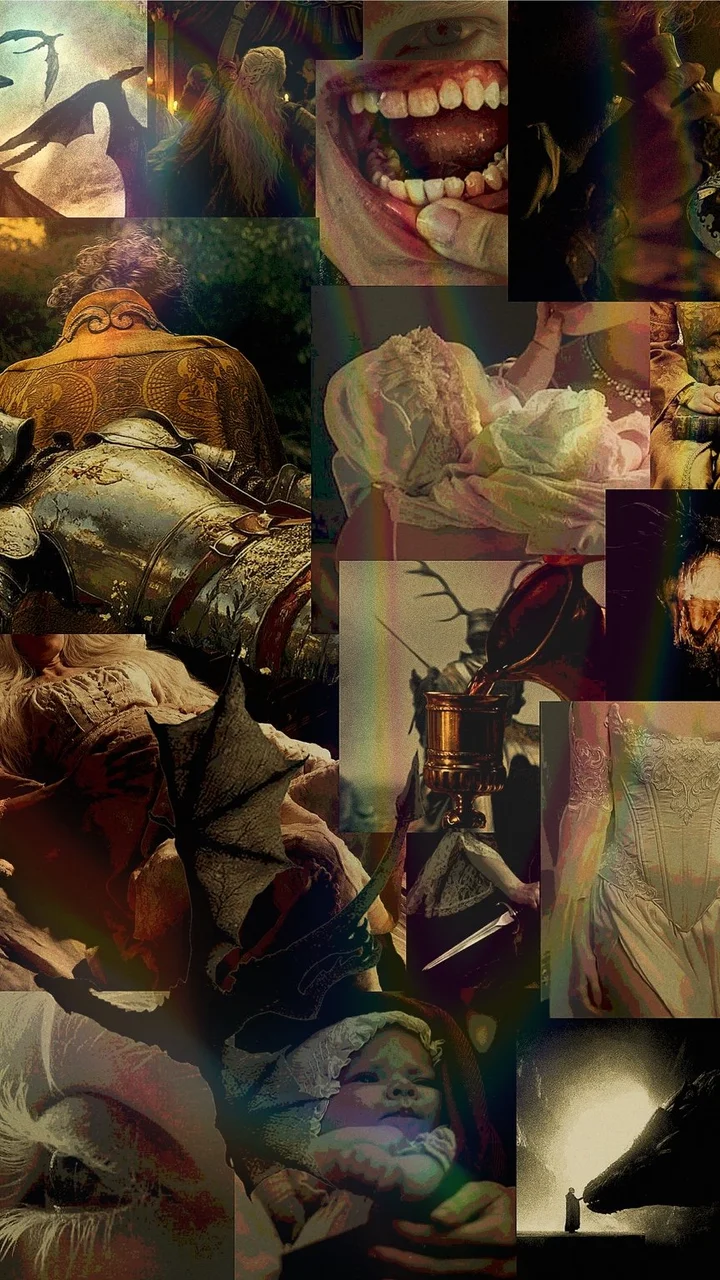
On the morning the king gave him away, Aerion Targaryen dressed for a wedding.
The wrong one, as it happened, though no one had yet told him so.
"Tighter," he said.
"My prince, the boning will bruise—"
"Then it will bruise. Tighter."
Marra set her heel against the bedpost and pulled, and the ivory stays closed around him like a hand, silk hissing over silk, until his waist went narrow as a wasp's and his breath came high and shallow in his chest, which was where he liked it. Breathlessness suited him. It put color in his lips and a fever-brightness in his eyes, and if he was to stand before the whole court while his grandsire the king proclaimed his future, then he intended to look the way a future ought to look. Like something out of a song. Like a promise the gods had sealed in silver.
He turned before the Myrish glass, slow, appraising, merciless, the way his father inspected a line of green recruits. The gown was white samite sewn with seed pearls, high at the throat as befit an unwed omega of the blood, but cut close, closer than the septas approved, so that no man in the hall could mistake the shape of what House Targaryen had kept for itself. His hair fell unbound past his waist, pale as spun moonlight, brushed until it crackled. Rubies at his ears. Rubies at his wrists. A dragon has no need of gold, his mother used to say. Gold is what the dragon sleeps on.
Four years in her grave, and he could still hear her saying it, could still feel her cool Dornish fingers working the tangles from his hair while his brothers shouted in the yard below. She had been the only one who never flinched from him. Some mornings that was a comfort. Most mornings it was a wound he dressed in silk and did not look at.
"There," Marra said, breathless herself, tying off the laces. "Though if you swoon before the Iron Throne, my prince, I'll swear before the Mother I had no part in it."
"Dragons do not swoon." He lifted his chin at the glass. The prince in the mirror lifted his chin back, violet-eyed, imperious, six-and-ten years old and certain of everything. "Dragons are swooned over."
Below his window, the outer yard rang with the noise of a court swollen past its banks. Half the realm had come to King's Landing for the great court his grandsire had called, and no one would say why, which meant that everyone knew why, or believed they did, which in a court was much the same thing. Aerion knew. He had known for years, the way one knows a thing that has been promised in every language except plain speech: in his father's silences, in his uncle Baelor's careful smiles, in the way the singers seated him beside Valarr at every feast since he was six-and-ten and let the harps say what the heralds had not.
Valarr. The Young Prince. His cousin, one year his elder, Baelor Breakspear's own heir, second in the line of succession after his father — brown-haired where Aerion was silver, quiet where Aerion burned, but an alpha of the blood of the dragon, and that was the whole of the arithmetic. There was one omega prince in House Targaryen, the only one whelped in a generation, and there was one alpha prince standing next in line to everything. Even a Frey could do that sum.
Still Targaryen, Aerion thought at his reflection. Still royal. Still within the circle. The blood of the dragon did not spill itself into lesser vessels. It curled back upon itself, jealous as fire, and burned brighter for the keeping.
He remembered a garden, two summers past. Valarr under the lemon trees with wine on his breath and courage borrowed from it, saying, When we are wed, cousin, you will have to be kinder to my household, and Aerion laughing at him, delighted, cruel, saying, When we are wed, cousin, I will own your household, and kindness is for things one does not own. Valarr had gone pink. Valarr always went pink. It was one of the reasons Aerion had decided he could tolerate him: a husband who blushed was a husband who could be managed.
The door banged open without so much as a knock, which meant it could only be one person in the Red Keep.
"You look," said his brother Daeron, propping himself against the doorframe with the exaggerated care of a man for whom the floor had recently misbehaved, "like an expensive ghost."
"You look like something a tavern coughed up." Aerion did not turn from the glass. "It is not yet midday."
"It is somewhere." His brother drifted into the room, two years his elder and forever ten years more tired, pretty in the soft, spoiled way of a fruit just past its best. The smell of last night's Arbor gold came in with him. He dropped onto the clothes chest, blinked at Aerion for a long moment, and frowned as though trying to remember where he had left something.
"What," Aerion said flatly.
"I dreamed of you." Daeron said it the way other men said I owe you money — reluctant, hoping not to be pressed. "Last night. This morning. Whenever it was."
Aerion's hands stilled on his cuffs. His brother's dreams were a family joke and a family secret both; Daeron the Drunken, the court called him, and laughed, and did not know that the wine was less a vice than a door he kept trying to close. He had dreamed of dragons falling on the Redgrass Field before a single banner was raised. He had been nine years old and no one had listened, and he had been sick for a week after the ravens came, and had never once said I told you. He had simply started drinking.
"Well?" Aerion said, lighter than he felt. "Was I magnificent?"
"There was thunder in it," his brother said. His eyes had gone unfocused, the grey-lilac of them clouded like a sky deciding. "A great deal of thunder. And you were laughing." He frowned deeper. "I think you were laughing. It rains in my head, little brother, I can never—" He stopped. Shrugged. Reached for the flagon on the sideboard, found it empty, and sighed the sigh of a man betrayed by the world entire. "It's nothing. Wear the rubies. You're wearing the rubies. Good."
"Thunder," Aerion repeated, contempt hiding the small cold thing that had turned over in his stomach.
"Or drums. Perhaps it was drums." Daeron waved a hand, vague as smoke. "There are always drums at a wedding."
And that — wedding — swept the cold thing away entirely, because of course there would be drums, and pipes, and seventy singers if Aerion had any say in it, and he would have every say in it. He let his brother's dream go the way he let all inconvenient things go: dropped from a great height, unwatched.
The bells of the Great Sept began to toll the hour across the city.
In the yard below, a column of riders was clattering in through the King's Gate in a river of gold and black — travel-stained, big-voiced, laughing at each other in the broad, carrying accents of the south — and above them their banners cracked and rolled in the wind off Blackwater Bay: a crowned stag, sable on a field of gold, again, and again, and again.
Storm lords, Aerion noted, with the fraction of his attention such creatures deserved. Come to bend the knee and gape at the dragonskulls and drink the king's cellars dry, no doubt, the way lesser houses did when a great court was called. There were a remarkable number of them. There was, at their head, a remarkably large one, black-haired and bareheaded, sitting his enormous courser as though he had been poured onto it, saying something over his shoulder that made twenty men roar.
Aerion turned away from the window and forgot him completely.
"Come, Marra," he said, and swept toward the door, toward the throne room, toward the future he had been promised in everything but words. "Let us go and be given what is ours."
***
The throne room of the Red Keep had been built to make men feel small, and in sixteen years it had never once succeeded with Aerion Targaryen.
He loved it the way other men loved their homelands. He loved the ribbed vaults lost in shadow high above, and the tall windows burning with morning, and most of all he loved the skulls — nineteen of them ranged along the walls on their iron plinths, from poor Morning's skull no bigger than a mastiff's up and up through the centuries of fire to the black mountain at the hall's far end, whose smallest tooth was longer than Aerion's forearm. Balerion. The Black Dread. Men crossed the hall hugging the far pillars to keep from walking beneath that shadowed jaw. Aerion had played inside it as a child, curled on the cool stone within the cage of teeth, and had never in his life felt safer anywhere.
Mine, he thought, as he thought every time he entered this hall. All of it. Mine by blood and fire.
Today the hall was packed to the walls. Half the peerage of the realm stood shoulder to shoulder in their finest — Tyrell green and Lannister crimson, the blue-and-rust of the riverlands, grave northern greys, a spray of Dornish orange near the dais because his grandsire had never stopped honoring his dead queen's kin — and the sound of them was the sound of a sea, hushing and swelling, a thousand small speculations breaking against the stones. Above them all, on the monstrous tangle of the Iron Throne, sat the king.
Daeron of House Targaryen, Second of His Name, King of the Andals, the Rhoynar, and the First Men, Lord of the Seven Kingdoms and Protector of the Realm, sat his throne the way a scholar sits a horse he respects but does not trust: carefully, precisely, touching as little of it as dignity allowed. He was not an impressive man to look at, the Good King. Spare and round-shouldered, beard more grey than silver now, ink ghosting his fingers even today, even beneath the rings. Aerion had heard drunk knights say the throne had never loved Daeron the Good. But it had never cut him, either, not once in twenty years of ruling, and there were men in this hall old enough to remember kings who bled.
At the foot of the dais stood the Hand. Prince Baelor was everything the king was not — tall, hale, dark-haired and dark-eyed as any salty Dornishman, the beloved of the commons, Breakspear, the realm made flesh — and beside him stood his son.
Valarr had dressed carefully. Black doublet, red dragon small upon the breast, no ornament. He looked, Aerion thought fondly, like a spun-glass copy of his father, all the lines correct and the fire somehow left out; but the fire was Aerion's to supply, and between them they would make one whole magnificent creature. Valarr's eyes found his across the hall the moment Aerion entered — the crowd parting for him the way it always did, silk whispering, heads turning, an omega prince in white samite trailing rubies and rumor — and Aerion gave his cousin the smallest, most private curve of a smile. Soon.
Valarr did not smile back.
Valarr looked, for the length of one heartbeat, like a man watching a cart-horse bolt toward a cliff, and then he looked at the floor.
Aerion's step did not falter. He was too well made for that. But somewhere beneath the pearl and boning, something small began, very quietly, to ring — a struck-crystal note of wrongness — and he could not have said why.
He took his place at the front, beside his father.
Prince Maekar of Summerhall stood like his own effigy, mail-and-plate even here, iron-grey beard cropped close, and did not greet his son with so much as a glance. That was nothing new. His father had two expressions, displeasure and vigilance, and had long since ceased wasting either on Aerion directly. But today the vigilance had a white-knuckled quality. Today the muscle at the corner of his jaw stood out like a knot in oak.
"Father," Aerion murmured, sweet as a septa. "You look as though you're passing a stone."
Maekar's jaw flexed once. "Be silent," he said, "and remember that you are a prince of this house."
As though I could forget. As though the whole hall is not here to see me remembered.
The herald's staff came down three times, and the sea of the court went still.
"His Grace the king," the herald cried, "bids the realm attend."
Daeron the Good did not rise. His voice was not loud. It was a testament to twenty years of peace that the hall of the Iron Throne had learned to lean in and listen rather than be shouted at, and it leaned in now, two thousand ears inclining toward the spare grey man among the swords.
"My lords. My ladies." The king's gaze moved along them slowly, and there was warmth in it, the patient warmth of a man who has spent his whole life reading and has decided that men are only a more difficult kind of book. "Eight years ago, on a field whose name I need not speak, the peace of this realm was bought back at a price we are still counting. Brothers fought brothers there. Sons buried fathers. The grass of that field grew red before it grew green again, and there are halls from the Marches to the Neck where a chair still stands empty at every feast."
Not a rustle. Even the Blackfyre wound was quiet when the king touched it; that was his gift, to touch it so gently that it did not scream.
"I have thought long on what a king owes the men who bled for him," Daeron went on. "Gold, some would say, and gold has been given. Honors, and honors have been given. But a wound is not healed with gold. A wound is healed with binding — with the knitting of flesh to flesh, until what was cut apart cannot remember it was ever two things." The pale eyes stopped, at last, on the front rank. On the gold-and-black knot of storm lords standing there in force. On the very large young man at their head, whom Aerion, with the first true stir of unease, now recognized from the yard.
"No house bled more freely for its king than the house of Storm's End," the king said. "No lord holds a harder march, nor holds it better. And it has long seemed to me a poor sort of gratitude, that the blood of the dragon and the blood of the storm, which mingled on the Redgrass Field, should never yet have mingled at an altar."
The crystal note beneath Aerion's ribs was ringing louder now. He found he was not breathing. The stays would not have allowed it in any case.
No, he thought, with perfect calm, the way one thinks no at a wave already breaking. No, that is not — he cannot mean—
"It is therefore our pleasure," said Daeron the Good, gently, so gently, and the gentleness was the worst of it, the gentleness said this has already happened, this happened weeks ago in a quiet room and you are the last to know, "to proclaim before gods and men the betrothal of our beloved grandson — Aerion of House Targaryen, second son of our son Maekar, Prince of Summerhall—"
Valarr, the wave said. Say Valarr.
"—to Lyonel of House Baratheon, Lord of Storm's End and Lord Paramount of the Stormlands. May the Seven bless this union, and may dragon and stag together stand surety for the peace of the realm."
The hall made a sound.
Aerion never afterward remembered what kind of sound. Acclaim, he supposed. Two thousand people exclaiming and applauding and turning to their neighbors, the storm lords roaring approval like the surf they were whelped beside — it reached him from a very great distance, through deep water, less sound than pressure. The windows were very bright. The skulls along the walls sat in their shadows with their vast jaws open, and it seemed to Aerion that they were laughing, all nineteen of them, at the joke that had just been told in the hall of their children.
Lyonel of House Baratheon.
He was aware of things in fragments, in shards, the way one is aware of a shattering while it is still in the air. His father's face, carved and grim and utterly unsurprised — he knew, he has known, they have all known. Valarr across the dais with his eyes closed like a man at a graveside. His uncle Baelor watching Aerion himself with a compassion so composed, so prepared, that Aerion understood in one flash of white fury that they had discussed this — discussed him — in that quiet room weeks ago: and how do you suppose the boy will take it?
And the stag lord walking out of the crowd toward him.
He was worse up close. Enormous, first — a full head above Aerion, who was not small, with shoulders that belonged on a portcullis and a chest like the door of a vault, black hair curling to his collar, short black beard framing a mouth that looked as though it laughed easily and often. Storm-blue eyes. Travel-brown skin. He wore gold and black like the others but plainly, richly-plainly, a man with nothing to prove, and he moved through the parting court with the rolling ease of someone to whom crowds and gales were much the same weather. He could not have been more than five-and-twenty. He smelled — even at ten paces, over the incense and the press, Aerion caught it and hated himself for catching it — of rain. Rain on hot stone, and the sharp blue smell of air after lightning, and under it leather and salt.
The whole storm coast, walking toward him with its hand out.
Lord Lyonel Baratheon stopped the proper three paces away and bowed. It was a good bow. Someone had taught him, or he had watched someone, and Aerion hated that too, that the bow gave him nothing to sneer at.
"My prince." His voice matched the rest of him, deep and warm, pitched courteously low but built for shouting across ship decks and battle lines. "Storm's End is made rich today, and I am made the envy of the realm."
The hall was watching. The hall was one single lidless eye, and Aerion had been trained from the cradle for exactly this and nothing at all like this. He heard his own voice come out smooth as poured cream, pitched to carry precisely as far as courtesy required and not one inch further:
"His Grace does me great honor, my lord."
Six words, each one a small white stone, with nothing under them at all. He saw the stag lord register it — the flicker in the storm-blue eyes, quick as weather — not offense, which would have been something, but attention, which was worse. As though Aerion had said something interesting. As though the flatness were a first move.
There was more, after. There was always more; ceremony abhors a mercy. The betrothal was spoken again in the formal words, the intent declared before the throne, and Lord Baratheon presented a token as custom demanded — a band of red gold, warm from his hand, which Aerion accepted with fingers that did not tremble because he had forbidden them to, and did not look at. The septon called down the blessing of the Seven upon dragon and stag. The king smiled from his throne of swords, kindly, wearily, a grandfather's smile, and Aerion smiled back at him with every tooth, and if any soul in that hall of two thousand had truly looked, they would have crossed themselves.
Then the herald's staff struck the stones, and the court broke like a wave into noise and motion, and it was done.
He had entered the hall as the realm's most treasured secret.
He left it as the price of the Stormlands' good behavior, sold and sealed and blessed, with a strange lord's gold burning on his palm and the future he had built for six-and-ten years lying in glittering ruin behind his perfect, perfect smile.
***
He did not weep. He wanted that recorded somewhere, in some maester's chronicle of the day: the omega prince did not weep.
He walked out of the throne room with his spine a lance and his chin a challenge, through the gauntlet of congratulation — such joyous tidings, my prince — the Stormlands are blessed, my prince — how well white becomes you, my prince — and he answered every one of them, gracious as a queen, gutting each speaker precisely once behind his eyes. He let his father's steward recite the arrangements at him in the gallery: the storm lords guested for a moon's turn, a courtship conducted under the king's own eye, a betrothal feast to be held when the preparations allowed, a wedding come the new year. He said, "How splendid," in a voice that made the steward's recitation die in his throat, and swept on.
He did not go to his chambers. Chambers had doors, and doors could be knocked upon, and if one more person congratulated him he was going to open somebody's face with his rings.
He went to ground the only place he had ever gone.
By dusk the throne room stood empty. It always emptied fast once the pageantry was done; men did not linger among the skulls by choice, and the servants who came to clear the tapers went about their work quickly and left quicker. Aerion slipped back in through the lords' door as the last of them scurried out, and walked alone up the long echoing dark, past Meraxes, past Vhagar with her broken tooth, to the black mountain at the end of the hall.
Balerion's skull swallowed the light of the few candles left burning. It always did; the maesters said the bone drank it somehow, and had written tedious letters to one another on the subject for a century. Aerion stood beneath the vast open jaw where he had hidden as a boy, in the shadow that fell like a benediction, and looked up into eye sockets deep enough to drown in.
"They mean to give me to a stag," he told the dark between the teeth.
The dark said nothing. It was the only counselor in the Red Keep who never said anything, which was why it was the only one he trusted.
"A stag." His voice came out low and shaking, now that there was no one to perform for but the dead. "Some storm-bred ox with a bow he practiced in a glass. They stood me up before the whole realm in my mother's pearls and sold me, and smiled while they did it, and I smiled back—" The words ran out. His breath was loud in the empty hall. Under the stays his ribs ached, and his eyes burned, and he would have put them out with hot irons before he let a single drop fall in front of Balerion the Black Dread.
There was a candle guttering on the plinth. He cupped his hand around the flame — close, closer, until the heat crossed over into a bright line of pain — and held it there, the way he had since he was small, until the pain steadied him the way nothing else ever had. Fire knows its own, his own voice said inside him, the old catechism, the private one. Fire keeps its own. You are the blood of the dragon, and they cannot make you less by handing you to a—
"Aerion."
He took his hand from the flame without haste. That much control he had. Then he turned, and it was exactly who he had known it would be from the first syllable, because there was only one man in the Red Keep with the gall to hunt him and the guilt to bother.
Valarr stood halfway down the hall, still in his careful black, his face doing something complicated in the candlelight.
"You looked everywhere else first," Aerion said. "Confess it."
"I looked everywhere else first," Valarr said. "I hoped I was wrong about where you'd be." He came closer, past Vhagar, glancing up at her the way sensible people did, as though she might mind. "Aerion. I didn't know. I swear it to you, before any god you like — Father told me only two days past, and by then it was done, signed, the ravens flown to Storm's End and back—"
"Two days." Aerion heard his own laugh, one soft ugly note. "Two whole days you knew, cousin, and you spent them practicing that face."
"What face?"
"*That* one." He crossed the space between them fast enough that Valarr rocked back on his heels — good — and looked up into his cousin's stricken eyes from a handspan away. "The one you're wearing now. The one you wore in the hall this morning while my grandsire the king auctioned me like a mare at a horse fair. I watched for it, you know. All those people, all that noise, and I found your face in half a heartbeat, the way I always—" He bit that off. Rebuilt. "Do you know what I looked for, Valarr? Anger. I could have used your anger. I would have taken triumph. Triumph would have meant you wanted—" Another bite. He was leaving pieces of himself all over the floor and he made himself stop, made his voice go silken. "But no. You gave me sorry. You stood there in your little black doublet looking sorry for me, like a man watching a horse he liked go to a buyer he doesn't."
"That is not—" Valarr's jaw worked. He was not quick, Valarr, not in speech; he assembled his sentences like siegeworks, and Aerion had always found it restful before and found it unbearable now. "I grieved for you. I grieve for — for what we both thought—"
"What did you think?" The question came out like a blade coming out. "Speak plainly for once in your careful life. Did you want it? The match. Me. Did you ever want it, or did you only fail to object?"
The silence was three heartbeats long, and it was the wrong three heartbeats, and Aerion had his answer before Valarr opened his mouth.
"I thought it would be a good match," Valarr said at last, with terrible honesty, because he had never learned to do anything else. "I thought — we understand each other, you and I, and you would have been… magnificent, and I—" He stopped. Started again, quieter. "There is talk of Tyrosh for me. The Archon's daughter. Father says—" A muscle moved in his cheek. "Father says Bittersteel sits in Tyrosh sharpening the Blackfyre boys like knives, and a marriage buys us the harbor they'd sail from. He says it as though it were already done. I imagine it is."
And there it was, the whole shape of it, laid out flat as a maester's map: two royal marriages, two borders bolted shut, the omega prince spent east and the alpha prince spent south, the realm secured at both ends with Maekar's son and Baelor's son for coin. It was, Aerion understood with the detached, drowning part of his mind, good statecraft. It was elegant. His grandsire had probably been pleased with it, in the mild way he was pleased with a well-made argument.
They had unmade Aerion's entire future in an afternoon of murmuring, and not one of them had thought it worth the telling until the herald did it for them.
"A dyed-haired Tyroshi," he said. His voice had gone light and glittering, which was the register just before the register people feared. "How exotic for you. I hear the Archon's daughters paint their hair green and blue and purple, like festival birds. You'll finally have some color about you, cousin. The gods know you never had any of your own."
Valarr flinched. Prettily, dutifully, the way he always flinched, and it gave Aerion nothing at all. That was the discovery of the hour: cruelty only fed him when there was something underneath to cut toward, and there was nothing under Valarr's flinch but more sorrow, oceans of it, sorrow all the way down.
"Aerion," his cousin said, gentle as a wound being cleaned, "he is said to be a good man. Baratheon. Ser Wendel says he's the finest lance in the stormlands, and openhanded, and his men love him like—"
"His men." Aerion turned away, back to the skull, because his face was about to do something he had not sanctioned. "Splendid. Perhaps he'll marry them."
"—and I thought — I only came to say—" The siegeworks assembled themselves one final time. "You are not being thrown away. I know how it must feel. But no one — no one who matters thinks of it so. It is a great match, truly, he is a great lord, and you—"
"If you pity me again," Aerion said to the dark between Balerion's teeth, very softly, "I will make you sorry for it in ways your father's office cannot mend. Now get out."
A pause. The candles fluttered in some draft from the high windows, and nineteen shadows leaned and straightened along the walls.
"For what it is worth," Valarr said at the edge of hearing, "I am sorry."
His boots went away down the long hall, quick and quiet, taking the last of Aerion's old future with them.
Alone, Aerion stood in the jaw-shadow of the Black Dread for a long time. The burn on his palm throbbed in time with his heart. Somewhere above the vaults the evening bells were ringing, and somewhere in the keep a hundred servants were hanging gold-and-black bunting for a betrothal feast, and somewhere the stag lord was drinking with his roaring bannermen, made the envy of the realm.
Pity, Aerion thought. He took the thought and turned it in the candlelight like a stone, examining its facets, and found it perfect, and put it away in the cold vault where he kept his permanent things. Pity is the one sin I will never forgive. Not from him. Not from anyone. Let them learn to be afraid of me again; fear at least is honest.
He looked up once more into the great drinking dark of the eye sockets.
"Exile," he told his oldest counselor, trying the words aloud for the first time, tasting them, bitter and true. "Exile in bridal silk."
The dark, as ever, kept his confidence.
***
The summons came at the hour of the bat, carried by the king's own steward: His Grace requests the pleasure of Prince Aerion's company in his solar.
Requests. Pleasure. Company. His grandsire's whole reign was in those three words, Aerion reflected as he climbed the winding stair of the Kingspyre alone — a fist so well gloved that men forgot, for years at a stretch, that a fist was what it was. He had left Marra behind and his temper banked and his face arranged into flawless filial blankness, because he had spent the hours since dusk deciding things, and the first thing he had decided was that no one in this keep would ever again see Aerion Targaryen surprised.
The guard at the foot of the last flight was one of the Kingsguard, white-cloaked, anonymous behind his half-helm. He inclined his head — my prince — and did not stop him. No one stopped princes. Aerion went up the last turn of the stair on slippered feet, toward the line of firelight under the solar's heavy door.
The door stood a hand's breadth ajar. The steward had gone in ahead, or gone off for wine, or simply gone; and through the gap came his father's voice, pitched low and hard, in the tone Maekar used only behind closed doors and only about one subject in the world.
Aerion stopped on the stair. In the dark. And listened, because they had spent weeks deciding his life in quiet rooms, and he was owed a quiet room of his own.
"—not questioning the policy." A pause; the sound of a man mastering himself, boots on carpet, back and forth. "The policy is sound. Tyrosh for the harbor, Storm's End for the marches — I can read a map, Father, I sat on your councils before Baelor could grow his beard. I am questioning the coin. You have spent the wrong son."
"I have only the sons and grandsons the gods gave me." The king's voice, mild, tired, unhurried. A page turned; even now, even for this, some part of him was reading. "And only one of them is an omega."
"Then wait for Rhaegel's boy, or match him east, or into the Reach, somewhere with septas and soft hands and — Father, you have met him. You cannot tell me you have not seen him. He is too proud. He was born too proud and we let him ripen. He is high-strung as a Dornish courser, he is vicious when his pride is pricked, and his pride is always pricked, he is—" Maekar's pacing stopped. When he went on his voice had dropped, and the dropping was worse than the anger. "He is young in the mind, if not in years. And too Targaryen by half. You have taken the most Targaryen creature bred in this keep since Aegon the Unworthy and handed him to a storm lord with a laugh like a landslide, and you expect him to behave."
Aerion stood very still on the dark stair. The stone was cold through his slippers. Somewhere below, a door closed, streets away in another world.
So, he thought. So that is how my father speaks of me, when he believes the doors are shut.
Strange, how little it stung. He had known the shape of his father's opinion for years, the way one knows the shape of a mountain one lives beneath. What he had never had before was the wording, and the wording was almost a gift. Too proud. High-strung. Vicious. Young in the mind. He gathered the words up one by one as they fell, like a man collecting the arrows shot at him, thinking: these will fit my bow as well as yours.
"I expect nothing of the kind." The king still had not raised his voice. Aerion, straining, heard the creak of the old chair, the clink of a cup set down. "Maekar. Sit. You wear out my carpets and my knees ache in sympathy… There. Now. Tell me honestly, between us, with no septons listening: in sixteen years, what has behaving gotten anyone with that boy? Your belts? Your sermons? The septas — how many septas has he gone through? Seven? Eight?"
"Discipline is not—"
"Nine, Baelor tells me. Nine septas. The falconer's boy who would not come back to the mews for a year. The matter of your other son's pup, which we do not speak of. The serving girls draw lots, did you know that? Over who must dress his hair when Marra is ill. They draw lots, Maekar, in my keep, over my grandson, and the loser prays to the Mother first." A silence with pages in it. "You have never been able to control him. No — do not bristle at me, it is not an accusation, no man could have. I could not have. He is what the blood throws up in every third generation, and we both know what it costs when it wears a crown, because we both buried the proof at Redgrass. Perhaps control is not the thing he needs."
"Then what," said Maekar, flat as a blade on a whetstone, "does my son need, that a stag can give him and his own blood cannot?"
The pause that followed was long enough that Aerion leaned into the dark, toward the firelight in the door's gap, his heart going hard and slow.
"Anchoring," the king said.
The fire cracked. Down in the bay, faint through the shutters, a ship's bell rang the change of watch.
"I have watched that boy his whole life," Daeron the Good went on, in the voice he used for the ends of arguments, quiet and final as snowfall. "He is a fire in a keep with no hearth. He rages through room after room because nothing in this court can hold him — not you, not the septas, not the fear of anyone, and fear is all we have ever offered him. Valarr would have knelt to him within a year and been ash within five, and the fire would have gone on looking for something it could not burn.
"Lyonel Baratheon is stone, Maekar. Storm-cut stone, good-humored, deep-founded, strong enough that our dragon can throw himself against it his whole life long and find it still standing. I have met the man three times and taken his measure thrice over. He is not cruel. He is not soft. And he was not afraid of me, which means he will not be afraid of Aerion, and no one — no one, in sixteen years — has managed that." The chair creaked again. "It is mercy, though the boy will not thank me for it. Not for years. Perhaps not ever. But it is mercy, and it is peace, and I am king, and I am permitted, once a decade or so, to do one thing that is both."
Another silence. When Maekar spoke again, all the iron had gone strange in his voice, twisted into something Aerion had no name for and did not examine.
"He is my son. Not a sum for your ledgers. Not a — you speak of him like a problem you are solving."
"He is your son," the king agreed, gently, gently, always so gently, "and he is a problem. I am solving him kindly. Would you rather I solved him the other way kings solve such problems? Because the realm will, Maekar, someday, if we do not. The realm always does."
On the dark stair, Aerion discovered that he had stopped breathing some while ago, and saw no pressing reason to start again.
A problem to be solved.
There it was. Under the pearls and the precedence and the beloved grandson, under sixteen years of my prince — there was the true wording at last, from the two men who owned him, in a warm room he had not been invited into. His father thought him a flaw in the bloodline. His grandsire thought him a fire to be walled in stone. Between them they had weighed him, priced him, and found a keeper for him, and they called it mercy, and the terrible thing, the thing that stood him swaying on the cold stair with his burned palm pressed against his mouth, was that neither of them had said it with any hate at all.
Hate, he could have used. Hate was fuel.
They had only been reasonable.
Footsteps in the passage below: the steward returning, unhurried, a flagon clinking on a tray. Aerion straightened. He gave himself three heartbeats — one to put his face on, one to put his voice on, one, the last, to stand in the dark and make the vow that would order the rest of his life:
You want a problem solved. Very well, Your Grace. Father. My lords.
I will be unsolvable.
Then he stepped up into the light and knocked on his grandsire's door like a good boy come when called.
His father passed him coming out. For half a heartbeat they were face to face in the doorway, close enough that Aerion could see the argument still banked and smoking behind Maekar's eyes, and something else beneath it, something almost like— but his father had never let him finish reading that particular line, not once in six-and-ten years, and did not now.
"Your king wants you," Maekar said. And was gone down the stair, mail whispering, taking whatever the something was away with him unspent.
The solar was warm and small and smelled of ink, candle-wax, and the king's Dornish wine. Daeron the Good sat wrapped in a robe by the fire with a book — actually with three books, one open on his knee and two waiting their turn like petitioners — and looked up at his grandson over the rims of the Myrish lenses he was too vain to wear at court, and smiled his tired good smile.
"Aerion. Come, sit. Will you take wine?"
"Your Grace is kind." Aerion sat. Accepted the cup. Did not drink. He arranged himself in the chair his father had just vacated, still warm, and folded his hands, and let his face be beautiful and open and attentive, which was the exact face he had worn at seven when the septas reported him and at twelve when the falconer did, and he watched his grandsire look for the storm in him and fail to find it.
"I imagine," the king said at length, feeling his way, "that today has been… difficult."
"Today has been instructive, Your Grace."
A small pause. "You are angry with me."
"I am the crown's to spend." Aerion turned the cup in his fingers, one slow revolution, and smiled at the fire. "Your Grace has spent me where I will purchase the most peace. It would be childish to be angry at arithmetic."
He watched that land. He watched his grandsire the king — subtlest man in the Seven Kingdoms, tamer of Dorne, reader of men and books alike — hear his own reasoning offered back to him in a voice of poured cream, and go very slightly still, the way a man goes still when he hears his own step echo in a house he thought empty.
"I would sooner you shouted," Daeron said quietly.
"Shouting is for problems, Your Grace." Aerion rose, set down the untouched wine, and made his courtesy, flawless, feeling the new smile fit itself to his face like something forged for him — thin and bright and edged, a smile to open letters with, a smile to open anything with. "I intend to be a solution. Do give my father good night."
He was three turns down the dark stair before he heard, far above, the solar door close: softly, thoughtfully, like the cover of a book a man has decided he must read again from the beginning.
***
The war began the next morning, in the seamstresses' hall, and the first casualty was a bolt of maiden-modest grey.
"Take it away," Aerion said.
The mistress of the wardrobe, a formidable Crownlands woman named Goodwife Harra who had dressed three generations of Targaryens and survived them, gestured her girls forward with the next bolt: dove-white, high-collared, suitable. "The septas have sent guidance, my prince, for the betrothal season. An omega spoken-for wears—"
"I know what an omega spoken-for wears." He walked the long table where the fabrics lay like a garden — and stopped where the forbidden colors were, the ones kept for other bodies than his. Crimson deep as a wound. Black samite with a water-shine to it, midnight given a surface. Cloth-of-silver fine enough to read through. He laid his hand flat upon the black. "And I know what I shall wear. This. All of this. Send to Lys for more of the sheer — the sheerest, mind, tell them it is for the king's own grandson and shame them on the price. And send for the corsetier. The old Pentoshi, not the septas' man." He smiled at Goodwife Harra, the new smile, the letter-opener, and watched thirty years of unflappability flap. "We are going to build something the realm will speak of."
They built it over a fortnight, in fittings that left the sewing girls wrung out and praying, while beyond the wardrobe doors the Red Keep filled and glittered with the business of the courtship season.
For there was, formally, a courtship to be observed. The storm lords were guested in the River Wing in scandalous numbers, filling the yards with their broad vowels and their wrestling and their enormous laughing lord; there were hunts arranged, and hawkings, and a dozen small suppers at which dragon and stag were to be seated adjacent and observed like weather; there was, looming at the fortnight's end, the great betrothal feast itself, at which the happy couple would be presented to the realm in joy. The whole apparatus of a royal wooing assembled itself around Aerion day by day, gracious and inexorable, and he attended precisely none of it.
He sent regrets. He sent exquisite regrets, calligraphed, each one citing a different indisposition — a megrim, a fast day, a sudden urgent piety, and once, memorably, the moult — and the court, which had spent one day cooing over the match, spent the next thirteen doing what courts do best. His name ran through the galleries like fire through dry grass. He learned to walk into rooms and count the conversations that died.
His father cornered him once, in the gallery above the fountain court, five days in.
"You will attend the hawking tomorrow." Maekar did not trouble with greetings anymore; they had worn through years ago. "You have shamed this house long enough. Lord Baratheon has sat through four suppers staring at an empty chair, and the man has been — " a muscle ticked — "*gracious* about it, which is more than you deserve."
"Has he." Aerion was studying his own reflection in the rain-dark window, adjusting a fall of hair by a finger's width. "How restful for you all. An empty chair that behaves."
"Aerion—"
"You will want to stand further off, Father." He said it pleasantly, to the window. "You are wearing your arguing face, and people can see us, and the tale by supper will be that you cannot control me." He turned then, and gave Maekar the letter-opener smile at close range, and had the satisfaction — cold, bright, entirely without warmth, the only kind left in his ledger — of watching his father actually take half a step back. "We couldn't have that. It's the one thing everyone already knows."
He walked away first. That fortnight, he always walked away first. It was a small sovereignty, but he was collecting those, now: hoarding them the way his ancestors had hoarded gold, one glittering refusal at a time.
The septas came on the eighth day, a delegation of two, gentle as sappers.
Septa Alerys was the elder, a Reach woman with a face like a disappointed loaf, who had survived him longer than any of her eight predecessors by the simple stratagem of expecting nothing. She took one look at what stood before the Myrish glass — the black samite gown, finished that morning; the bodice cut in a long fearless plunge to the last permissible inch and one inch past it; the sleeves and side-panels of Lysene sheer through which his skin gleamed like a lamp behind horn; the Pentoshi corsetry beneath cinching him to a span a man could bracket with two hands — and made the sign of the seven-pointed star, briskly, as though swatting something.
"You cannot mean to wear that at the feast."
"Can I not?" Aerion turned before the glass, watching the sheer panels catch the light and let it partway through. Behind him, Marra was threading rubies into his unbound hair, drop after drop after drop, a slow hemorrhage of them from crown to waist.
"My prince." Septa Alerys folded her hands, deciding, visibly, to spend her life's savings of patience in one purchase. "You are betrothed. A betrothed omega binds his hair. One plait, blessed with the seven oils, as your lady mother wore for Prince Maekar, as every—"
"My lady mother," Aerion said, "is dead, and her plait with her, and I will thank you to leave them both in the crypt." It came out with more blade than he had authorized. He breathed; the corset told him how much. "My hair stays loose."
"Every soul in that hall will read it as defiance."
"Every soul in that hall can read. How gratifying. I had heard literacy was declining."
"And the gown—" The septa's gaze made the pilgrimage again, bodice to sheer to waist, and came back shaken. "Modesty, my prince, is the omega's crown, the Maiden's own gift, the—"
"Modesty," said Aerion, lifting his chin as Marra set the last ruby, "is for those with something to hide." He met his own eyes in the glass: painted, gleaming, corseted to a gasp, wearing a fortune in stones and a scandal in silk, every inch of him a proclamation nailed to the realm's door. "I am flawless. Hiding it would be a kind of lying, and lying, septa, is a sin."
Septa Alerys looked at him for a long moment. She was, he would grant her, no fool; she had watched him since he was fourteen, and whatever she saw now in the glass beside his reflection, it made her voice come out quiet, and almost, almost, kind.
"What is it you imagine this will win you, child?"
And because it was almost kind, and because almost was the exact distance at which kindness became unbearable, Aerion answered her honestly, which was the cruelest thing he had left.
"They sold me, septa." He watched himself say it, jeweled and glittering, the letter-opener smile sitting easy now, worn in. "Before the whole realm, for the price of a quiet border. So the whole realm is going to look at what was sold. Every lord who cheered, every lady who cooed, my father, my grandsire, my — all of them. They will look at me until their eyes water, until they know exactly what they spent, and they will never, ever be comfortable again." He turned from the glass at last and gave her the full court courtesy, flawless, mocking, deep. "That is what it will win me. Now go and tell my father. You know you must, and I have kept you from it too long already."
She went. At the door she paused, hand on the frame, and did not turn around.
"I will pray for the storm lord," she said, and was gone before he could decide whether to laugh.
He laughed anyway, alone, at the glass. The prince in the mirror laughed back, brilliant, breathless, armored head to heel in everything they had tried to make of him — the pride, the vanity, the viciousness, every word off the dark stair polished now and set like a stone — and if the laughter rang strange in the empty room, rang high, rang almost like something else entirely, there was no one there to hear it but the two of them, and neither one was telling.
That night, the eve of the feast, he had the gown laid out across his bed the way a squire lays out his knight's harness before the tourney: bodice, sleeves, jewels, the small pearl-hilted comb, each in its place, gleaming faintly in the dark.
He slept beside his armor, and did not dream at all, or none that he kept.
***
They gave the betrothal feast in the Great Hall, under a thousand candles, and Aerion was late to it on purpose and beautiful past all forgiving, and the moment he crossed the threshold the hall lost its collective breath in one soft, audible rush, like a wave drawing back down a shingle beach.
He had planned that pause. He stood in it, letting it stretch, letting them look — the black samite drinking the candlelight, the sheer panels giving it back, rubies bleeding down through his loose hair, his waist an impossibility, his chin an act of war — and he watched the great and good of the realm perform, in one held breath, the entire argument he had built the gown to start. The septas' faces. The young knights' faces. Lord Tyrell's face, and then Lady Tyrell's face at Lord Tyrell's face. His father, at the high table, going stone. His grandsire the king beside him, pausing with his cup halfway raised, and lowering it, and looking down the length of the hall at his grandson with an expression that even Aerion, fluent from birth, could not entirely translate.
And the stag lord.
Lyonel Baratheon had risen from his seat when the doors opened — country manners; you could dress a storm lord in gold but he stood when things entered rooms — and he did not sit back down. He stood there at the high table, an enormity in black and cloth-of-gold, and looked at Aerion the whole length of the hall, and Aerion, sweeping toward him through the parting court with his heartbeat high and hard under the stays, cataloged the look with a connoisseur's care. Astonishment: good. Heat, banked but readable even at this distance: good, let him want what he was owed and see how he liked the owing. But there, around the eyes, riding above both like a gull above a wreck — and it took Aerion until the foot of the dais to name it, because it was the one response he had not planned for—
Delight.
The great brute looked delighted. Not scandalized-delighted, not lecherous-delighted; delighted the way men look at a green sky before a storm, at a wonder, at a magnificent unnecessary catastrophe bearing down on their own roofs.
It threw Aerion's stride off by half a beat. No one else would have seen it. He had the uncomfortable certainty, meeting those storm-blue eyes as he made the dais steps, that the one man in the hall who had seen it was the one currently causing it.
"My prince." Lyonel bowed over his hand. His fingers were warm and enormous and rein-calloused, and his mouth did not quite touch Aerion's knuckles, which was correct, and his breath did, which was a liberty, and the scent of him rolled up from the contact like weather crossing a bay: rain on hot stone, lightning-struck air, leather, salt, and under it something dark-sweet and living, like the earth after a downpour. Every finely bred instinct Aerion owned sat up in the depths of him, ears pricked, traitorous. He was going to have the man's entire household scrubbed with lye. "You've made the candles pointless," Lyonel said. "They'll be jealous."
"How you talk, stag." Aerion reclaimed his hand and arranged himself in the chair beside the stag's — they were seated together at the king's right hand, dragon and stag adjacent, the realm's newest tapestry hung up for viewing — and gave him a smile of purest frost. "One would almost think you'd been to court before."
"Twice," Lyonel said equably, sitting. The chair creaked under him. Everything, Aerion suspected, creaked under him. "Once as a squire, when I broke Lord Rowan's son's nose in the melee and my father made me apologize to the nose. And once for the Redgrass, though I saw less of the court that year and more of the mud." He said the great battle's name the way marcher men did, without dressing on it. "Third time's the charm, they say."
"Do they. And what is it meant to charm?"
"Ask me at the end of the evening."
Below them the hall settled, the pipes and drums took up, and the feast came on in waves: peacocks roasted and re-dressed in their own iridescent plumage, lampreys drowned in honey and spice, a boar borne in on a plank the size of a door to a roar from the storm lords' tables, who seemed to regard cheering the food as a duty owed it. There were toasts. Gods, there were toasts. The king toasted the peace. Prince Baelor toasted the Stormlands. A fat marcher lord, Swann by his blazon, toasted "the fairest prize ever won at Redgrass Field, eight years late in the paying," and the storm lords bayed and hammered the boards, and Aerion drank to himself with his eyes cold above the cup's rim and set it down and said, gently, to his betrothed:
"Am I to be paraded like a tourney purse all evening, or does your kennel eventually tire?"
"They're merry," Lyonel said. "They've reason. You'll find storm men loud in joy and louder in grief, and both are honest."
"Honest." Aerion selected a candied violet and did not eat it. "What a charming word for unhousebroken. Tell me, my lord keeper — do they teach letters in the Stormlands, or only how to hit things and cheer at pork?"
He watched for the flinch. Valarr would have flinched; his father would have gone to iron; even his grandsire would have gone gently, reproachfully sad, which was the royal flinch. Lyonel Baratheon speared a slice of the boar, considered it with the calm of a man genuinely interested in his dinner, and said, "Letters first, hitting after. The maester had a rule: a man who can't write an apology shouldn't start what needs one." He ate. "I've written a few in my day. I have a good clear hand, they tell me."
"How marvelous. You may write one to me. I'll dictate."
"For what offense?"
"Existing," said Aerion sweetly, "and persisting in it."
And there — there, damn the man — the corner of Lyonel's mouth went. Not a laugh, not yet, but the deep crease of one banked, held under like a fire under turf, and his eyes when they came sideways to Aerion's were bright with exactly the delight from the doors, closer up now and worse. "I'd best get parchment in bulk, then," he said gravely. "It sounds an ongoing offense."
Down the table, Aerion's brother Daeron surfaced from his cup with the slow, planetary majesty of the truly sodden, and fixed the Lord of Storm's End with a look of clouded significance.
"I dreamed of you, storm lord," he announced.
"A good dream, I hope, my prince?" Lyonel said it courteously, no mockery in it, and Aerion, who had watched a decade of courtiers handle his brother like something sticky, registered the absence and resented it.
"It was raining." Daeron frowned into the middle distance, where his dreams were kept. "Everyone was laughing. There were antlers in it, and — small things, flying, in the rain. Little—" His hand made a vague, winged motion, knocked over a saltcellar, and abandoned the endeavor. "It rains in my head," he confided, and went back down into the wine like a whale sounding.
"He's drunk," Aerion said, into the pause.
"He's your brother," Lyonel said, in the same pleasant tone, and righted the saltcellar. And that was somehow a rebuke, delivered so mildly and so entirely without heat that it slid in under every armor plate Aerion owned before he even felt the cut, and he sat there beside this enormous courteous ox of a man feeling — of all things, in all places — corrected, and the sensation was so foreign, so scalding, so infuriatingly interesting that his body could not decide between flushing and going for the eyes.
He did neither. He rebuilt his smile point by point, and turned it up at his betrothed, glittering.
"You've a talent for gentleness, my lord. It must serve you well with your hounds and your horses. You will find it wasted on dragons — but then His Grace didn't buy you for your talent, did he?" He let his gaze go slowly, insolently, down the great gold-and-black breadth of the man and back up. "He bought a wall. A nice broad loyal wall to prop against a restless border, with a keep on one end and a kennel name — the king's own hound, leashed in gold. Does he scratch your ears when you sit, my lord? Or does he simply whistle?"
The words carried. He had built them to carry, pitched at that trained register that reached exactly the twenty nearest ears; he heard the ripple go out around them, the small horrified hush, a serving man freezing mid-pour. At the corner of his eye he saw his father's knuckles go white around a cup, and beyond him the king's grey head beginning, wearily, to turn — and none of that mattered, because it would be worth any punishment in the realm's gift to see this immovable, unoffendable, storm-smelling mountain of a man finally crack and show him the anger underneath, the contempt, the thing they all had for him at the bottom, so he could hate his keeper cleanly and be done—
Lyonel Baratheon put down his knife. He looked at Aerion for a long moment, storm-blue eyes gone unreadable at last — there it is, Aerion thought, cold and satisfied and strangely breathless, there's the bottom of him, now we'll see it —
And the Lord of Storm's End threw back his great black head and laughed.
It was not a courtier's laugh. Nothing about it was managed. It came up out of the deep keel of him like weather, vast and delighted and entirely unarmored, a laugh that hit the high stone vaults and rolled, that turned heads forty feet away, that made the candle flames shiver in their hundreds — a landslide of a laugh, his father had said, and his father for once had undersold a thing. It went on. It gathered the nearer tables into its skirts; the storm lords, hearing their lord, began to grin and bang the boards without even knowing the jest; somewhere down the hall a fool tumbled, opportunistic. Lyonel laughed until he had to wipe his eyes with the heel of one huge hand, and Aerion sat frozen beside him in his black samite and his fortune of rubies with his cruelest arrow spent and this — this rolling, helpless, hall-filling joy — standing where the wound should be.
"Seven — seven save me," Lyonel managed at last, still rumbling with it, gone rich at the edges like distant thunder. "The ears. The whistle. Oh, they told me you were the most beautiful creature at court, my prince, the ravens were full of it, every man I met on the kingsroad—" he had to stop and breathe— "but not one of them, not one, thought to tell me you were the sharpest. I've taken sword cuts with less craft in them. Does he scratch—" It nearly took him again; he mastered it, barely, and reached for his cup, and rose.
He rose. The whole hall was watching now, from the salt to the dais, two thousand eyes; the king himself had turned fully; and Lyonel Baratheon lifted his cup to the light, huge and shining-eyed and entirely at his ease at the heart of what should have been his humiliation, and said, in the voice built for battle lines, warm as a hearth and carrying to the rafters:
"My lords! To my betrothed — Prince Aerion of House Targaryen, the wonder of the age—" his eyes came down to Aerion's, blue and bright and brimming, and the next words were for the hall but aimed, unmistakably, like a lance, at him alone— "and may his tongue never, ever dull."
The hall came up in a roar. Storm lords on their feet, cups high, gold light everywhere; the Reach lords laughing and rising because the storm lords had; the tension of the last minute discharging all at once into cheer, into toast, into a wave of warm approving noise that broke over Aerion's head and streamed off him and left him sitting at its center utterly, invisibly, comprehensively robbed. His insult was gone. He watched it happen in real time: watched his venom pass through the great laughing creature beside him and come out the other side transmuted, minted, stamped with a stag and spent back into the room as charm — his cruelty made into their entertainment, his war made into their wedding toast — and the court that should have been scandalized was on its feet drinking to his wit.
Even the king was smiling. Even — Aerion's eyes found him last, helplessly — even his father had unclenched, fractionally, from stone into mere granite, and was watching the storm lord with the arrested expression of a man revising an estimate.
Aerion rose. It was that or begin killing.
"My lord is too kind," he said, into the settling roar, with a smile that could have frozen the Blackwater at the mouth. "Pray excuse me. Such warmth — I find it wants air."
He did not run. He would have died first, and taken the hall with him. He processed — chin high, rubies swinging, black skirts gathering the candlelight — down the whole endless golden length of the Great Hall through a court still glowing with his betrothed's laughter, and every step was a coronation and a gauntlet both, and he hated them, he hated every shining drunken one of them, and above and beneath and behind it all, pacing him like weather the whole way to the doors, he could feel the stag lord watching him go.
Not smug. He could have used smug.
Glad.
The doors boomed shut behind him. The corridor was cold and blessedly empty, torch-shadows leaning, the feast reduced to a golden murmur through the stone, and Aerion Targaryen stood alone in the dark in his armor of silk and rubies, shaking — with rage, he told himself, cataloging it, filing it, rage, and filed away with it, small and vicious and unspendable as a foreign coin, the fact that his heart was beating like a wing and had been since the laugh.
Anger, he could have fought. Anger was his mother tongue; he had teeth for anger, forged and fitted before he could walk. Contempt he could have fed on for a year. But the great storm-smelling brute had taken the worst of him full in the face — the worst of him, aimed and barbed and public — and had found it, found him—
Delightful.
There was no weapon in all his arsenal for being delighted in. He stood in the cold with the discovery, turning it and turning it, looking for the edge to grip it by, and it had none; it was round and warm and impossible, like a stone from someone else's sun.
"Then I shall forge one," said the blood of the dragon to the empty corridor, to the torches, to the murmuring gold behind the doors and the laughing man within it. His voice came out low and level and quite calm, which was how he knew himself to be angrier than he had ever been in his life. "Do you hear me, storm brute? Laugh. Laugh. I will make you a scholar of me yet. I will be a text you cannot read and a fire you cannot bank and a bride the realm will not stop staring at until the Wall melts, and on the day — on the hour — you finally learn what you have been given—"
The threat stood open a moment, magnificent, waiting for its ending.
It never found one. That was the other discovery of the night, the one he did not file, the one he dropped from a great height, unwatched, on his way to bed: that he had built the sentence like all his sentences, to end in blood or ash — you will curse the king who gave me — you will wish you had wed the storm itself — and that his mouth had simply declined to finish it. As though the ending were in another language. One with thunder in it, and antlers, and rain coming in off a warm sea; one he did not speak.
Yet.
***
He slept badly, and woke once before dawn with his heart going hard and the sound of rain on the shutters, and lay there furious in the dark for a long while before he understood there was no rain. The night was dry as bone, and silent.
Whatever had rained, it had rained in the dream, and the dream was already gone — all but the last of it, the shred that had followed him up into the waking dark and dissolved there even as he grasped it:
Somewhere in all that water, someone had been laughing.
He did not tell Marra. He did not tell the skulls, even. He rose, and was dressed, and had his hair brushed until it crackled, and by the time the sun cleared the bay Prince Aerion Targaryen was flawless again, and at war.
A fortnight ago he had believed he knew the shape of his life. Very well: the shape was changed. Let the realm learn, and the Stormlands first of all, that a dragon does not dwindle to fit the cage. The cage learns to fit the dragon —
— or it burns.