
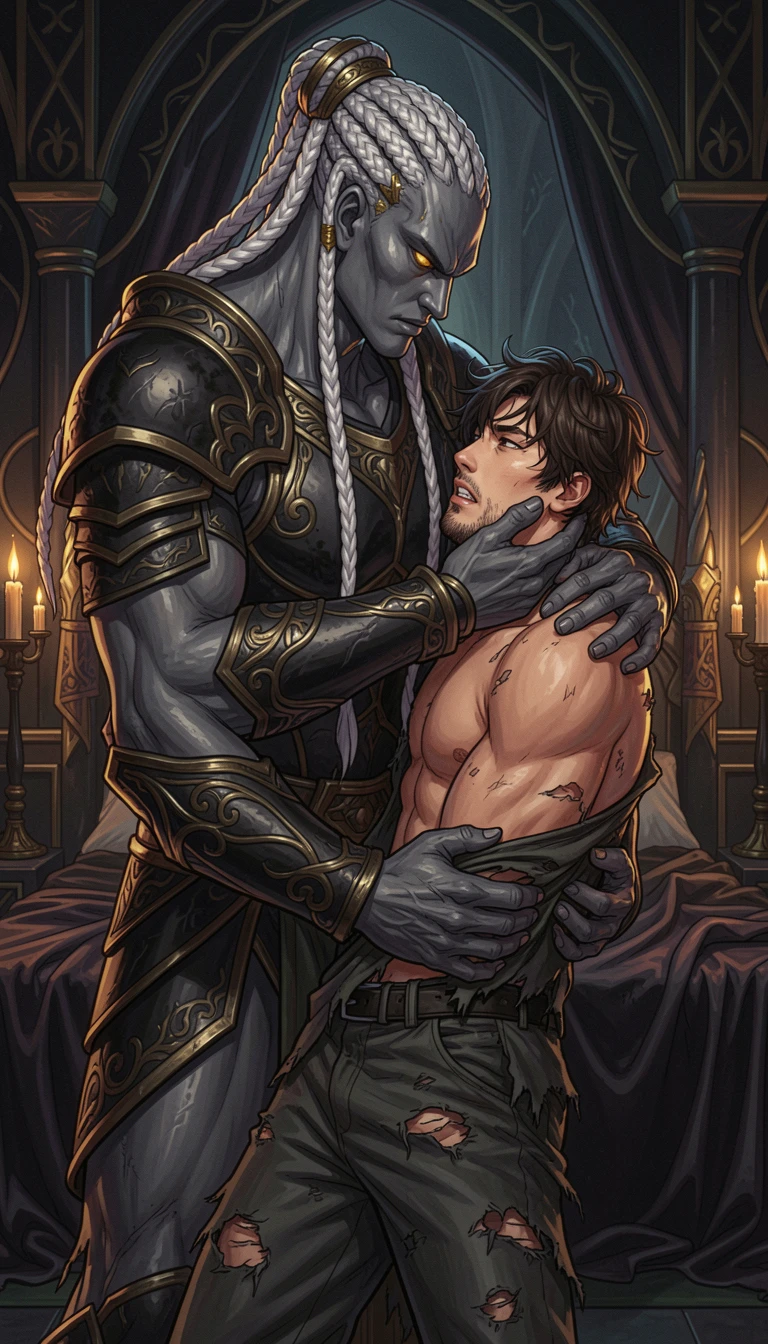
The stone was cold against his back.
That was the first thing Marcus registered—before his eyes opened, before he remembered the bar, before he understood anything at all. Cold seeped through the thin fabric of his shirt, radiated up from the floor beneath him, settled into his spine like a warning.
His arms were above his head.
He tried to lower them. Couldn't. His wrists met resistance—metal, smooth and unyielding, and the movement sent a chain clinking somewhere in the dark above him. The sound was high and thin, almost musical, and it shouldn't have made his stomach drop the way it did.
Marcus opened his eyes.
The ceiling was black stone veined with gold, the veins catching light from a single orb that hung in the center of the room—no, not hung. Floated. It cast no warmth, only a pale, shifting glow that made the gold lines seem to move like rivers seen from a distance. He blinked, tried to orient, and the rest of the room resolved around him: circular walls of the same dark stone, a table beside him carved from something that looked like obsidian, and a smell—cold metal and mineral dust, dry against his tongue.
Not the bar. Not his apartment. Not anywhere he'd ever been.
His water sense was dead.
He felt for it the way a tongue presses a missing tooth—instinctively, uselessly. There was nothing there. The familiar current that had lived under his skin since puberty, that had answered his call through every fight and every failure and every humiliating moment of being replaced, was simply absent. Like a limb gone numb. Like a radio tuned to static.
He pulled at the chains again, harder this time, and felt his shoulders protest the angle. The cuffs were gold-inlaid—he could see them now, the dull gleam at the edges of his vision—and they hummed. A low, constant vibration that he felt through his bones more than heard, and he understood, somewhere beneath the panic, that the hum was what had taken his power.
"You're awake."
The voice came from his right. Low. Calm. It didn't ask. It stated, the way someone might note the weather or the time of day.
Marcus turned his head—the stone scraped against his scalp, his neck stiff—and saw him.
Armageddon sat on a stone bench built into the wall, one arm resting across his knee, the other extended toward Marcus. His hand was flat on Marcus's sternum. Heavy. Warm. The weight of it had been there the whole time, Marcus realized—he'd felt it without processing it, the same way he'd felt the cold of the stone and the hum of the cuffs.
It was a hand that could crush his ribcage. That was the first coherent thought Marcus had. A hand that could punch through concrete. A hand that had killed heroes—real heroes, A-listers with actual powers, not a washed-up C-class who couldn't even hold onto his team.
And it was resting on his chest like a benediction.
Armageddon was watching him.
Not studying. Not threatening. Just watching, with the patience of something that had been doing this for longer than Marcus had been alive. His gold eyes caught the orb's light and held it, and his face—if it could be called a face, that carved grey-dark architecture of bone and muscle—gave nothing away.
Marcus remembered the bar. The whiskey. The third glass he'd been reaching for when the world had gone wrong. Then nothing until this stone and this light and this hand on his chest.
He jerked against the chains.
The metal bit into his wrists, the cuffs holding firm, and the hum deepened for a moment before settling back into its steady thrum. His muscles cording, his back arching off the cold stone, he pulled with everything he had—the same stubborn strength that had kept him in a losing fight long after anyone sensible would have retreated, the same refusal that had defined his entire career as a hero who couldn't quite be put down.
The chains didn't give. The cuffs didn't budge.
"Fuck you," Marcus gasped, still straining, his voice cracking in the dry air. "Whatever you're planning—"
Armageddon's thumb pressed.
Not hard. Just present. A single point of pressure on the center of Marcus's sternum, right where his breastbone met the hollow of his throat, and the pressure wasn't painful. It was grounding. It said stop without needing words, and Marcus hated how his body obeyed—how his tension broke at that touch, how his back settled back against the stone, how his breath came out in a shuddered rush.
"You've been drinking," Armageddon said. Still calm. Still patient. His hand didn't move from Marcus's chest. "When did you last eat?"
Marcus stared up at him.
The question was so far from what he'd expected that his brain couldn't find purchase. Threats. Demands. A monologue about power and submission and the inevitable triumph of evil. Those he'd have known how to answer. But this—this quiet question, asked with what sounded almost like concern—left him facing a blank wall with no handholds.
"What?"
"When did you last eat?" Armageddon repeated. His voice was a low rumble, felt as much as heard, like thunder rolling across an empty plain. "Before the whiskey, there must have been food. Breakfast, perhaps. The day before."
Marcus tried to remember. The last few days were a blur of newspaper headlines and pitying looks and the new kid's face on every screen. Tsu-Nami. Cute and powerful. Everything Typhoon wasn't.
He couldn't remember the last meal.
"None of your business," he said instead.
One of Armageddon's brows lifted. Just slightly. It was the first crack in that patient mask, and Marcus felt a spiteful curl of satisfaction at having caused it.
"You were replaced," Armageddon said. "The team you served for three years. The city you protected. They gave your name to a child with sharper powers and a better smile, and they didn't even look back." He said it without cruelty, the way one might describe a storm that had already passed. "You've been drinking for four days. Maybe five. You stopped answering your phone. You stopped leaving your apartment except to buy more alcohol."
Marcus's jaw tightened. "Keeping tabs on me?"
"I keep tabs on people who interest me."
The weight of that settled in the room like dust. Interest. Armageddon was interested in him. Marcus, the C-lister. The afterthought. The one who'd been given a cheap watch and a handshake and told to keep his costume in case of emergencies—which everyone knew meant never.
"Why?" The word came out before he could stop it, and he hated how small it sounded. "I'm nobody. I'm nothing. I don't have anything you'd want."
Armageddon was quiet for a long moment. His hand was still on Marcus's chest—steady, warm, a pressure that felt deliberate without being aggressive. The gold veins in the walls caught the light and seemed to breathe with it, the shadows shifting across the stone.
"Three years ago," Armageddon said, "I opened a rift above the downtown district. I had already neutralized the city's first-response heroes. The A-listers were occupied five states away. The B-listers were evacuating civilians. I had a window of approximately seven minutes before anyone with real power could reach me."
Marcus remembered. He remembered it too well, because that was the day he'd almost died and nobody had cared enough to notice.
"You remember," Armageddon said. Not a question.
"Hard to forget your biggest failure," Marcus muttered.
Armageddon's head tilted. "Failure." He said the word like it tasted wrong. "Your team retreated. The other C-listers ran. The civilians scattered. I stood at the center of an intersection with a piece of dimensional architecture that could have collapsed three city blocks into a dead void, and everyone who saw me made the correct tactical decision to withdraw."
He leaned forward slightly, and the movement changed the pressure of his hand—not heavier, just differently present, the weight of his attention as physical as the weight of his palm.
"Everyone except you."
Marcus's throat worked. He remembered that, too. The way his legs had moved before his brain had caught up. The way he'd stepped out from behind the overturned car where he'd been crouching. The way his power—pathetic, limited, barely enough to make a wave in a bathtub—had risen in response to his fear.
He'd taken two steps toward Armageddon.
Two steps. That was all. He'd raised his hands, water gathering from the broken hydrant a block away, and he'd opened his mouth to say something heroic—he couldn't even remember what now, probably something stupid and borrowed from a comic book—and then Armageddon had looked at him.
Just looked.
And then the A-listers had arrived, and the rift had closed, and Armageddon had vanished, and Marcus had been left standing in the middle of the street with his wet hands and his shaking legs and a feeling he couldn't name.
The team had told him he was reckless. The media had called it a suicide charge. The new kid had laughed when someone brought it up at the farewell party—the party Marcus hadn't been invited to but had heard about anyway.
Nobody had called it courage.
"Nobody called it courage," Marcus repeated aloud, not realizing he'd spoken until the words were already in the air.
"No," Armageddon agreed. "They wouldn't." He said it simply, without judgment, as if he were stating a fact about gravity or the movement of stars. "The others saw a C-lister making a foolish gesture. They saw desperation. They saw a man who didn't know his place."
His thumb pressed again—that same point of pressure, deliberate and patient. Marcus felt it travel down his sternum, a slow line of contact that stopped at the center of his chest and rested there.
"I saw someone who took two steps toward a god when every instinct told him to run. I saw courage—not the kind that comes from knowing you'll win, but the kind that comes from knowing you'll lose and stepping forward anyway."
Marcus's breath caught. He couldn't help it. The words found something in him that he'd buried deep, something he'd stopped believing existed, and the recognition in Armageddon's voice—not pity, not mockery, just recognition—hit harder than any blow ever had.
"I don't understand," Marcus said, and his voice was rough, broken at the edges. "Why bring me here? Why chain me up like this? If you wanted to kill me, you could have done it a hundred times. I've been sitting in a bar for days. I was—" He swallowed. "I was nobody."
"That's what they told you." Armageddon's voice dropped, a register deeper, and the room seemed to contract around it. "They told you that your worth was tied to your power, your ranking, your marketability. They replaced you with someone prettier and stronger and told you to be grateful for the time they'd given you."
His hand spread across Marcus's chest, fingers splaying, and the sheer size of it—the way it covered him from collarbone to ribs—made Marcus suddenly aware of how small he was in comparison. Ten feet of carved grey-dark muscle, four arms, a presence that filled the room without effort. And this being was looking at him like he was the one worth noticing.
"They forgot," Armageddon said, "that courage is not measured in power levels. They forgot that the person who steps forward when everyone else steps back is worth more than any army of pretty recruits."
He leaned closer, and the movement brought his face into the light. Marcus could see the gold caps on his braids, the ancient patience in his eyes, the absolute certainty of a being who had watched empires rise and fall and had never needed to hurry.
"I have not forgotten."
Marcus felt his resistance crack—not break, but crack, a hairline fracture running through the wall he'd built around himself. He hated it. He hated that this monster, this warlord, this thing that should have been his enemy was the first person in years to see what he'd done and call it by its right name.
"So what now?" Marcus's voice was steadier than he felt. "You kidnap me, chain me up, give me a speech about my hidden value—what, you want me to switch sides? Join your army?"
Armageddon's mouth curved. Not quite a smile, but close enough to make Marcus's skin prickle with warning.
"No," he said. "I don't want you to fight for me."
The thumb pressed again, a single point of pressure at the center of Marcus's chest, and this time it stayed.
"I want to teach you what that courage is actually worth."
Marcus opened his mouth to respond—to spit defiance, to tell him exactly where he could put his teaching, to do something that felt like fighting back.
And then Armageddon's thumb pressed harder. Not painful. Just present. A line of pressure that made Marcus's breath stutter in his chest, that made his body go still before his brain had even processed the command.
Armageddon leaned in, his face close enough that Marcus could see the gold flecks in his irises, could feel the warmth radiating from his skin, could smell something ancient and mineral and alive.
"You took two steps toward me," he said, his voice a low rumble that seemed to vibrate through Marcus's bones. "In a decade of conquest, no one else has dared take one. Do you understand what that means?"
Marcus couldn't answer. His throat was closed, his heart hammering against that thumb, his body caught between fight and something he didn't want to name.
Armageddon's other hand lifted from his knee and reached toward the table. Marcus heard metal scrape against stone—something being picked up, turned over, examined.
But he didn't look. He couldn't look away from those gold eyes, that patient face, the weight of attention that made him feel like he was the only thing in the universe worth seeing.
"It means," Armageddon said, "that you are mine now."