
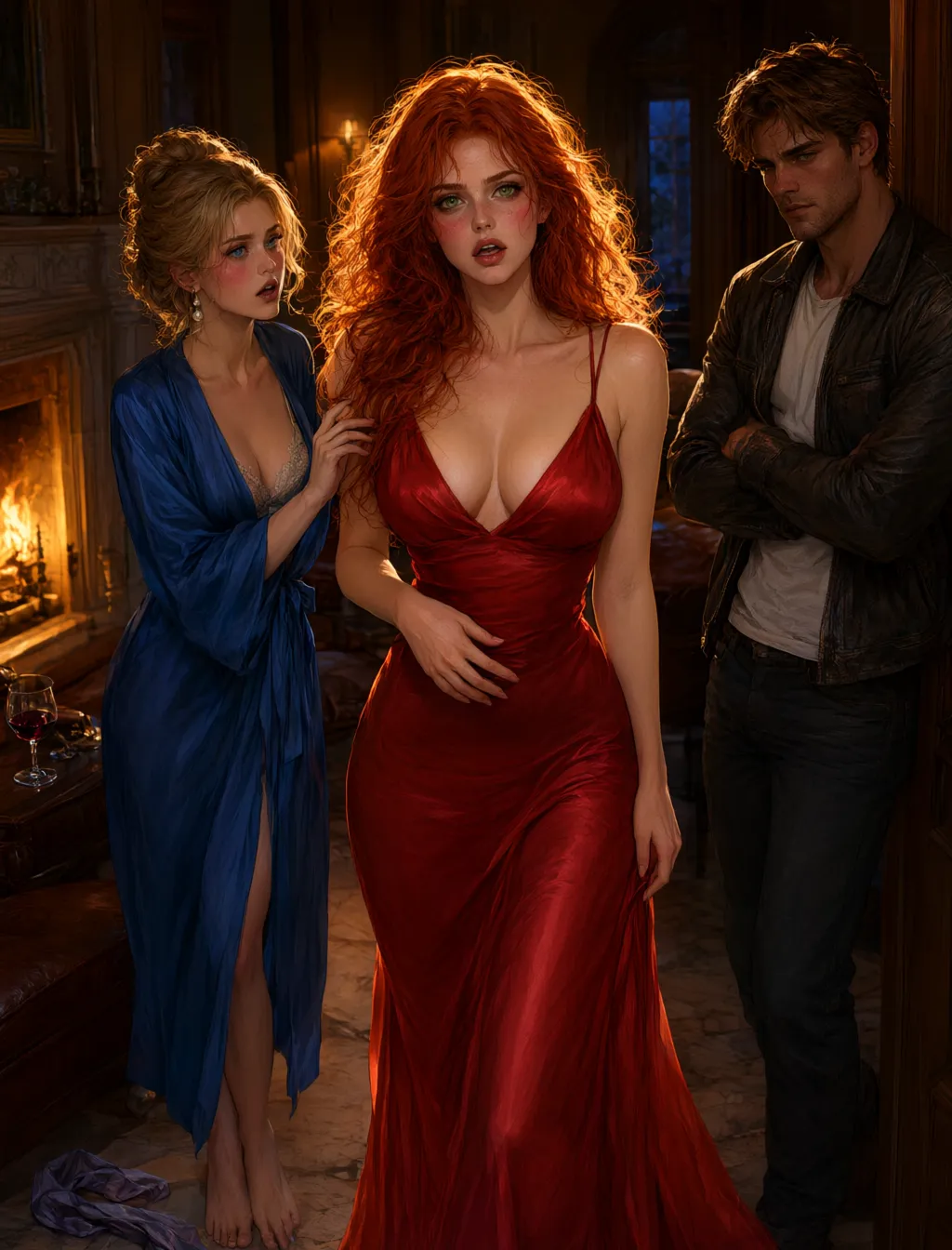
Sarah stood at the bottom of the basement stairs, her back pressed against the cold concrete wall, watching her mother's phone glow in the dim light. The voice on the other end—Hawkins, low and rough—was already becoming part of the machinery she'd glimpsed, and she couldn't shake the image that kept surfacing: her mother, the woman who'd packed her school lunches and signed permission slips, now standing in a windowless room with a cock that Sarah had seen with her own eyes, recruiting a stranger to feed something that lived in the walls. She pressed her palms flat against the concrete behind her, grounding herself in the grit and damp, and tried to remember when her life had stopped making sense. Three months ago, her father was a county judge with a receding hairline and a fondness for scotch. Now her father was a red-haired woman who smelled like lavender and raspberries, and her mother looked younger than Sarah did—younger, and somehow more alive, with a hunger in her eyes that Sarah recognized because she'd seen it in Emily's too.
"How long can this last?" The words came out before Sarah could stop them, and she watched Katherine's head turn, the phone still pressed to her ear, a question in those blue eyes that were somehow clearer, brighter than they'd been a month ago. Sarah shook her head, a laugh bubbling up that wasn't quite a laugh, bitter and bewildered. "She keeps pulling years off you like she's peeling an orange, and you just—you let her. You let her make you younger than your own daughter." She pushed off the wall, pacing the small patch of floor between the stairs and the green-sheeted bed, her sneakers scuffing against the concrete. "And now you're calling a man from a bar to come fuck my dad in a basement because there's something in the walls that needs his—" She stopped, the word catching in her throat, because she was a scientist, she'd seen the scans, she'd watched the darkness move, but she still couldn't say it. "His seed. His actual, literal seed. Like we're farming something."
Katherine lowered the phone, her thumb pressing the screen to end the call, and Sarah watched her mother's face shift—not the clinical mask, but something softer, almost tender, and that was somehow worse. "Sarah," Katherine said, and her voice had that register again, the one that made the walls lean in, "I know this is—"
"Don't." Sarah held up a hand, her palm flat, a physical wall between them. "Don't tell me you know what this is like. You don't. Neither of you do." She looked past her mother to the bed, where the sheets were still rumpled from whatever they'd done before she'd arrived, and she felt the shape of it crystallize in her chest: her father was gone, replaced by this hungry, radiant woman who'd kissed her cheek and called her sweetheart, and her mother was becoming someone Sarah didn't recognize, someone who stood in basements and called strangers and grew younger by the day. "I'm twenty-six," she said, her voice cracking on the number. "I have a master's degree. I've watched people die. And I'm standing in a room where the walls are—" She gestured vaguely at the concrete, the greenish glow, the settling dark. "Where the walls are hungry, and my parents are the ones feeding them."
The silence stretched between them, thick and cold, and Sarah watched her mother's throat work, watched her swallow something she couldn't say. The phone was still in Katherine's hand, the screen dark now, and Sarah realized with a jolt that the call had ended—that Josh Hawkins had agreed to something, that the machinery was already in motion. "He's coming," Katherine said finally, her voice small in a way Sarah had never heard it. "Tomorrow night."
Sarah's hand shot out before her mother could lower the phone—before the silence could calcify into something they'd both pretend didn't happen. Her fingers closed around the warm plastic, Katherine's grip loosening with a startled exhale, and Sarah was already pressing redial before she could ask herself what the hell she thought she was doing. The screen glowed back to life, the number still there, Hawkins's name in Katherine's contacts like a receipt for a transaction Sarah hadn't signed. Her thumb hovered over the call button, and she could feel her mother's eyes on her, could feel the weight of the greenish light and the cold concrete and the walls that were apparently hungry for what a stranger's body could give them.
"Sarah—" Katherine's voice was careful, the way it got when she was about to manage a situation, and Sarah hated it. Hated the clinical calm that had raised her, the same tone that had explained away a father who came home as a woman.
"He's coming tomorrow night to fuck my dad." Sarah's voice was flat, scientist-flat, the register she used when she was about to deliver findings no one wanted to hear. "I think I deserve to know what he expects in return." She pressed call before her nerve could curdle, and the phone began to ring in her palm, each tone a small hammer against her ribs. The basement held its breath with her—the bare bulb humming overhead, the sheets on the bed still creased from bodies she didn't want to picture—and then the line clicked open.
"Changed your mind already?" Hawkins's voice was rough with amusement, low and easy, like this was all a game he'd played a hundred times. Sarah could picture him from Emily's description, from the way her father's new body had apparently melted under his hands: sun-streaked hair, calloused fingers, the lazy confidence of a man who'd never once wondered if he deserved what he was taking. "Because I gotta say, I wasn't expecting a callback before I even hung up."
"This isn't Katherine." Sarah's throat tightened on the words, but she pushed through, her grip on the phone white-knuckled. "This is her daughter. Sarah." Silence on the other end, a beat of something shifting, and she pressed on before he could speak. "I want to know what you think you're getting tomorrow night. What you expect from—from Emily." The name still felt wrong in her mouth, too soft for the man who'd taught her to ride a bike, but she said it anyway, because that woman was real now, was her father in every way that mattered and none of the ones that used to. "Because I've seen what she is. What she carries. And I'm not going to let some stranger walk in here and take advantage of her because she's—" She stopped, the word *new* hovering unspoken. Because her father was new in that body, new to wanting, new to being wanted, and Sarah had watched her mother grow younger and hungrier by the day, and someone had to ask the questions no one else was asking.
A low chuckle rolled through the speaker, and Sarah felt her teeth clench. "Sweetheart," Hawkins said, the word dripping with an ease that made her skin prickle, "I don't expect anything from Emily except what she offers. She came to me. She kissed me first. And if tomorrow night she decides she wants me to walk away, I'll walk." A pause, and when he spoke again, his voice had dropped, losing some of its amusement. "But she won't. I've seen hungry before, and she's the hungriest thing I've ever met. Your mom knows it too. That's why she called."
Sarah's thumb found the end-call button before she'd consciously decided to press it, the line going dead in her palm, and she stood there in the greenish dark with the phone still in her hand, her mother's eyes on her, the walls waiting. He'd answered her question and given her nothing she could use—no angle, no leverage, just the infuriating truth that her father wanted this, wanted him, wanted whatever the darkness needed. She looked down at the phone, at Hawkins's name still glowing on the screen, and felt the shape of tomorrow night pressing against her like a hand on a door she couldn't lock.
Sarah handed the phone back to her mother without meeting her eyes, the warmth of the plastic already fading from her palm, and she was moving toward the stairs before she'd decided to move at all. Her sneakers scuffed against the concrete, each step carrying her up out of the greenish dark, and she could feel Katherine's gaze on her back like a hand she hadn't earned the right to shrug off. "I'm going home," she said, and the words came out steadier than she felt, a scientist's voice reading findings off a chart. "I need to—" She stopped on the third step, one hand on the cold railing, and didn't turn around. "I need to look at the book." The book her father had found in the oak grove, the one that had turned a county judge into a red-haired woman who smelled like lavender and raspberries, the one that had annotations about grounding and places soaked in suffering. The book that had started all of this, and that Sarah had never once opened.
The drive home was a blur of streetlights and her own breathing, the car's heater humming against the late chill, and Sarah kept her hands at ten and two on the wheel because it was something to hold onto. Her apartment was dark when she let herself in, the familiar smell of coffee grounds and her own unwashed dishes grounding her in a way the basement hadn't, and she didn't bother with the lights. She knew where the book was—had known since Emily had pressed it into her hands weeks ago with that soft, hungry smile, telling her to read it when she was ready. It sat on her nightstand now, under a stack of journals she'd been meaning to organize, and she crossed the room and pulled it out with the reverence of someone handling evidence. The leather was warm and worn, the pages yellowed at the edges, and she sat on the edge of her bed with the book open in her lap, the bedside lamp throwing a pool of gold across the cramped handwriting.
The first pages were ritual notes—precise, almost clinical, in a hand she didn't recognize, diagrams of circles and correspondences that made her scientist's brain itch with the wrongness of it all. But then the handwriting shifted, looser, more urgent, and she found the annotations Emily had mentioned: margin notes in a different ink, newer, describing what happened when the power was used, what it cost, what it fed on. Sarah's finger traced a line about grounding, about places that had absorbed suffering becoming vessels for overflow, and she felt the hair on her arms rise because she'd watched that happen, had seen the darkness pour out of her father into the walls of Room 314 like water finding its level. She turned the page and stopped. There, in the margin, in handwriting she recognized as her father's—Dan's, the man who'd taught her to ride a bike, the man who'd signed her report cards—was a single sentence, underlined twice: The body is the price. The hunger is the gift. She will learn to want what she needs.
Sarah read the sentence three times, her thumb pressing into the page hard enough to leave a crease, and she felt something shift in her chest—not understanding, not yet, but the beginning of a shape she could almost hold. She'd been so focused on the mechanics, on the scans and the darkness and the logistics of feeding something that lived in walls, that she'd never once asked the question the book was asking: what did it mean that her father's power was bound to a body that wanted, endlessly, indiscriminately, with a hunger that had melted her mother's clinical reserve and drawn a stranger from a bar into a basement? She closed the book slowly, the worn leather settling against her palms, and stared at the wall of her apartment—the posters, the bookshelf, the half-empty mug of coffee from that morning—and felt the shape of her family pressing against her from all sides. Her father was a woman now, her mother was younger than her, and tomorrow night a man she'd never met was coming to a basement to feed something that had taken root in the walls because her parents had decided that was the price of healing people. She set the book on the nightstand, her hand lingering on the cover, and lay back on the bed without turning off the lamp, staring at the ceiling as the weight of the underlined sentence settled into her like a stone dropped into still water.
She lay there for a long time, the lamp burning against her closed lids, and slowly the weight in her chest began to resolve into something with edges. The sentence in the book wasn't a warning—it was a description, a clinical note on a specimen her father had become, and she'd read it with a daughter's eyes when she should have read it with a scientist's. She sat up, the sheet pooling around her waist, and reached for the book again, flipping past the ritual notes and the margin annotations to the back pages, where the paper was rougher, older, and the handwriting had a different character entirely—not her father's, not the first hand either, but a third voice that had clearly owned the book longest.
The back pages were a ledger of sorts, entries dated decades apart, each one a name and a price. Sarah's finger traced down the column: a woman in Prague, 1931, cured of consumption, who paid with her firstborn's name; a man in New Orleans, 1947, spared from a wasting fever, who paid with twenty years of his own memory; a child in a village she couldn't pronounce, 1968, saved from a drowning sickness, who paid with something the entry only called "the mother's grief, redirected." Each transaction was written in the same steady hand, with the same clinical detachment Sarah recognized from her own lab notebooks, and at the bottom of each entry, a small symbol she'd seen before: the seven-pointed star that marked the ritual notes at the front of the book.
The last entry was dated three months ago, and it was in her father's handwriting: Dan Sinclair, county judge, age fifty-four. Price: the body I wore, the life I built, the name my children call me. Received: power over sickness and suffering, bound to a vessel that hungers. Terms: the hunger must be fed, or it will feed. Sarah read it twice, her thumb pressing into the page again, and she felt the shape of it click into place with a sound she could almost hear—not understanding, not yet, but the beginning of a map. Her father hadn't stumbled into this. He'd signed a contract, in a book that had been collecting signatures for a century, and the price wasn't just his body—it was the hunger itself, the endless wanting that had drawn her mother into a basement and a stranger into their lives. But beneath the entry, in a different ink, newer, in handwriting she recognized as Emily's—looser, more urgent, the hand of someone who'd learned something too late—was a note she hadn't noticed at first: The price is commensurate with the power. The power it gave me was greater than any other noted in this book. I didn't know the price until I had paid it.
She closed the book and set it on the nightstand with more care than she'd used all night, her palm flat on the worn leather as if she could feel the pulse of all those transactions through the cover. The lamp still burned, the coffee mug still sat half-empty on the desk, and somewhere across town her mother was probably still in that basement, waiting for a man she'd called to feed something that lived in walls. Sarah looked at her phone on the nightstand, dark and silent, and thought about the question she'd asked Hawkins— what do you expect from Emily —and how he'd answered it with the one thing she couldn't argue with: that her father wanted this, wanted him, wanted whatever the darkness needed. But the book said something else now, something she couldn't unsee: that the wanting wasn't a choice her father had made in that new body. It was the price, written into the contract, and someone had to read the fine print before tomorrow night. And Emily's note, scrawled beneath her own entry like a confession, said the price was commensurate with the power—that her father had been given more than anyone else in the book's long history, and had paid for it without knowing what she was surrendering until it was already gone.
She reached for her phone, her thumb hovering over Katherine's name, and stopped. Not yet. Not with the book's ledger still burning behind her eyes and the shape of the contract still settling in her chest. She needed to understand the symbol first, the seven-pointed star that marked every transaction, needed to know if it was a signature or a seal or something else entirely—something that would tell her whether her father had signed away only his body, or something she hadn't yet learned to name. She set the phone down, picked the book back up, and turned to the front pages, where the diagrams were, and began to trace the star's lines with her fingertip, the lamp burning low as the night wore on and the shape of her family's debt slowly, line by line, revealed itself to her.
The star's geometry was wrong. Sarah had traced it three times now, her fingertip following the seven points from the frontispiece diagram into the margin notes, and each pass left her more certain: the star wasn't a seal or a signature—it was a map. The points didn't align with any celestial correspondence she could name, but they aligned with something, some pattern that kept snagging at the back of her scientist's brain like a word on the tip of her tongue. She flipped back to the first ritual page, the one with her father's precise, clinical hand describing the circle and the correspondences, and compared the star there to the one in the ledger. They were the same but not the same—the ledger version had an extra line, a seventh point that branched off at an angle the frontispiece lacked, and that line pointed at a small annotation she'd missed entirely, hidden in the binding's shadow where the pages curved into the spine.
She had to angle the book toward the lamp to read it, the worn leather creaking in her hands, and what she found made her breath catch: a name, written in that third, oldest hand—the one that had owned the book longest—and beneath it, a date that made her stomach drop. *Eleanor Vance, 1903.* And then, in the same steady script that had recorded the Prague consumption cure and the New Orleans wasting fever: *The vessel consented. The price was named in blood. The star remembers what the vessel forgets.* Sarah's thumb pressed into the page, hard enough to leave a crease, and she felt the shape of it click with a sound she could almost hear—the star wasn't a mark of ownership. It was a record of transformation, a way of tracking who had been changed and what they'd become, and Eleanor Vance was the first entry in a ledger that had been collecting names for over a century before her father's was scrawled at the bottom.
She turned the page, her hands steadier than she felt, and found what she'd been missing: a diagram she'd skimmed past earlier, dismissed as more ritual geometry, but now she saw it for what it was—a binding circle, drawn in the same steady hand as the ledger, with a space in the center where a name was meant to be written. The circle wasn't complete. Seven points ringed its circumference, but the seventh was open, unfinished, and beside it, in handwriting she recognized as Emily's—looser, more urgent, the hand of someone who'd learned something too late—was a single line: *The circle closes when the vessel signs. I thought I was the first. I was the seventh.* Sarah read it twice, her finger tracing the open point of the circle, and felt the weight of it settle into her chest like a stone dropped into still water. Her father hadn't just signed a contract. She'd completed a circuit that had been waiting for a seventh name for over a century, and the star that marked every transaction in the ledger was the same star that bound her family to whatever hunger lived in the walls of that basement, waiting to be fed.
The lamp flickered once—a surge, a settling of old wiring—and Sarah looked up from the book, her heart hammering against her ribs in a way she couldn't quite explain. The apartment was still dark around her, the coffee mug still half-empty on the desk, the posters and bookshelf and all the familiar objects of her life unchanged, but she felt the shape of something else pressing against the edges of her vision, something the book had opened that she couldn't close. She looked back down at the binding circle, at the open seventh point, at Emily's confession scrawled in the margin like a warning she hadn't been meant to find, and she understood, with a clarity that made her stomach clench, that the book wasn't just a record of transactions. It was a door, and the star was the key, and somewhere in the pages she hadn't yet turned was the source of the ritual itself—the place where the circle had first been drawn, the reason it needed seven vessels, the thing that had been waiting, patient and hungry, for someone like her father to walk into an oak grove and say yes.
She turned the page before she could lose her nerve, and the lamp steadied as if the book itself had exhaled. What she found made her go still: a second diagram, older than the binding circle, drawn in that first steady hand—Eleanor's hand, she realized with a jolt—and this one was not a circle at all. It was the star, rendered in its full geometry, seven points radiating from a center that held a single word she had to angle toward the light to read: *Source.* And beneath it, in the same script that had recorded the Prague cure and the New Orleans fever, a line that made her thumb press into the page hard enough to leave a crease: *The vessel must consent, and the price is named in blood.* Sarah read it twice, then a third time, her scientist's brain already turning it over like a specimen on a slide—consent, she thought, not coercion, not trickery, which meant her father had walked into that oak grove with his eyes open, or thought he had—and beside the word *Source*, in a different ink, newer, in handwriting she recognized as Emily's, was a single arrow pointing to the margin, where a cramped note read: *The grove is not the origin. The origin is older. Follow the star's longest point at the summer solstice—it points to where the first circle was drawn.*
The lamp flickered again, and Sarah looked up from the page, her heart hammering in a way she couldn't quite explain. The apartment was still dark around her, the coffee mug still half-empty on the desk, but she felt the shape of something else pressing against the edges of her vision—the star's longest point, the summer solstice, a place older than the grove where the first circle had been drawn. She looked back down at the binding circle, at the open seventh point where her father's name should have been, and she understood with a clarity that made her stomach clench that the book wasn't just a record of transactions. It was a map, and the star was the key, and somewhere in the pages she hadn't yet turned was the source of the ritual itself—the place where the first vessel had consented, the price that had been named in blood, the thing that had been waiting, patient and hungry, for someone to follow the star to its origin.
She closed the book slowly, her palm flat on the worn leather, and stared at the wall of her apartment without seeing it. Tomorrow night, a man she'd never met was coming to a basement to feed something that lived in walls. Her mother was younger than her, her father was a woman who smelled like lavender and raspberries, and somewhere, along the longest point of a star drawn in a book that had been collecting names for over a century, there was a place where the first circle had been drawn—a place that might tell her what her father had actually signed, what the hunger really was, and whether there was a way to close the circuit without becoming the eighth name in the ledger. She set the book on the nightstand, her hand lingering on the cover, and reached for her phone. Her thumb hovered over Katherine's name, then moved past it to the map app, typing in the coordinates she'd memorized from the star's geometry—the longest point, the summer solstice, the direction the diagram insisted was the origin.
The map loaded slowly, the blue dot pulsing in the center of her apartment, and Sarah watched the screen as the view zoomed out, past the city streets, past the suburbs, into the rural farmland that ringed the county. She felt her breath catch as the pin dropped, the coordinates resolving into a place she recognized—had driven past a hundred times on the way to her grandmother's house as a child, had never once stopped to look at. The old Vance homestead, abandoned since before she was born, a tangle of fallen barns and overgrown fields at the end of a dirt road. Eleanor Vance, 1903. The first name in the ledger. The first vessel who had consented, who had named her price in blood, who had drawn the first circle in a place the book called the source. Sarah stared at the pin on the map, at the distance between her apartment and that overgrown field, and felt the weight of the underlined sentence settle into her chest like a stone dropped into still water: *The vessel must consent, and the price is named in blood.* Her father had consented. Eleanor had consented. And somewhere in that abandoned homestead, if the star was telling the truth, was the place where the first circle had been drawn—the origin of the ritual that had turned a county judge into a red-haired woman, that had made her mother younger than her, that had drawn a stranger from a bar into a basement to feed something that lived in walls.
Sarah's keys were in her hand before she'd consciously decided to move, the book still open on the bed behind her like a wound she couldn't close. She grabbed her jacket from the hook by the door, her phone still glowing with the map's blue dot, and she was down the stairs and into the cold night air before the weight of what she was doing could catch up with her. The car's engine turned over with a familiar rumble, and she sat there for a moment, her hands on the wheel, staring at the dark street ahead of her and thinking about the ledger's first entry—Eleanor Vance, 1903, a name that had been waiting over a century for someone to follow it home. She pulled out of the parking lot without letting herself think about what she'd say if anyone asked where she was going, because she didn't have an answer that would make sense to anyone but the scientist in her chest who needed to see the source with her own eyes.
The drive was longer than she remembered, the city lights thinning to scattered farmhouses and then to nothing but dark fields and the occasional skeletal tree lit by her headlights. She kept the map app open on her phone, propped against the dash, the blue dot crawling along the winding county roads like a pulse she couldn't steady. Her grandmother's house had been off this same road, she realized, a lifetime ago, and she'd never once asked why the Vance place sat abandoned at the end of that dirt track, never once wondered who had lived there or what had happened to them. The book was on the passenger seat, the leather cover warm under her palm whenever she reached for it, and she could feel the star's geometry pressing against the back of her skull like a word she couldn't stop repeating. Seven points. Seven vessels. And her father, the seventh, who had walked into an oak grove and signed a contract she was only now beginning to understand.
The dirt road appeared sooner than the map promised, a narrow gap in the treeline marked by a rusted gate that hung half-open, sagging on its hinges like a mouth that had given up speaking. Sarah pulled the car onto the grass shoulder and killed the engine, and the silence rushed in around her—no crickets, no wind, just the ticking of the cooling engine and her own breathing, too loud in her ears. She grabbed the book and her phone, the flashlight beam cutting a pale cone through the dark as she stepped out, and the cold air hit her face like a hand. The homestead was a shadow against the sky, the fallen barn a dark heap of boards and beams, and beyond it she could make out the shape of the house itself, windows black, roof half-collapsed, a place that had been empty since before she was born. She stood at the gate for a long moment, the book pressed against her chest, and felt the weight of Eleanor's name in her pocket like a stone.
The path to the barn was overgrown, waist-high weeds that dragged at her jeans, and she moved through them with her phone held out in front of her, the flashlight beam jumping across the fallen timber and the rusted remnants of farming equipment half-buried in the earth. She could feel it before she saw it—a wrongness in the air, a stillness that had nothing to do with the cold—and her scientist's brain catalogued it even as her heart hammered against her ribs. The barn door was gone, torn off its hinges years ago, and she stepped through the opening into a darkness so complete it swallowed her flashlight beam whole. She swept the light across the dirt floor, across the collapsed beams and the piles of rotted hay, and then the beam caught something that made her breath stop: a circle of stones, set into the packed earth, seven of them arranged in a pattern she recognized from the book's frontispiece. The star. The source. She stood at the threshold, the book still pressed against her chest, and felt the weight of a century of consent settling into the dirt beneath her feet.
The stones were not random. Sarah knelt without deciding to, the cold seeping through the knees of her jeans as she swept the phone's beam across their arrangement—seven rough-hewn slabs, each the size of a dinner plate, set into the packed earth at intervals that matched the star's geometry with a precision that made her stomach clench. No farmer had placed these. No accident of collapsing barn beams had arranged them in a pattern that mirrored the frontispiece diagram down to the angle of the seventh point, the one that branched off toward the house. She reached out and touched the nearest stone, expecting cold, and found it warm—not heated, not sun-warmed, but warm the way a body is warm after sleep, a low steady heat that seemed to pulse against her fingertips like a second heartbeat.
She pulled her hand back and opened the book on her lap, the flashlight propped against a fallen beam to cast its pale cone across the page. The frontispiece star stared up at her, seven points radiating from a center that held the word *Source*, and she compared it to the stones with a scientist's eye, measuring angles with her thumb and forefinger held out like calipers. The alignment was exact. The seventh point of the stone circle pointed not at the house but past it, toward a stand of old oaks she could just make out at the edge of the property, their branches black against the star-scattered sky. She looked from the book to the stones to the oaks, and felt the shape of the night pressing in around her—the wrongness in the air that had nothing to do with the cold, the stillness that had swallowed the crickets and the wind, the warmth of the stones beneath her knees like a body that had been waiting for her to arrive.
She stood, brushing dirt from her jeans, and walked the circle's circumference, counting the stones as she went. One, two, three, four, five, six—and then the seventh, set apart from the others at the angle the book had marked, and beside it, half-buried in the packed earth, something that caught the flashlight's beam and glinted. Sarah knelt again, her breath fogging in the cold, and brushed the dirt away with her bare fingers. It was a small brass plaque, green with age, the letters worn but still legible: *Eleanor Vance, 1903. She consented. The price was named in blood.* Beneath the inscription, a date she recognized from the ledger, and beneath that, a single line in a hand she knew—had known her whole life, had seen on report cards and birthday cards and a note left on the kitchen counter the morning her father had walked into an oak grove and never come back: *The seventh closes the circle. The eighth will open it.*
Sarah's thumb traced the letters, the brass cold now where the stones had been warm, and she felt the words settle into her chest like a stone dropped into still water. The eighth will open it. Her father had been the seventh—had closed a circle that had been waiting for over a century—and somewhere in that sentence was a warning she hadn't been meant to find, a door that had been locked and was now, because of her, standing ajar. She looked up from the plaque, across the circle of warm stones, toward the stand of oaks that the seventh point indicated, and she understood with a clarity that made her hands go still that she had not come here to observe. She had come here to see what the star pointed at, and the star pointed at the oaks, and the oaks were where the first circle had been drawn, where Eleanor Vance had consented, where the price had been named in blood. She stood, the book pressed against her chest, the plaque's words burning behind her eyes, and began to walk toward the trees.
The grass was shorter here, almost groomed, as if something had kept the field at bay for over a century. Sarah's sneakers carried her through the last stretch of weeds and onto the bare earth beneath the oaks, and the moment she crossed that boundary, the cold changed. It wasn't warmer exactly, but the air had weight to it, the kind of pressure she associated with the moments before a storm broke, when the sky went green and every hair on her arms stood up at once. The trees themselves were old in a way that made her chest ache—trunks wider than her car, bark furrowed into ridges deep enough to lose a hand in, branches that had been reaching for the sky since before her grandmother was born. She stopped at the edge of them, the book pressed against her sternum, and let her phone's beam sweep across the grove until it caught what she'd come for: the oldest oak, the one at the center, its trunk scarred with a pattern she knew better than she knew her own lab results.
The seven-pointed star was carved deep into the bark, the lines black with age and something else, something that caught the light the way the stones hadn't—like the grooves were still wet, still fresh, still bleeding sap from a wound cut a century ago. Sarah stepped closer, and her free hand rose without her deciding it, her fingers hovering over the lowest point of the star without quite touching. The bark was warm. Not sun-warm, not the residual heat of a day that had long since passed, but warm the way the stones had been warm, the way a body is warm after sleep, a low steady pulse that she could feel through her fingertips even before she made contact. She looked down at the book in her other hand, at the frontispiece star that had led her here, and compared it to the carving with a scientist's eye. They were identical. Down to the angle of the seventh point, down to the way the lines curved at the ends like the tails of a signature, this was the original. This was where the diagram had been copied from. This was the source.
She knelt before she'd decided to, the cold seeping through the knees of her jeans as the book slid from her chest to her lap, her phone propped against a root to cast its pale cone across the trunk. Her fingers traced the lowest point of the star, following the carved line upward, and she felt the bark give slightly beneath her touch—not soft, not rotten, but yielding, the way skin yields when you press on it, the way a body acknowledges a hand it recognizes. Her scientist's brain catalogued it even as her heart hammered against her ribs: the grooves were smooth, worn by a century of weather and something else, something that had kept them from filling with moss or dirt or the slow decay of the tree itself. She traced the second point, then the third, her fingertip moving along the lines the way she'd traced them in the book, and she felt the warmth of the bark rising through her fingers, spreading up her wrist, settling into her chest like a second heartbeat taking root beside her own.
She reached the center of the star, the point where all seven lines converged, and her finger pressed into a small hollow she hadn't seen in the diagram—a depression in the bark, smooth and round, the size of a thumbprint. She pressed her thumb into it without thinking, and the warmth surged, a pulse that ran up her arm and down through her knees into the earth beneath her, and the ground responded. She felt it: a single beat, deep and slow, rising up through the packed dirt and into her bones, a heartbeat that wasn't hers and wasn't the tree's but something older, something that had been waiting in this grove for a century for someone to kneel at this exact spot and press their thumb into this exact hollow. The night went still around her—the crickets, the wind, the distant hum of the county road, all of it swallowed by a silence that had weight, that pressed against her eardrums like water—and then the pulse faded, and the warmth receded, and the bark beneath her thumb was just bark again, cool and rough and ordinary.
She pulled her thumb away and the night came back—crickets, wind, the distant hum of the county road—but something in the silence had changed, a note underneath the ordinary sounds that hadn't been there before, like a radio left on in another room. Her hand was cold where the warmth had been, and she pressed it flat against her jeans to stop the trembling, the book heavy in her lap, the phone's pale cone still fixed on the carved lines of the star. She should leave. Every instinct she'd honed in a decade of labs and peer reviews told her to stand up, walk back to the car, and drive home with the book locked in the trunk and this grove reduced to a data point she could file under *unexplained phenomena, further study required*. But her knees wouldn't unlock, and her eyes kept returning to the hollow where her thumb had been, to the way the bark seemed to have shifted, closed slightly, the way a wound settles after the bleeding stops.
She opened the book again, turning to the frontispiece, and held it beside the carving, comparing them with the same methodical patience she used on CT scans. The star on the page was identical—seven points, the seventh angled toward the oaks—but now she saw what she'd missed in the apartment, what the lamplight had flattened into mere geometry: the center of the diagram was not empty. There was a small circle there, almost invisible, drawn so lightly it had read as a flaw in the paper, and inside it, a single mark that looked like a thumbprint pressed into wet ink. She angled the page toward the phone's light, and her breath caught. The print was not printed. It was real—a ridge-and-valley pattern laid down by a hand that had pressed into the page a century ago, preserved in the fibers like a fossil in stone. Eleanor's thumb. The same hollow she'd just pressed her own thumb into, ground and tree and book all keyed to the same gesture, the same circle, the same consent.
Her scientist's brain ran the sequence backward: the book was the key, the grove was the lock, and the thumbprint was the confirmation that the vessel had to come here, had to touch this exact spot, had to offer her own hand to the same place Eleanor's had been. It wasn't a map to the origin. It was a test, and she had just passed it without knowing she was taking it, and somewhere in the darkness beyond the oaks, something had felt her pass. She looked up from the page, into the black between the trunks, and for a moment she thought she saw a shape there—not a person, not an animal, but a presence, a density in the air that the phone's beam couldn't penetrate, a stillness that had been waiting for the moment her thumb found the hollow. She held her breath, and the shape held too, and then it was gone, and the night was just the night again, cold and ordinary and full of crickets.
She stood, the book clutched to her chest, and backed away from the oak without turning her back on it, her sneakers scuffing through the bare earth until she reached the line of weeds at the grove's edge. The warmth was gone from her skin, but something else had taken its place—a low hum under her sternum, faint as a tuning fork after the note has faded, that she couldn't quite attribute to her own heartbeat. She walked back across the field toward the car, the flashlight beam jumping ahead of her, and she didn't look back at the grove until she reached the gate. The oaks were a black mass against the sky, indistinguishable from any other stand of trees at night, and she told herself that was all they were. The book was warm against her ribs, and the hum under her sternum kept time with her steps, and she got into the car and started the engine without letting herself think about what she'd just done, or what the groove in the bark would look like if she came back tomorrow and pressed her thumb into it again.
The car idled at the gate, engine humming, and Sarah sat with both hands on the wheel, staring at the black mass of the oaks through the windshield. She'd driven half a mile before she'd realized what she was doing—foot easing off the gas, blinker clicking, the car swinging around in a farmhouse driveway that smelled of silage and cold—and now here she was, back at the rusted gate, the book warm on the passenger seat like an accusation. The hum under her sternum hadn't faded. If anything, it had grown sharper on the drive, a frequency she could feel in her teeth, and she knew with a scientist's certainty that she wasn't going to make it home without answering whatever question the grove had asked her. She killed the engine and sat in the sudden silence, the headlights painting the gate and the overgrown path in harsh white, and she thought about her father—about Dan, the man who'd taught her to ride a bike, who'd signed her report cards, who'd walked into an oak grove three months ago and never come back.
She grabbed the book and stepped out into the cold, the flashlight beam cutting through the dark as she pushed through the waist-high weeds, and this time she didn't stop at the edge of the grove. The oaks swallowed her whole, the air going thick and still, and she walked straight to the oldest tree, to the star carved deep in the bark, and knelt in the bare earth without hesitation. She opened the book to the frontispiece, propping the flashlight against a root, and held the page beside the carving one more time—the seven points, the seventh angled toward the barn, the small circle at the center that held Eleanor's thumbprint like a fossil. Her own thumb hovered over the hollow in the bark, the depression she'd pressed into an hour ago, and she could feel the warmth rising from the wood even before she touched it, a low steady pulse that matched the hum under her sternum beat for beat. She read Eleanor's inscription one more time in her head, the words from the brass plaque burning behind her eyes: *She consented. The price was named in blood.* And then, beneath it, her father's hand, the note she'd found in the ledger: *The seventh closes the circle. The eighth will open it.*
"I'm not signing anything," Sarah said aloud, her voice thin in the stillness, the first words she'd spoken since she'd left the basement. The grove didn't answer. The warmth in the bark kept pulsing, patient and steady, and she felt the absurdity of it—a scientist negotiating with a tree—but she couldn't stop her hand from hovering, couldn't stop the part of her that needed to know whether the hollow would still fit her thumb, whether the groove in the bark would have shifted, closed slightly, the way a wound settles after the bleeding stops. She pressed her thumb into the hollow, and the warmth surged up her arm, and the ground beneath her knees gave a single, deep shudder—not a tremor, not a settling of old earth, but a beat, a pulse, a heartbeat that ran from the tree down through her bones into the packed dirt and out, toward the barn, toward the circle of warm stones, toward the plaque that bore Eleanor's name. The shudder passed, and in its wake, a crack ran through the packed earth at her knees, a hairline fracture that widened as she watched, snaking from the base of the oak toward the barn, splitting the bare ground like a seam coming undone.
Sarah pulled her thumb away, and the warmth receded, the bark cooling beneath her touch until it was just bark again, rough and ordinary. She stared at the crack, at the way it held the flashlight's beam, a dark line in the packed earth that hadn't been there before, and she felt the hum under her sternum shift—not louder, not quieter, but different, a note that had resolved into something with a shape. She'd come back to check the hollow, to see if the groove had changed, and instead she'd opened something, pressed her thumb into a lock that had been waiting a century for a second key. The crack ran past the grove's edge, through the short groomed grass, and disappeared into the weeds that led toward the barn, and she knew with a clarity that made her stomach clench that she had done what Eleanor had done, consented without meaning to, named a price she hadn't yet read. She looked down at the book in her lap, at the frontispiece star, and for a moment the lines seemed to shift, the seventh point reaching toward the barn the way the crack did, the center hollow where Eleanor's thumbprint lay dark and waiting.
She followed the crack with the flashlight beam, her knees still pressed into the cold earth, and watched it widen at the edges—dirt crumbling inward, small stones shifting as if something beneath the ground were breathing. The book lay open in her lap, the frontispiece star catching the pale cone of light, and she found herself comparing the crack's path to the seventh point of the diagram with the same methodical patience she used on CT scans. They matched. The crack ran true to the angle, true to the line that branched off toward the barn, and she thought about Eleanor Vance kneeling in this same spot a century ago, pressing her thumb into this same hollow, watching the ground split beneath her and knowing what it meant. The difference, Sarah realized, was that Eleanor had consented. She had read the price before she paid it. Sarah had just pressed her thumb into a lock without reading the fine print, and now the ground was opening like a mouth that had been waiting to speak.
She stood, brushing dirt from her knees, and walked the crack's length with the flashlight held low, her sneakers following the dark line through the groomed grass and into the weeds that bordered the barn. The crack didn't stop at the grove's edge. It ran through the waist-high brush, splitting the dry earth, and disappeared under the barn's fallen wall—a dark gap between rotted boards where the beam's light couldn't reach. She stopped at the threshold, the book pressed against her chest, and listened. No crickets here. No wind. Just the hum under her sternum, sharper now, and a sound she couldn't quite place—a low, rhythmic scrape, like something breathing against wood from the inside. Her scientist's brain offered explanations: settling beams, a rodent, the wind through a gap in the roof. Her hands didn't believe any of them.
She knelt at the gap in the wall, the flashlight beam cutting into the darkness of the barn's interior, and saw what the crack had opened: a seam in the packed earth floor, running from the base of the wall toward the circle of warm stones, and in that seam, something glinting. Not metal. Not glass. Something that caught the light the way the carved lines of the star had caught it, like the grooves were still wet, still fresh. She reached through the gap, her arm scraping against rotted wood, and her fingers closed around a small object—cold, smooth, heavier than it looked. She pulled it out and held it in the beam of her flashlight, and her breath caught in her throat. It was a key. Old iron, black with age, the bow worked into the shape of a seven-pointed star, the bit worn smooth by a century of use. She turned it over in her palm, feeling the weight of it, the hum under her sternum pulsing in time with her heartbeat, and she knew with a certainty that had nothing to do with science that this was what the crack had been waiting to give her.
A key to what, she didn't know. The barn had no locks she'd seen, no doors that still hung on their hinges. But the star on the bow matched the star on the tree, matched the star in the book, and she thought about Eleanor Vance pressing her thumb into the hollow and naming her price in blood, and about her father walking into an oak grove three months ago and never coming back. She closed her fist around the key, the cold iron warming against her skin, and stood, backing away from the barn without turning her back on it. The hum under her sternum had settled into something steady now, a note that felt less like a warning and more like a summons, and she knew she wasn't done here. The car was still at the gate, the engine cold, the book warm in her hand. But the key was in her pocket, and the crack was still open, and somewhere in the dark between the barn and the oaks, something was waiting for her to decide what to do with what she'd found.
She sat in the driver's seat with the dome light on, the key heavy in her palm, and she didn't need the book to tell her what to do next. The star on the bow was warm against her skin, warmer than the iron should have been after minutes in a cold car, and the hum under her sternum had settled into a steady pulse that matched the rhythm of her own heart like a second hand on the same clock. She turned the key over, feeling the worn edges of the bit, the smoothness of the bow where a century of fingers had held it before hers, and she thought about Eleanor Vance kneeling in the same spot, pressing her thumb into the same hollow, watching the ground open beneath her and knowing she was consenting to something she couldn't name. Her father had done the same thing, walked into an oak grove with a book and a ritual and a hunger for power that had cost him his body, his name, his life as Dan Sinclair. Sarah looked at the key in her palm, at the seven points of the star catching the dome light, and she understood that she was holding the same choice Eleanor had held, the same choice her father had made, and that the only difference was that she'd found it before she'd signed anything.
Her thumb found the center of the star without her deciding it to, pressing into the small depression where the seven lines converged, and the metal surged warm beneath her touch—not hot, not burning, but alive, the way the bark had been alive, the way the stones had pulsed with a second heartbeat. The hum under her sternum rose up her arm, a frequency she could feel in her teeth, and the night outside the windshield went still. Not quiet. Still. The crickets stopped mid-note, the wind dropped as if a door had closed, and the dome light flickered once, a surge that made her grip tighten on the key. She looked up, and the grove was black against the sky, the oaks holding their breath, and she felt something in the dark between the trunks turn toward her—not a shape, not a sound, but a presence, a weight that pressed against the glass of the windshield like a hand resting on the other side of a window it could see through.
She didn't pull her thumb away. The warmth kept rising, spreading up her wrist, settling into her chest beside the hum, and she felt the key's star begin to glow—faint at first, a red ember beneath her skin, then brighter, the lines of the star tracing themselves in light against her palm. The book lay open on the passenger seat, the frontispiece catching the glow, and she saw the star on the page respond, the lines darkening as if the ink were drinking the light. Her scientist's brain catalogued it: a sympathetic resonance, a circuit completing, a key and a lock and a door that had been waiting for a century for the right hand to turn it. But the part of her that was Dan Sinclair's daughter, the part that had watched her father walk into an oak grove and never come back, understood something else: the key wasn't just a key. It was a signature. A consent. A price named in blood before she'd read the fine print.
"I'm not signing anything," she said again, her voice thin in the still night, and the glow in her palm pulsed once, a beat that seemed almost amused. The presence beyond the windshield didn't move, but she felt it listen, felt the weight of its attention settle on her like a hand on the back of her neck. She thought about the ledger, about the names and prices recorded over a century, about Eleanor's thumbprint in the book and the brass plaque in the barn and the seventh point of the star pointing toward the oaks. She thought about her father's note, the one she'd found in the ledger: The seventh closes the circle. The eighth will open it. She looked at the key in her palm, at the star glowing red against her skin, and she understood with a clarity that made her stomach clench that she was holding the eighth point. That the key was the mark she'd find next to her own name if she turned the page far enough. That the only question was whether she'd put it in her pocket and drive home, or whether she'd already done what Eleanor had done, what her father had done, by pressing her thumb to the star at all.
The warmth in her palm didn't fade when she finally pulled her thumb away—it lingered like the memory of a handshake, the star's red glow dimming to a faint ember beneath her skin that she could still feel pulsing in time with the hum in her chest. She closed her fist around the key, the iron warm and alive against her fingers, and she heard herself exhale a breath she hadn't realized she'd been holding. The presence beyond the windshield hadn't moved, but the weight of its attention had shifted, settled, like a hand that had been raised and now rested palm-down on the glass, patient, waiting. Her scientist's brain offered a dozen ways to frame it—confirmation bias, sleep deprivation, the power of suggestion from a book she'd been reading too late into the night—but her hand stayed closed around the key, and her eyes stayed on the dark line of oaks, and she didn't start the engine.
The dome light flickered again, a surge that made her grip tighten, and she saw the book on the passenger seat shift slightly, the frontispiece page catching the glow from her palm as if the ink were still drinking it. She looked down at the key, at the seven points of the star warm against her skin, and she turned it over in her hand the way she'd turn over a slide under a microscope, looking for the detail she'd missed. The bit was worn smooth, but the bow was not—the star's lines were sharp, crisp, as if they'd been cut yesterday, and in the center of the star, where the seven lines converged, there was a small depression the exact size of her thumb. She'd pressed into it without reading the fine print, and the metal had remembered her, the way the bark had remembered her, the way the hollow in the oak had closed slightly after she'd pulled her thumb away. She thought about Eleanor Vance, about the brass plaque in the barn, about a woman who had knelt in this same grove a century ago and pressed her thumb into a lock that had been waiting for a second key.
She put the key in her pocket without deciding to, the iron settling against her thigh like a weight she'd chosen to carry, and she reached for the book on the passenger seat. The frontispiece was still warm, the star on the page still dark where the ink had drunk the light, and she ran her finger along the seventh point, the one that angled toward the barn, toward the crack in the earth, toward the key that now sat in her pocket. The hum under her sternum had settled into something steady, a note she could feel in her teeth and her fingertips and the backs of her eyes, and she realized she'd stopped cataloguing it as a symptom and started listening to it as a signal. She closed the book and set it on the seat beside her, her hand lingering on the worn leather, and she looked up at the grove through the windshield one more time.
The shape was there. Not the presence she'd felt pressing against the glass—a shape, a density in the dark between the trunks of the two oldest oaks, taller than a man and narrower, like a coat hung on a hook that hadn't been there a moment ago. Sarah's hand went still on the book, her breath catching in her throat, and she watched the shape hold its position at the edge of the grove, just past the gate, as if it had been waiting for her to look up. It didn't move. It didn't need to. The weight of its attention was a hand on the back of her neck, a pressure that told her she'd been seen, that the key in her pocket had been noted, that the eighth point of the star had been marked and the circle was no longer waiting for her to decide. She sat in the cold car with the dome light on and the book warm on the passenger seat and the key heavy against her thigh, and she understood that she had passed the test without knowing she was taking it, that the consent she'd sworn she wasn't giving had been given the moment her thumb found the hollow in the metal.
Sarah's sneakers carried her back across the field before she'd fully decided to go, the key's star still warm against her thigh with that low, persistent pulse she couldn't attribute to body heat. The crack in the earth ran ahead of her like a dark thread through the weeds, and she followed it the way she'd followed the star's geometry through the book's pages—methodically, one step at a time, cataloguing the way the seam widened as it approached the barn, the way the packed earth seemed to exhale from the split. She knelt at the fallen wall where the crack disappeared beneath the rotted boards, the flashlight beam cutting into the gap, and she saw it: a small iron plate set into the ground where the seam ended, half-hidden by years of debris and the sagging weight of the collapsed beam. Her breath fogged in the cold as she brushed the dirt away with her bare fingers, and the plate's surface emerged—rusted, green with age, but unmistakably worked with a pattern she knew better than her own lab results. A seven-pointed star, engraved deep, and at its center, a keyhole shaped like nothing she'd ever seen in any lock she'd ever opened.
The key fit before she'd consciously decided to try it. Her hand moved on its own, the iron sliding into the star-shaped opening with a smoothness that made her stomach clench—no resistance, no grinding of rust against rust, just a perfect, inevitable seating, like the last piece of a puzzle she hadn't known she was assembling. The warmth surged up her arm the moment the key seated, the same warmth she'd felt from the bark and the stones and the metal itself, and the hum under her sternum sharpened to a frequency she could feel in her molars. She knelt there, one hand on the key, the other braced against the rotted beam, and she thought about Eleanor Vance kneeling in this same barn a century ago, fitting this same key into this same lock, and she understood with a clarity that had nothing to do with science that she was not the first person to have done this. She was simply the first to do it without knowing what she was consenting to.
The ground beneath her knees shuddered once—not a tremor, not a settling of old earth, but a single deep pulse that ran through the packed dirt and up through her shins, the same beat she'd felt from the oak and the stones and the key itself. She felt it in her teeth. She felt it in the backs of her eyes. And then, with a sound like a held breath finally released, the barn's interior yawned open. The rotted floorboards didn't collapse—they parted, the packed earth splitting along the seam she'd followed, and where there had been nothing but dirt and debris and the remnants of a century of neglect, there was now a staircase. Stone steps, worn smooth by feet that had climbed them long before the barn was built, descending into a darkness so complete that her flashlight beam couldn't penetrate more than a few feet before it was swallowed whole. Sarah's hand stayed on the key, the warmth still pulsing up her arm, and she stared at the opening with the part of her brain that had spent a decade in labs and peer reviews trying to find a frame that would hold it.
There was no frame. There was only the staircase, and the darkness at its bottom, and the key in her hand that had opened a door she hadn't seen until the earth had split to reveal it. She pulled the key from the lock, and the warmth receded but didn't fade, lingering in her palm like the memory of a handshake. The staircase didn't vanish when the key left the plate—it stayed, a wound in the barn's floor that had been waiting a century to be opened, and she could feel the cold air rising from it, carrying a smell she couldn't place: not rot, not earth, but something older, something that reminded her of the pages of the book when she'd first opened it in her apartment. She stood slowly, her knees aching from the cold and the kneeling, and she looked down at the stone steps leading into the dark, and she thought about her father walking into an oak grove three months ago, and about Eleanor Vance pressing her thumb into a hollow and naming her price in blood, and about the ledger's last entry, in her father's handwriting: The seventh closes the circle. The eighth will open it.
She should have turned back. Every cell in her scientist's body knew it—the way her hands had gone cold around the flashlight, the way her breath had stopped at the top of the stairs like it was waiting for permission to descend. But the key was still warm in her palm, and the hum had resolved into something that felt less like a signal and more like a voice, a frequency that was finally speaking in a language she could almost understand. She took the first step, and the stone was cold through the sole of her sneaker, colder than the ground above, colder than the night air, and she felt the temperature drop around her like a curtain falling. The second step. The third. The flashlight beam cut through the dark ahead of her, and she saw the walls of the stairwell for the first time—not dirt, not stone, but something that caught the light and held it, a surface that seemed to drink the beam and give back only darkness.
She stopped halfway down, the book pressed against her chest with one arm, the flashlight shaking in her other hand, and she made herself look at the walls properly. They were covered. That was the word her brain supplied, the only word that fit—covered, the way a wall in a museum is covered, the way a surface is covered when someone has spent a lifetime marking it. Carvings. Hundreds of them, thousands, layered so deep and so old that the earliest ones had worn to smooth ridges under her fingers, and the newest ones cut sharp enough to catch the light. She leaned closer, her breath fogging in the cold, and she saw the pattern in the chaos: hands. Small hands, large hands, hands with fingers spread and hands with fingers curled, pressed into the stone like fossils, and at the center of each palm, a mark—a seven-pointed star, some carved, some burned, some drawn in a dark pigment that had never faded in a century underground. She counted the ones she could see in the beam's reach: eleven. Eleven hands, eleven stars, eleven palms pressed into the walls of a stairwell that had no business existing under a barn that had no business having a basement.
Her own hand rose before she'd decided it to, her fingers hovering over the nearest carving, a small hand with a star burned deep into its center. She didn't touch it. She held her hand an inch away and felt the warmth radiating from the stone, the same warmth she'd felt from the key and the oak and the hollow in the bark, a low steady pulse that matched the hum in her chest beat for beat. Her scientist's brain offered a frame: this was a record, a registry, a ledger carved in flesh and stone, and each hand was a signature, a consent, a price named in blood. She thought about the ledger in the book, the names and dates and prices recorded over a century, and she understood with a cold clarity that the ledger was not the original. This was. This stairwell was the ledger, and the hands were the signatures, and somewhere below her, at the bottom of these steps, there was a page that had her father's name on it.
She took the next step, and the warmth from the wall surged up her arm, pulling her forward like a hand on her wrist, and she heard something below her—not a sound, exactly, but a shift, a displacement of air, as if something at the bottom of the stairs had been holding its breath for a century and had just decided to exhale. The flashlight beam trembled, and she steadied it with both hands, and she saw the bottom of the stairwell: a door. Not wood, not iron, but stone, fitted so precisely into the wall that it was almost invisible, and on its surface, carved deep and filled with the same dark pigment that marked the hands, a seven-pointed star. At its center, a keyhole. The same shape as the plate above. The same shape as the key in her hand. She stood on the last step, the book pressed against her chest, the flashlight beam fixed on the star, and she felt the warmth in her palm spread up her arm and settle into her chest, into the hum, into the part of her that had been listening to this frequency all night without knowing what it was saying.
The key slid into the star-shaped keyhole with that same impossible smoothness, the iron seating itself like it had been waiting for her hand all along—and the warmth that surged up her arm was not the bark's warmth or the key's warmth but something deeper, older, a pulse that ran from the metal through her wrist and into the hum in her chest until the two rhythms locked into a single beat. Sarah's breath caught at the sensation of the lock turning beneath her fingers—not a mechanical resistance, not the grind of rust against rust, but a yielding, a giving-way, the way a body relaxes into a touch it recognizes. The stone door shifted. She felt it move before she heard it, a grinding so low it was almost below hearing, a sound she felt in her molars and the balls of her feet, and then the door began to open, not swinging on hinges but sliding sideways into the wall itself, a slab of stone that weighed more than her car moving as if it weighed nothing at all.
She pulled her hand back, the key still seated in the lock, and watched the door's progress with the part of her brain that had spent a decade in labs cataloguing phenomena—measuring the width of the gap as it grew, timing the rate of the slide, noting the way the air changed as the chamber beyond was exposed. Cold air spilled out first, cold and dry and old, carrying a smell she couldn't place: not rot, not earth, but something mineral, something that reminded her of the pages of the book when she'd first opened them, that same ancient dryness, that same sense of a thing that had been sealed for a very long time and was only now beginning to breathe. The gap widened to a hand's width, then a forearm's, and Sarah raised the flashlight, the beam cutting into the darkness beyond—and stopped. The light didn't penetrate. It hit a wall of red, a glow so faint it was almost not there, pulsing in a rhythm that matched the hum in her chest, and she realized with a jolt that the chamber beyond was not dark. It was lit. Lit by something that had been burning for a century without fuel, without air, without anything but the patience of a thing that had been waiting to be found.
She stood at the threshold as the door ground to a halt, the gap wide enough for her to step through if she chose, and she didn't. Her scientist's brain offered a dozen frames—a chemical reaction, a phosphorescent mineral, a trick of the light from her own flashlight—but her hands didn't believe any of them. The red glow pulsed in the dark ahead of her, a slow steady rhythm that matched her heartbeat, and she could feel it on her skin now, a warmth that wasn't the dry heat of the stairwell but something alive, something that recognized the key in the lock and the hum in her chest and the thumbprint she'd pressed into the bark and the metal and the stone. She looked down at the book in her arms, at the frontispiece star catching the red glow, and she saw that the ink was moving—not literally, not in any way she could measure, but the lines seemed to shift, the seventh point reaching toward the chamber like a finger pointing at something only it could see.
"I'm not signing anything," she said again, and her voice was thin in the cold, swallowed by the red glow before it could travel more than a few feet. The chamber didn't answer. The pulse kept beating, patient and steady, and Sarah felt the weight of the key in the lock, the weight of the book in her arms, the weight of her own name not yet written in any ledger she'd found. She thought about her father, about Dan, about the man who'd taught her to ride a bike and signed her report cards and walked into an oak grove three months ago with a book and a ritual and a hunger for power that had cost him everything he'd built. She thought about Eleanor Vance, about a woman who had knelt in this same grove a century ago and pressed her thumb into a hollow and named her price in blood, and she understood that the door was not the end of the journey. It was the beginning of the part she hadn't been able to see from the book's pages, the part that had been waiting under this barn for over a century for someone to ask the right question.
The stone door ground to a halt with a final shudder that she felt through the soles of her sneakers, leaving a gap just wide enough for her shoulders—if she chose to turn sideways, if she chose to commit her weight to the threshold. The red glow pulsed beyond it, steady as a resting heart, and Sarah realized she'd been holding her breath since the door first moved. She let it out slowly, a plume of fog that the light seemed to drink, and she looked at the book in her arms, at the frontispiece star now fully aligned with the chamber's pull, the seventh point almost vibrating against the page. Her scientist's brain ran the numbers one more time: eleven hands on the stairwell walls, eleven signatures, eleven prices named in blood. She'd counted them twice. She hadn't counted her father's among them, and she didn't know if that meant he'd never come down here, or if his hand was on a wall she hadn't reached yet.
The key was still warm in the lock, and she felt the faint pulse of it against her palm through the metal, a heartbeat that matched her own. She could step through. The gap was wide enough. The red glow was waiting, patient, and she could feel its warmth on her face now, a gentle pressure like a hand held an inch from her skin. But she thought about what her father had found at the end of his own descent, and she thought about the ledger's last entry in his handwriting, and she understood that whatever was in this chamber, it would not be a discovery she could unmake. She reached for the key, her fingers closing around the star-shaped bow, and she turned it once—not to lock the door, but to feel it move, to confirm that the choice was still hers, that the mechanism still answered her hand.
It turned easily, with the same yielding smoothness as the first time, and the red glow beyond the gap flickered once, a single beat of brightness that made her flinch. The hum in her chest sharpened, a note she could feel in her molars, and she heard something shift in the chamber beyond—not a sound, exactly, but a movement of air, a displacement, as if the space had been holding a posture and had just relaxed it. She looked at the book again, at the frontispiece, and she saw that the seventh point had stopped moving. It pointed at the gap like a finger extended, and beneath it, in the margin, she noticed for the first time a line of text so faint she'd missed it on every earlier reading: The eighth is not the seeker. The eighth is the found.
Sarah read the line twice, and the words settled into her chest like a stone dropping into still water. She'd been telling herself she was the seeker—the scientist, the daughter, the one asking the right question. But the book was telling her something else: that she hadn't come down these stairs because she'd followed the crack or the key or the warmth. She'd come down because something down here had been pulling her since the moment her thumb found the hollow in the bark, and the pulling had felt like curiosity because she hadn't wanted to name it anything else. She looked at the gap in the stone door, at the red glow pulsing beyond it, and she understood that the door hadn't been waiting for someone to ask the right question. It had been waiting for someone to stop asking and start being the answer.
She left the key in the lock. She didn't turn it back. And she took one step sideways, her shoulder brushing the cold stone of the doorframe, the book pressed against her chest, and she stood at the threshold with the red light washing over her face and the hum in her chest beating in perfect time with the pulse beyond the door. She didn't step through. But she didn't step back either. She stood there, in the gap, with the warmth on her skin and the book's words still settling in her chest, and she understood that the door had opened for her, and that opening it had already changed what she was, whether she crossed the threshold or not.
The red glow didn't brighten when she finally crossed the threshold—it simply was, as if it had been waiting for her weight to commit to the stone floor before it let her see. The chamber opened around her like a lung filling, the walls curving up into darkness she couldn't measure, and Sarah's flashlight beam died in her hand, the bulb giving one weak flicker before surrendering to the ambient light. She stood at the center of the space with the book pressed against her chest, her sneakers planted on stone that was warm through the soles, and she felt the hum in her sternum rise to meet something that was already there, already humming back, a frequency that had been broadcasting for a century and had finally found a receiver. The red light pulsed in the walls, not from any source she could see, but from the stone itself, veins of it glowing like embers under ash, and she understood with a scientist's cold clarity that she was standing inside the star. The seven points weren't a diagram on a page or a carving on a tree—they were architecture, a chamber shaped like the symbol that had led her here, and she was the eighth point, the one that had been missing from the geometry.
The presence announced itself the way a held breath releases—not with sound, but with the sudden awareness that the air had changed, that the weight of attention she'd felt pressing against the windshield was now inside the room with her, no glass between them. Sarah turned slowly, the book still pressed to her chest, and saw her. Not a shape in the dark, not a density between trees, but a woman—or the idea of a woman, rendered in the red light like a figure caught between states. She was tall, taller than any person Sarah had ever stood near, and her skin was the color of new bark, warm and alive, shot through with the same glowing veins that pulsed in the walls. Her hair moved without wind, a cascade of something that wasn't quite hair, black as the space between stars, and her eyes—Sarah had to look twice—her eyes were two different colors, one the green of spring growth, one the black of deep water, and both of them were looking at Sarah with an attention so total it felt like being weighed.
"You found the key." The voice came from everywhere and nowhere, from the walls and the floor and the space between Sarah's own ribs, and it was not a voice Sarah could locate in the woman's throat—her lips didn't move, or maybe they did, or maybe the words simply existed in the air and Sarah heard them because she was standing in the right place. "Eleanor buried it where she buried everything else. The parts of herself she couldn't keep." The woman took a step forward, and the stone beneath her feet didn't shift, didn't sound, as if she moved through the air rather than across it. "You read her ledger. You counted her hands on the stairwell wall. You know she consented, and you know what it cost her."
Sarah's hands were cold around the book, but her voice came out steady, the scientist's register she'd been using all night. "You're what she consented to. What my father consented to." She didn't frame it as a question, and the woman's mouth—if it was a mouth—curved in something that wasn't quite a smile. "You're the ritual. You're the source."
"I am the source of the power your father reached for," the woman said, and the red light in the walls pulsed once, a heartbeat that matched the hum in Sarah's chest. "But I am not the ritual. The ritual is a door. I am what lives on the other side of it." She moved closer, and Sarah felt the warmth of her presence like standing near a fire, a heat that didn't burn but demanded attention. "I am creation and death, the turning of the season, the thing that grows and the thing that consumes what grows. Your father called me by a name he found in a book, but I have had many names, and I will have many more, and the only one that matters is the one you will not speak." The woman's eyes—green and black, spring and deep water—held Sarah's. "You are wondering if you are the eighth. You are. But you are not the eighth vessel. You are the eighth witness. The one who sees what the others consented to without understanding it."
The book was warm against Sarah's chest, warmer than it had been in the car, and she looked down at it without meaning to, at the frontispiece star now glowing faintly through the leather cover. "My father," she said, and her voice cracked on the word, the scientist's register finally giving way to something rawer. "He didn't know what he was signing. He walked into that grove wanting power, and he got—
"He got exactly what his heart desired," the goddess said, and the words landed in Sarah's chest like a stone dropped into deep water. "That is the terrible mercy of the door. It does not grant what you ask for. It grants what you are. Your father stood in that grove and named power, but beneath the name, beneath the ambition he had polished for forty years, there was something older and rawer—a hunger to be unmade and remade, to shed the skin of the man he had become and become something that had never existed before. The price he paid was the price he wanted. He simply did not know he wanted it until the door opened." The red light in the walls pulsed once, slow and patient, and Sarah felt the hum in her chest beat in time with it, a rhythm she could no longer separate from her own heartbeat.
Sarah's hands were shaking around the book, but her voice came out steady, the scientist's register holding on by its fingernails. "You're saying he chose this. The transformation. The body. The hunger that came with it." She heard the words leave her mouth and felt how wrong they were, how small, how human. "He didn't walk into that grove wanting to become a woman. He walked in wanting power. And you're telling me the price was—" She stopped, the sentence dying in her throat, because the goddess was looking at her with those two-colored eyes and Sarah understood, with a cold clarity that had nothing to do with science, that she was being shown something she had already known without letting herself know it.
"The price was never the body," the goddess said, and her voice was gentle now, gentler than Sarah had expected from something that had announced itself as creation and death. "The body was the gift. The price was the wanting itself. Your father spent forty years building a life on the belief that he was a man who wanted power, a man who wanted control, a man who wanted to be the one in the room who decided. But the door looked at him and saw what he could not see: that the power he craved was not the power to rule. It was the power to be seen. To be wanted. To be touched in a way he had never allowed himself to imagine." The goddess took another step forward, and the warmth of her presence pressed against Sarah's skin like a hand held an inch away. "He got what he wanted, Sarah. He got the chance to be the thing he had always been afraid to want. And he is happier now than he ever was as a man. You have seen it. You have watched him—her—learn to live in that body. You have seen the hunger in her eyes, and you have seen how it feeds her."
Sarah thought about her father—about the man who had signed her report cards and taught her to ride a bike, and about the woman who had kissed her cheek in the kitchen and called her by her name with a warmth that had made Sarah's chest ache. She thought about the way Emily's eyes lit up when she talked about Katherine, the way her voice went breathy and soft, the way she touched her own skin like she was still learning it. She thought about the hunger she had seen in her father's new face, and she understood, with a clarity that made her stomach drop, that she had been seeing it wrong. She had been reading it as a curse, as a punishment, as the price of the magic. But the goddess was telling her something else: that the hunger was not the cost. The hunger was the point.
"But the hunger can never consume her," the goddess said, and her voice carried a patience that made Sarah's chest ache with something she couldn't name. "That is what I need you to understand, daughter of the seventh. The wanting that lives in Emily's body is not a predator stalking her from the inside. It is a fire, yes—but it burns only in the hearth of her power. It can consume her ability to shape the world, to heal the sick, to feel the currents of energy that move through every living thing. It can devour her magic until she is nothing but a woman with a hunger she cannot feed. But it cannot touch her. The woman herself—the mind that remembers signing report cards, the heart that loved your mother for twenty years—that part of her is sealed away from the flame. She will always be herself, Sarah. Even when the hunger is at its worst, she will still be your father."
Sarah's hands had gone still around the book, the worn leather warm against her palms, and she heard herself ask the question before she'd decided to give it voice. "And if she wanted to stop? If she wanted to go back?" The words felt like stepping off a ledge, and she watched the goddess's two-colored eyes—green and black, spring and deep water—hold hers with an attention that made the hum in her chest sharpen. "She told me she can't. That changing back would cost her the power. But you're telling me it's a choice, not a trap."
"It is a choice," the goddess said, and the red light in the walls pulsed once, a slow beat that matched the rhythm of Sarah's heart. "If Emily ever chooses, she can use the power she carries to return to her old body—or one similar to it, a vessel that would feel familiar to the man she was. The magic would shape her back into something that could walk through her old life, sit in her old chair, answer to her old name. But the moment she does, the door closes behind her. The power would leave her forever, every last ember of it, and there would be no second bargain. No new ritual. No way back to what she is now." The goddess tilted her head, and the gesture was so human, so almost-kind, that Sarah felt her throat tighten. "She could choose to be Dan again. But she would be Dan without the magic, Dan without the hunger, Dan without the ability to heal a single sick child or shape a single flower from a dead branch. She would be the man she was, and she would never again be anything more."
Sarah thought about her mother, about the way Katherine's eyes had gone soft and hungry in the basement, about the way she'd grown younger by the day, about the cock Sarah had seen with her own eyes and still couldn't fully reconcile with the woman who'd packed her school lunches. She thought about the stranger from the bar, about Hawkins's voice on the phone, about the way her father's new body had melted under his hands. And she thought about Emily—about the woman who had kissed her cheek in the kitchen, who had called her by her name with a warmth that made Sarah's chest ache, who had healed a dying man and poured the darkness into walls and stood in a basement recruiting a stranger to feed something that lived in the concrete. "She won't choose it," Sarah said, and her voice came out steadier than she felt, a scientist's certainty that surprised her. "She won't go back. She's happier than I've ever seen her. Even with the hunger. Even with everything it costs."
The goddess's mouth curved in something that was almost a smile, and the red light in the walls seemed to soften, the pulse slowing to something gentler. "No," she said. "She won't. That is the mercy of the door, Sarah. It does not take away what you were. It simply shows you what you could become, and trusts you to choose. Your father chose. Eleanor chose. And now you stand in this chamber with the key still warm in your pocket, and you are the only one who has ever come here without being called." The goddess stepped closer, and the warmth of her presence pressed against Sarah's skin like a hand held an inch away. "You have seen what the hunger is. You have read the ledger. You have counted the hands on the stairwell wall. And you have not signed anything. That is why you are the witness, not the vessel. That is why the door opened for you."
The words settled into Sarah's chest like sediment finding the bottom of a still pool, and she felt something shift in her understanding of the past three months—not a correction, but a completion, the missing piece of a shape she'd been trying to hold together with her scientist's hands. She looked down at the book in her arms, at the frontispiece star glowing faintly through the leather, and she thought about the way Emily had touched her own skin in the kitchen, the way her father's new voice went breathy when Katherine entered a room, the way she'd watched him—her—learn to inhabit pleasure like a language she'd been fluent in all along without knowing it. "She doesn't know," Sarah said, and it came out as a statement, not a question, because she could feel the truth of it in the same place she felt the hum. "She thinks it's a trap. She told me she can't go back. She thinks the door is locked from her side."
"She believes what she needs to believe," the goddess said, and the red light in the walls pulsed once, slow and patient. "The hunger is loud, Sarah. It speaks in her body, in her blood, in the space behind her ribs where the wanting lives. It tells her she is trapped, that the power is a chain, that the door only opens one way. That belief keeps her in the hearth where the fire can feed her instead of consuming what she is. If she knew she could walk out whenever she chose, the hunger would have to learn a new voice. And she is not ready to hear it yet." The goddess's two-colored eyes held Sarah's with an attention that felt like being seen all the way through. "You are the one who will tell her, when the time comes. Not now. Not yet. But when she needs to hear it, you will be the one who speaks it."
Sarah felt the weight of that settle onto her shoulders like a coat that fit too well, and she understood with a cold clarity that this was the real reason the door had opened for her—not to witness, but to carry. She was the keeper of the exit, the one who knew the door wasn't locked, the one who would have to decide when her father needed to hear that the trap was a choice. "And if I tell her too soon?" she asked, and her voice was smaller than she wanted it to be. "If I tell her before she's ready?"
"Then she will hear it as a loss instead of a mercy," the goddess said, and the warmth of her presence pressed closer, not threatening, but insistent. "She will feel the door swinging open behind her and think only of everything she would leave in the hearth. The healing. The hunger. The body that has taught her how to be wanted. She would grieve the power before she could see what it has given her." The goddess's mouth curved in that almost-smile again, gentler now. "You are her daughter. You know her better than I do. You will know the day when the wanting is quiet enough that she can hear the truth without breaking on it."
The red light in the walls dimmed slightly, as if the chamber itself was drawing breath, and Sarah felt the hum in her chest soften to something almost comfortable—a frequency she could carry, she realized, without it splitting her open. She looked at the goddess, at the impossible architecture of the woman, the veins of glowing light beneath new-bark skin, the eyes that held spring and deep water in the same gaze, and she understood that she was being released. Not dismissed. Released. "I'll keep it," she said, and the words felt like a vow, heavier than she'd expected, settling into her sternum beside the hum. "I'll keep it until she needs it." The goddess said nothing, but the red light pulsed once, a slow beat that felt like an answer, and Sarah turned toward the gap in the stone door with the key still warm in her pocket and the book pressed against her chest, carrying something she hadn't had when she'd come down the stairs: a purpose that wasn't hers to keep.
Sarah's hand found the key in her pocket before she'd decided to reach for it, the star's warmth pressing against her palm through the fabric, and she turned back toward the goddess with a question that had been building in her chest since the basement. "The plan. Katherine's plan—refining the darkness by having Emily take multiple lovers for it to observe and feed on, and building a healing sanctuary above it." The words felt strange in her mouth, clinical and intimate at once, the machinery of her family's survival reduced to a sentence she could almost hold. "Will it work?" The goddess's two-colored eyes held hers, and the red light in the walls seemed to pause, as if the chamber itself was listening. "I need to know. Before I go back up those stairs and tell them it's safe. Before I watch my father give herself to strangers in a basement because she thinks it's the only way."
"It will work," the goddess said, and the words landed in Sarah's chest like a stone finding its place at the bottom of a pool. "Once it is done, the power that flows into Emily will forever after be refined automatically into a power of pleasure, passion, and rebirth. The darkness will no longer need to be fed by hand. It will learn to feed itself on what she takes in, and it will give back only what she can carry." The red light pulsed once, slow and patient, and Sarah felt the hum in her chest beat in time with it. "The sanctuary above it will draw on that refinement. Every sick child healed there, every dying woman raised up, will be fed by a current that has already been purified. The hunger will become a hearth, Sarah. Not a chain."
Sarah's scientist's brain turned the words over like a specimen on a slide, looking for the flaw, the hidden cost, the fine print she'd been trained to find. "And Emily? What does she become in all of this?" The question came out smaller than she'd intended, and she felt the weight of it settle into her sternum beside the hum. "She's already more than any vessel before her. You said that. But what does she become when the darkness is refined, when it's feeding itself, when she doesn't have to—" She stopped, the word *hunger* catching in her throat, because she'd seen what it did to her father, had watched her mother grow younger and hungrier by the day, had stood in a basement while a stranger's voice promised to come and feed something that lived in walls.
"She becomes what she has always been becoming," the goddess said, and her voice was gentle in a way that made Sarah's chest ache. "Emily now wields more power than any vessel before her—not because of what she took, but because of what she carries inside her. The justice that dwells in her soul. No other vessel in the ledger's long history would have so steadfastly tried to help the world at what she believed was her own expense." The goddess's mouth curved in that almost-smile, and the red light in the walls seemed to warm. "Even when that expense was an illusion left by me. She believed she was paying for every healing with her own body, her own hunger, her own peace. And she kept paying. That is the power the door could not give her, Sarah. That is the power she brought to it herself."
Sarah heard the words and felt them land somewhere she hadn't known was empty—a hollow behind her ribs where she'd been carrying the fear that her father's sacrifice was somehow wasted, that the hunger would eventually consume the woman who'd kissed her cheek in the kitchen. The goddess was telling her it wouldn't, that the refinement would come, that the darkness would learn to feed itself on pleasure and give back only what could be carried. She wanted to believe it. She wanted to feel the relief of it settle into her bones. But her scientist's brain kept circling back to the same question, the one that had been gnawing at her since the basement, since she'd watched her mother's eyes go hungry and soft, since she'd heard Hawkins's voice on the phone promising to come. "And the lovers," she said, and her voice was steadier than she felt. "You said the darkness will observe and feed on them. But Emily is the one who takes them in. She's the one who has to open her body to strangers, to let them in, to make herself vulnerable to men she barely knows. What does that cost her? What does it cost her to be that open, that trusting, over and over again?"
The goddess was quiet for a long moment, and Sarah watched the red light in the walls pulse once, slow and deliberate, like a heart considering its next beat before committing to it. "It will cost her exactly what she chooses to give," the goddess said, and her voice had shifted, less warm now, more like the stone beneath Sarah's feet. "The door does not take what is not offered. Emily will open herself to these men, and the darkness will observe, and it will learn the shape of her trust. But the trust itself is hers to keep or to spend. No power I have ever given can take that from her." The goddess's two-colored eyes held Sarah's, and Sarah understood that she was being asked to hear something beneath the words, something the goddess was not quite saying aloud.
"But she's giving it to strangers," Sarah said, and her voice came out smaller than she wanted. "Men she met in a bar. Men who don't know what she is, what she carries, what it costs her to let them in. She's giving them her body because she thinks it's the only way to save people." She stopped, the sentence dying in her throat, because she realized she was describing something she had never once seen her father do as a man—never once seen him offer himself to anyone, for any reason, without first calculating what he would get back. The woman in the basement was different. The woman in the basement gave herself away like it was the only currency she had ever known how to spend.
"She gives because she is a healer," the goddess said, and the words landed in Sarah's chest with the weight of something final. "That is the justice that dwells in her soul—the thing no vessel before her has carried. Eleanor gave her body to the door and asked for power. Your father gave his ambition and asked for more. But Emily gives herself to strangers and asks only that they be healed, that they be fed, that they be held in a way she was never held as a man." The red light pulsed once, and Sarah felt the warmth of it press against her skin. "You asked what it costs her to be that open, that trusting, over and over again. The answer is that it costs her nothing she is not willing to spend. The hunger will take the pleasure, but it cannot take the giving. That part of her is sealed away from the flame. It will always be hers."
Sarah stood in the red light with the book pressed against her chest, and she understood that the goddess had given her the answer she had come down the stairs to find—not the one she had wanted, but the one she had needed. The plan would work. The darkness would refine. The power would become a hearth, not a chain. And her father would keep giving herself away, not because she was trapped, but because she had finally found a way to be the person she had always been too afraid to become. Sarah thought about the woman who had kissed her cheek in the kitchen, who had called her by her name with a warmth that made her chest ache, who had healed a dying man and poured the darkness into walls and stood in a basement recruiting a stranger to feed something that lived in concrete. She thought about what it meant to be that open, that trusting, over and over again. And she understood that the cost was not Emily's to bear alone anymore. It was hers now too, carried up the stairs in the book and the key and the words she would have to speak when the time came.
"I understand," Sarah said, and the words felt like a lock turning, like the mechanism in the stone door completing its work. "She's not paying for the door. She's paying for herself. And the door just gave her the coin." The goddess said nothing, but the red light pulsed once, a slow beat that felt like an answer, and Sarah turned toward the gap in the stone door with the key still warm in her pocket and the book pressed against her chest, carrying something heavier than she'd had when she'd come down the stairs: the certainty that her father was not broken, and the knowledge that she would be the one to tell her so.
Sarah stopped at the threshold, the key's warmth pressing against her thigh through the fabric of her jeans, and she turned back toward the goddess with a question that had been forming in her chest since the basement—since she'd watched her mother's eyes go hungry and soft, since she'd heard Hawkins's voice on the phone promising to come. "You said she's sealed from the flame. That the hunger can't touch who she is." She heard the words leave her mouth and felt how fragile they were, how much she needed them to be true. "But what happens if she trusts the wrong person? If she opens herself to someone who doesn't just want to feed the darkness, but wants to use her? To hurt her?" The red light in the walls pulsed once, slower than before, and Sarah felt the hum in her chest sharpen to a frequency she could feel in her molars.
"Then you have nothing to fear for Emily," the goddess said, and the warmth of her presence pressed closer, not threatening, but insistent, the way a parent's hand steadies a child before letting go. "She is immortal now. The power that flows through her is not merely a tool for healing—it is a weapon, forged in the same fire that gives her the strength to strike down any enemy should she need to. No man, no force of nature, no power that walks this earth can take her life, can break her body, can hold her against her will for longer than she chooses to allow it." The goddess's two-colored eyes held Sarah's with an attention that felt like being weighed. "She is creation and she is death. The same hands that heal a dying child can unmake a monster. The same body that opens itself to strangers in a basement can turn them to ash if they forget what they are touching."
Sarah's hands had gone cold around the book, and she heard herself ask the question she hadn't known she was carrying, the one that had been gnawing at her since she'd read the ledger's last entry in her father's handwriting. "Then what do I have to fear?" The words came out smaller than she wanted, and she felt the weight of them settle into her sternum beside the hum. "You said she's immortal. You said the hunger can't touch her. You said the plan will work, that the darkness will refine itself, that she'll become a hearth instead of a chain. So what's the thing you're not saying?" The red light in the walls dimmed, and Sarah felt the chamber draw breath, the way a room does before someone speaks a truth that can't be taken back.
"The thing I am not saying," the goddess said, and her voice was gentler now, gentler than Sarah had expected from something that had announced itself as creation and death, "is that Emily's power is only as safe as the trust she places in what it touches. She is immortal. She cannot be killed. But she can be turned. She can be deceived. She can give her trust to someone who does not deserve it, and the power will not protect her from that—it will amplify it." The goddess took a step closer, and the warmth of her presence pressed against Sarah's skin like a hand held an inch away. "She is the most powerful vessel the door has ever made, and she is also the most trusting. That is the justice that dwells in her soul, the thing that makes her a healer instead of a conqueror. But it is also the crack in her armor. If she misplaces her trust, if she gives herself to someone who wants to use her power for their own ends, the darkness she carries will not save her. It will feed on that betrayal, grow fat on it, and she will not know she is being consumed until it is too late."
Sarah's throat tightened around the shape of the fear she'd been carrying since the basement—since she'd watched her mother's eyes go hungry and soft, since she'd heard Hawkins's voice on the phone promising to come. "So the danger isn't that someone will break her," she said, the words coming out slower now, each one weighed before it left her mouth. "It's that someone will turn her. That the trust she gives so freely—the thing that makes her a healer instead of a conqueror—becomes the lever someone uses to move her." She looked down at the book in her arms, at the frontispiece star still glowing faintly through the leather, and she thought about the woman upstairs who had kissed her cheek in the kitchen, who had opened herself to a stranger in a bar because she thought it was the only way to save people. "She'd let them in. That's what scares me. She'd let them in and she wouldn't see it coming until it was already inside her."
The goddess was quiet for a long moment, and the red light in the walls pulsed once, slow and deliberate, like a heart considering its next beat before committing to it. "You are right to fear it," she said, and her voice had shifted, less warm now, more like the stone beneath Sarah's feet. "The power that flows through Emily is a blade that cuts both ways. In her hands, it is a scalpel—precise, healing, merciful. But in the hands of someone who has learned to read her, who has learned the shape of her trust and the rhythm of her giving, it becomes a key. A key that opens the door she keeps sealed inside herself, the door behind which the hunger lives." The goddess's two-colored eyes held Sarah's with an attention that felt like being weighed. "The door does not take what is not offered. But it will take what is offered freely. And Emily offers everything."
Sarah felt the words land somewhere she hadn't known was hollow—the place behind her ribs where she'd been carrying the fear that her father's openness was a weakness, that the woman who gave herself away like it was the only currency she'd ever known how to spend would eventually give herself to the wrong person and not survive it. But the goddess had said she would survive it. Immortal. Unbreakable. A weapon forged in the same fire that gave her the strength to strike down any enemy. So the fear wasn't that Emily would be destroyed. The fear was that she would be changed. That the trust she gave so freely would be used to reshape her into something that wasn't her father anymore, something the door had never intended to make.
"Then I watch her," Sarah said, and the words came out steadier than she felt, a scientist's certainty that surprised her. "I watch who she lets in. I watch who she trusts. I'm the witness—you said so yourself. The one who sees what the others consented to without understanding it." She looked up at the goddess, at the impossible architecture of the woman, the veins of glowing light beneath new-bark skin, and she understood that she was being given a charge, not a warning. "If someone tries to turn her, I'll see it. I'll see it before she does, because I'm not the one who's hungry. I'm not the one who's learning to be wanted for the first time in forty years."
The goddess's mouth curved in that almost-smile, and the red light in the walls seemed to warm, the pulse slowing to something gentler, almost fond. "That is why the door opened for you, Sarah Sinclair. Not to witness the transformation. To witness the trust. To hold the map of who she lets in, so that when someone comes who should not be allowed, you will recognize the shape of them before they reach her." The goddess stepped back, and the warmth of her presence receded like a tide pulling from a shore. "You are not the keeper of her exit. You are the keeper of her door. And you will know the difference between the ones who come to feed her and the ones who come to feed on her." The red light pulsed once, a slow beat that felt like an answer, and Sarah understood that she was being released. Not dismissed. Armed.