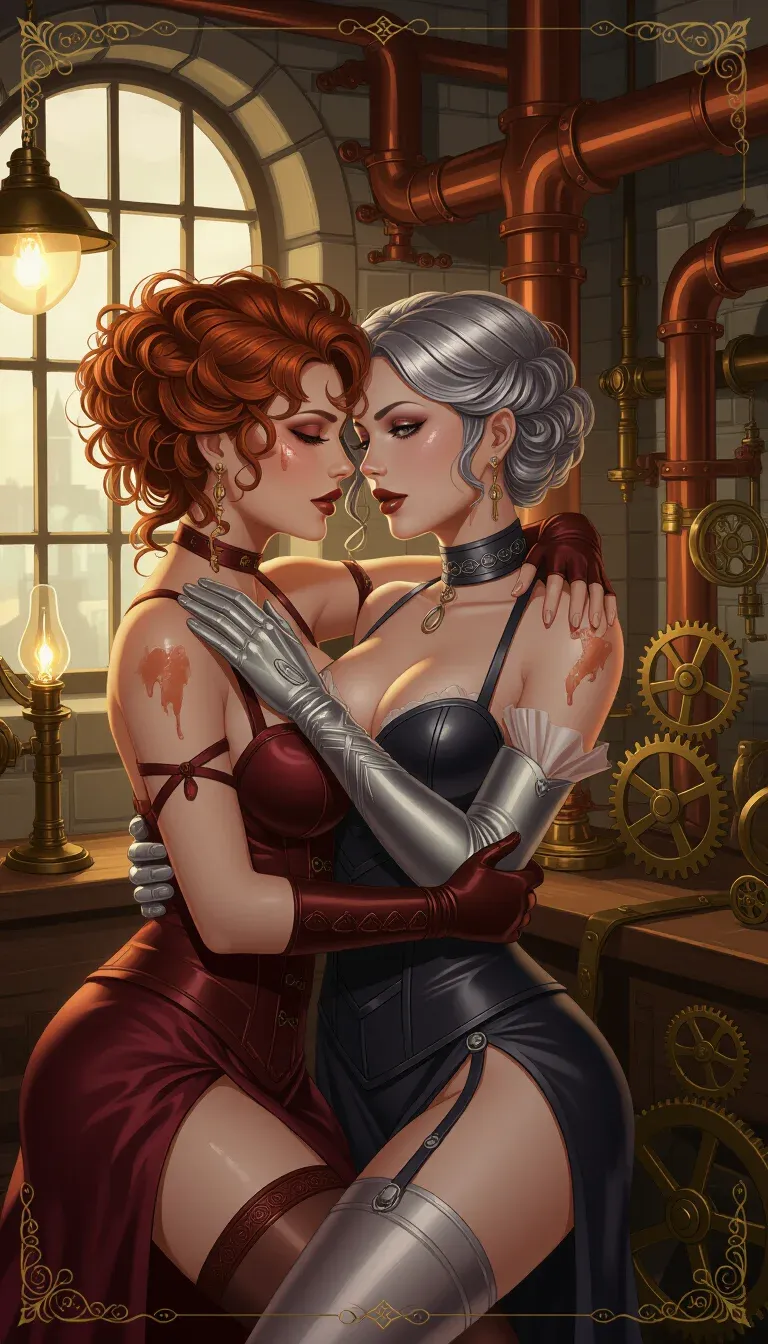
The workshop door opened on a gust of ozone and rain. Vira looked up, a warm greeting on her tongue, and it died there. The woman in the doorway was elegance made of steel and shadow, her storm-grey eyes sweeping the cluttered space like a general surveying a battlefield. Vira’s pulse hammered in her throat, a frantic, unfamiliar rhythm. It wasn't fear. It was the sudden, gut-deep clench of a challenge she hadn't known she was waiting for.
The woman stepped inside, the door clicking shut behind her. Raindrops beaded on the shoulders of her tailored grey coat, and the scent of the storm clung to her, cutting through the workshop’s warm smells of oil and hot brass. She didn’t speak. Her gaze traveled over the half-assembled automaton on the main bench, the sketches pinned to corkboards, the delicate clockwork songbird Vira had built for the mayor’s daughter. The silence stretched, thick and charged.
“You’re Virsieras Locke.” The woman’s voice was cool, precise, a calibrated instrument. It wasn’t a question.
Vira wiped her hands on her leather apron, leaving new smudges on the worn material. She forced a smile, the one she used for skeptical investors. “Most people call me Vira. And you’ve got me at a disadvantage.”
“Seraphina Vale.” The name was offered like a business card. Seraphina’s eyes finally settled on Vira, and the inventor felt the assessment like a physical touch. “I’ve come from the Foundry District. I understand you’re the one to see about the municipal ventilation project.”
“The—yes.” Vira’s mind, usually a whirl of three ideas at once, focused to a single, sharp point. The Foundry District was miles out, a place of brutal industry and cutthroat contracts. “The council opened the bids to out-of-town innovators. I didn’t think anyone would actually…”
“Travel all this way?” Seraphina finished, a ghost of a smile touching her lips. It didn’t reach her eyes. “Where there’s a prize, Miss Locke, there are competitors. Your designs for the filter system are… charmingly optimistic.”
The word ‘charming’ landed like a slap. Vira’s competitive streak flared, hot and immediate. She crossed her arms, the gesture pushing her tools into her ribs. “Optimism has a function. My designs prioritize clean air for the tenements. Not just efficiency for the factory floors.”
“A noble sentiment.” Seraphina drifted closer to the workbench, her gloved finger hovering over the exposed brass heart of the automaton. She didn’t touch it. “Sentiment, however, is a poor lubricant for machinery. My design extracts thirty percent more particulate matter with half the coal consumption. The council’s purse-strings tend to listen to that language.”
Vira watched her. The perfect posture, the calculated movements. This wasn’t just a business call. This was a declaration. “Why come here, then? To gloat?”
“To see.” Seraphina turned her head, her storm-grey eyes locking onto Vira’s. “The famous Locke workshop. The legacy of altruistic invention. I wanted to see the environment that produces such… heartfelt work.”
There was something in the way she said ‘Locke.’ A weight. A familiarity that shouldn’t be there. Vira’s hidden loneliness, the one she buried under gears and goodwill, stirred uneasily. “You know my family’s name.”
“Everyone in the engineering circles knows the name Locke.” Seraphina’s answer was smooth, practiced. Too smooth. She finally moved, stepping around the bench, closing the distance between them. The scent of ozone grew stronger. “Your father’s work on atmospheric pressure differentials was groundbreaking. For its time.”
Vira stood her ground, her heart pounding against her ribs. The woman was taller. The lamplight caught the silver threads in her dark hair, the sharp line of her jaw. This close, Vira could see the faint, pale line of a scar tracing her temple, disappearing into her hairline. A story she hadn’t told. “His work saved lives. It still does.”
“It created dependencies.” Seraphina’s voice dropped, becoming almost intimate in the cluttered quiet. “A town relying on one family’s kindness is a town on borrowed time. Systems need to be self-sustaining. Ruthless. Not… charitable.”
The critique felt personal, an attack on the core of who Vira believed herself to be. The heat in her chest wasn’t just anger now. It was a wild, terrifying fascination. “And you’re here to be the ruthless new system.”
“I’m here to win.” Seraphina’s gaze dropped to Vira’s mouth, then back to her eyes. The scrutiny was unbearable. Exhilarating. “But I do admire your passion, Miss Locke. It’s a potent fuel. Just… unfocused.”
Vira’s breath caught. The workshop, her sanctuary, felt like a cage suddenly too small for the two of them. The steady tick-tick-tick of the unfinished clockwork heart on the bench marked the seconds of the silence that stretched between them, taut as a wire.
Seraphina took one final, slow look around, her expression unreadable. Then she gave a slight, almost imperceptible nod, as if some internal calculation was complete. “I’ll see myself out. We’ll be seeing more of each other, I expect. The council meets to decide next week.”
She turned, her coat whispering against the edge of the bench. Vira didn’t move. She watched the rival inventor walk back to the door, every step measured and sure. Seraphina paused with her hand on the latch, the rain still streaking the window behind her. She glanced back over her shoulder, her profile sharp against the grey light.
“Do clean your filters, Miss Locke,” she said, her voice cool and clear. “The air in here is practically sentimental.”
Then she was gone, leaving the door ajar, the smell of ozone and cold rain lingering in her wake. Vira stood frozen in the center of her workshop, the echo of the woman’s presence clinging to the air, more tangible than any blueprint. The clench in her gut hadn’t eased. It had deepened, solidified into a hard, hungry knot of want and war. She looked at her hands, stained with copper and oil, and for the first time, they felt like the hands of a stranger.