
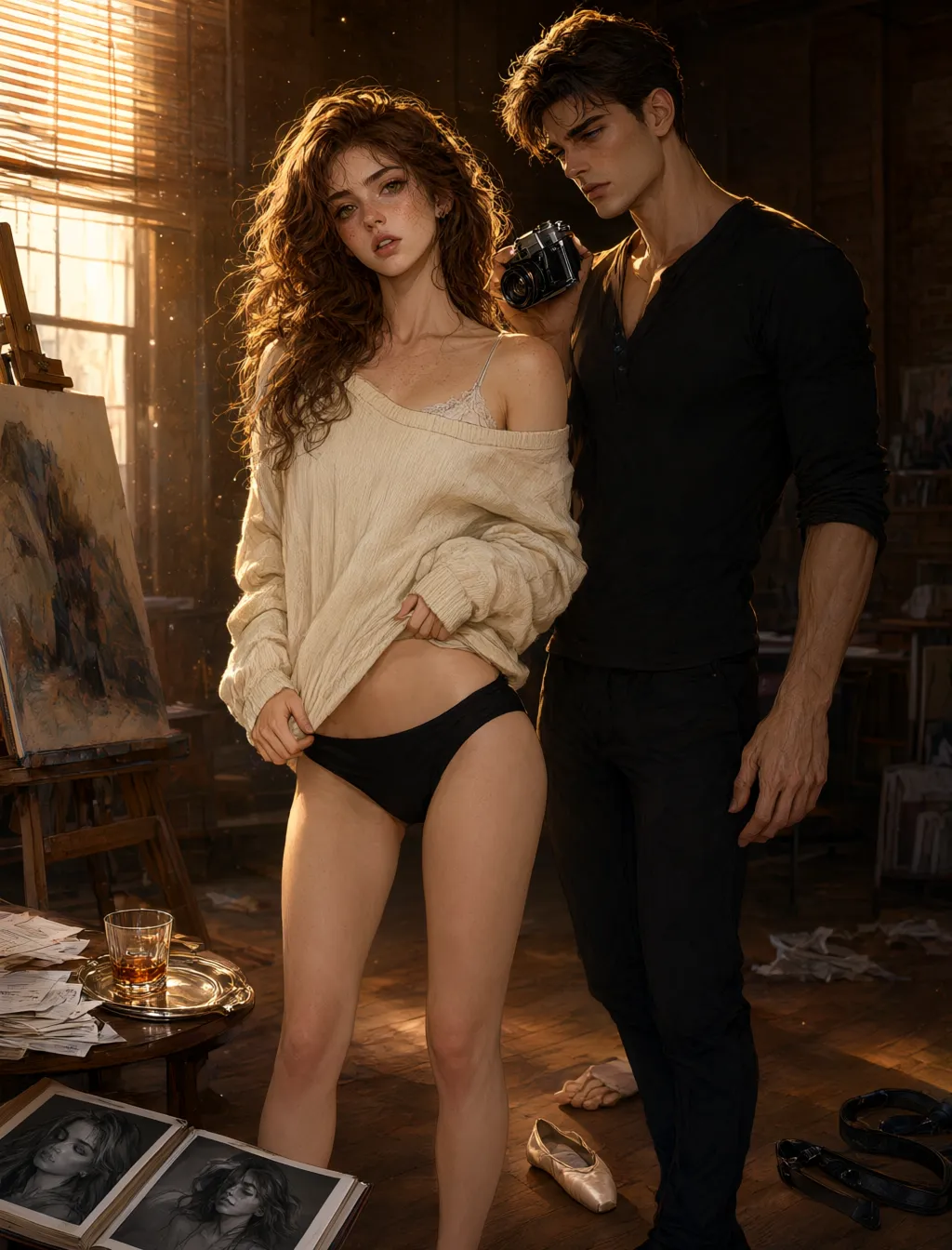
The knot in the sash had gone damp from my palm. I could feel it—the twisted fabric, the way it had coiled into a tight little fist between my fingers, the same way my stomach had coiled the moment I walked through the door. The Persian rug was soft under my bare feet, its pattern faded in places, the deep reds and golds worn thin by years of other people standing exactly where I was standing. Other people who had probably not been about to do what I was about to do.
The overhead light was warm. Almost too warm. It pressed down on my shoulders like a hand, and I could smell the hot lamps, that faint metallic burn, and underneath it the leather of the camera bag and something else—something clean and sharp, like the air before a storm.
Marcus wasn't looking at me.
He was adjusting the camera on its tripod, his fingers moving with a kind of slow precision that made me think of a surgeon. Or a man defusing a bomb. His head was tilted, dark hair catching the light, and I watched the way his shoulders moved under the black of his shirt—steady, unhurried, like he had all the time in the world and I had all the time in the world and neither of us had anywhere else to be.
My fingers twisted the sash again.
The robe was thin. I'd bought it at a thrift store two days ago, pale blue, the kind of thing that belonged on someone's grandmother. It had been the cheapest thing I could find that wasn't a towel, and now it felt like a costume. Like armor made of paper. The fabric brushed against my bare legs every time I shifted my weight, and I was acutely aware of everything it was supposed to be hiding.
The silence stretched.
I'd expected him to say something. To fill the space with instructions, with reassurance, with the kind of smooth professional patter I'd read about in articles about modeling. But Marcus just stood there, one hand resting on the camera body, his thumb absently stroking the shutter button, and let the quiet do its work.
It was worse than talking. The quiet made room for the thoughts I'd been trying to keep at bay.
The overdue notice on my kitchen table. The red PAST DUE stamp, so dark it was almost brown. I'd read it so many times I had it memorized—the date, the amount, the threat of further action printed in smaller type at the bottom, as if the smaller type made it less real.
My mother's prescription bottle, orange plastic, sitting on the counter next to the toaster. The label was starting to peel at the corner. I knew the dosage by heart. I knew what it cost to refill, and I knew I didn't have it.
I knew a lot of things I didn't want to know.
"Elara."
His voice was low, measured, like he was testing the weight of my name before he let it go. I looked up. His eyes met mine—blue, cold, the color of winter sky, and I felt something shift in my chest. Not fear. Something closer to recognition.
"Whenever you're ready," he said.
Not a question. Not a demand. Just a statement, hanging in the warm air between us.
My fingers tightened on the sash.
I'd done this before, I reminded myself. The clothed session, three weeks ago. He'd been professional then. Distant, almost. He'd told me where to stand, how to angle my chin, where to put my hands. He'd praised my collarbones like they were architectural features, and I'd felt something flutter in my stomach that I'd told myself was just nerves.
This was different.
This was the same studio, the same man, the same camera—but the robe between us changed everything. It was a line I hadn't crossed yet. A door I hadn't opened.
And the money. God, the money.
I'd done the math on the bus ride over. Triple the fee. Triple. It would cover the rent. The prescription. The groceries I'd been pretending I didn't need. It would buy me a month, maybe two, and in a month maybe I'd figure out something else, some other way to keep the plates spinning.
Or maybe I wouldn't. Maybe I'd be back here, in this studio, with this robe and this light and this man with his cold blue eyes, and I'd have already crossed the line so many times it wouldn't feel like a line anymore.
The thought should have frightened me. Instead, it sent a small, hot pulse through my stomach.
I pushed it down.
"Can I—" My voice came out thin. I cleared my throat. "Can I ask you something first?"
He tilted his head. The gesture was almost animal—a predator listening to something in the underbrush. "Of course."
"Why me?" I asked. "You could have hired anyone. Someone who's done this before. Someone who wouldn't be standing here like a—" I gestured vaguely at myself, at the robe, at the whole ridiculous situation. "Like this."
Marcus's mouth curved. Not quite a smile. Something smaller and more contained. "Because you're not someone who's done this before."
I blinked. "That's the reason?"
"That's the reason." He stepped closer, and I felt the air change around me. Not threatening. Just present. Just aware. "I don't want someone who poses on autopilot. I want someone who's still deciding. Someone who's still feeling it." His eyes moved over my face, studying me like I was a photograph he was trying to read. "You're still deciding, aren't you?"
I swallowed. "I'm standing here."
"That's not the same thing."
No. It wasn't. I was standing here in a thrift-store robe on a worn Persian rug with my fingers twisted in the sash, and I still could have walked out. I still could have said I changed my mind. The money would vanish, and the overdue notice would still be on my kitchen table, and my mother's prescription bottle would still be sitting on the counter, but I could walk out.
I could.
My fingers were shaking. I could feel the tremor in them, small and insistent, like a second heartbeat. I pressed my palm flat against my thigh to still it, and the robe shifted against my skin, and I felt the cool air slide up my leg.
Marcus didn't look away.
"You're thinking about something," he said. "Something that isn't this room."
I almost laughed. Almost. "I'm thinking about my kitchen table."
He waited.
"There's a notice on it," I said. "An overdue notice. Red stamp. PAST DUE, like it's a verdict." I was talking too fast, the words spilling out of me like water through a crack in a dam. "And there's a prescription bottle on the counter. My mother's. She needs it. I can't afford to refill it, and I can't afford not to, and I've been doing the math in my head for three weeks, trying to find a way to make it work, and there isn't one. There isn't a way. This is the way."
I stopped. My chest was tight, and I realized I'd been holding my breath.
Marcus was still looking at me. His expression hadn't changed—still calm, still patient, still that same careful attention, like I was a subject he was learning to frame.
"That's a lot to carry," he said.
I nodded. I couldn't trust my voice.
"It doesn't have to be carried alone."
Something in my chest loosened. Just a little. Just enough to let me breathe.
"I know you're not doing this because you want to," he said. "Not the way you'd want a vacation, or a new dress. You're doing it because you need to. And there's no shame in that." He paused, and his voice dropped, just a fraction. "But I want you to know that what happens in this room is yours. You're in control. You can stop at any time. You can say no. You can walk out that door, and I'll still pay you for the session we already did, and you'll never hear from me again."
He said it simply. Matter-of-factly. Like he was telling me the weather.
And somehow that made it real.
"Why would you do that?" I asked. "Why would you pay me for nothing?"
"Because you showed up," he said. "That's not nothing."
I stared at him. The light from the hot lamp cast a sharp pool on the scuffed wood floor, and he was standing just outside it, half in shadow, his face unreadable. But his eyes—his eyes were steady on mine, and I believed him.
I don't know why. Maybe because there was nothing in his voice that wanted anything from me. Maybe because he'd given me an out and meant it. Maybe because I was so tired of carrying everything alone that the offer itself felt like a hand reaching out in the dark.
I took a breath.
Then I let go of the sash.
The knot had come loose somewhere in the middle of my confession. I hadn't noticed. But now the fabric was falling open, and I felt the cool air slide across my collarbones, down my chest, across my stomach. The robe slipped from my shoulders—just an inch, just enough to bare the first pale curve of skin—and I heard my own breath catch.
The air was warm. The light was warm. Everything in this room was warm except the space between us, which felt electric and cold and alive.
I didn't close the robe.
I looked at Marcus. His hand was on the camera, and I saw his thumb move—a small, almost imperceptible shift, hovering over the shutter button. Ready. He was ready.
And I was still deciding.
The robe hung open at my chest, the fabric caught on my shoulders, and I could feel the weight of his gaze like a physical thing. Not heavy. Not demanding. Just present. Just aware. He was looking at me the way he'd looked at my collarbones in the clothed session—like they were something worth studying. Worth capturing.
Worth keeping.
"You don't have to look away," he said, and his voice was softer now, almost gentle. "You're not doing anything wrong."
I knew that. I knew it in the logical part of my brain, the part that could recite the facts: I was an adult. I was consenting. I was being paid a fair wage for difficult work. There was nothing wrong about any of it.
But the other part of me—the part that had never been naked in front of anyone, that had spent twenty-two years hiding her body under oversized sweaters and careful angles—that part was screaming.
I let the robe fall.
It was a small thing. A simple thing. The fabric slid off my shoulders and pooled at my feet on the worn Persian rug, and suddenly I was just standing there. Bare. Exposed. Every inch of skin I'd spent my whole life covering was open to the warm air, open to the sharp white light, open to his gaze.
I didn't close my eyes. I didn't turn away.
I looked at him.
And Marcus looked at me.
His expression didn't change. His eyes didn't widen. But I saw his throat move—a small swallow, the only crack in his composure—and I felt something shift in the room. Something that had been building since I walked through the door.
"Beautiful," he said, and the word was quiet, almost reverent. "Just stand there. Don't move."
I didn't move.
His thumb pressed down on the shutter button.
The click was sharp and final, cutting through the warm air like a stitch. And in that instant, I felt something leave me—a weight I hadn't known I was carrying. The overdue notice. The prescription bottle. The math I'd been doing in my head for weeks. All of it, suspended in that single moment of sound.
The first image of my bare body, captured before I could change my mind.
And I was still standing there, still breathing, still alive.
The shutter clicked again.
My bare foot slid across the rug, and the worn fibers felt rough against the arch. I nudged the fallen robe aside with my toe—pale blue fabric pooling like a shed skin—and took one step forward.
The light hit me differently there.
Under the lamp's pool, the warmth was closer, more intimate, like standing inside someone's breath. I could feel it on my shoulders, on the tops of my feet, on the soft plane of my stomach. Every inch of bare skin was awake, alert, registering the air in a way I'd never felt before. I'd been cold in my own bedroom with the windows open in winter. I'd been hot on the subway platform in July, pressed between strangers. But I'd never felt the air like this—like a garment I was wearing instead of a thing I was moving through.
My hands hung at my sides, and I didn't know what to do with them.
I'd seen photographs of models, of course. I knew the poses—the hand on the hip, the arm crossed under the breasts, the fingers raking through hair. But those were performances. Scripted. I had no script now. I had only this body, this light, this man watching me through a lens.
"Your hands," Marcus said. "Let them relax. Don't pose them."
I tried. I let my fingers go loose, and they felt enormous, dangling at the ends of my arms like things I'd forgotten I owned.
"Good," he said. "Now look at me."
I did. His blue eyes were steady behind the camera, and I could see the way his thumb hovered over the shutter—waiting, patient, ready.
"I'm going to take a few," he said. "Don't think about them. Just stand there."
The click came, sharp and clean.
Another.
A third.
I stood there, and the strangest thing happened: nothing happened. The world didn't end. The light didn't turn harsh. My body didn't betray me. I was just standing, bare, in a pool of warm light, and the man behind the camera was doing his job.
My shoulders loosened. Just a fraction. Just enough to notice.
"There," Marcus said, and his voice had a thread of something new in it—approval, maybe. "That's better. You're not holding yourself anymore."
I hadn't known I was holding myself. But the moment he said it, I felt the difference. My spine had been braced, my ribs locked, my jaw tight. Now something had given way, and I was just... standing. Existing. Taking up space in my own skin for the first time in as long as I could remember.
"Turn your head to the left," he said. "Slowly."
I turned. The light caught my profile, and I felt the heat of it on my cheekbone, my neck, the curve of my ear.
"Good. Now back to me."
The click again. I was beginning to hear the rhythm of it, the way he worked—a pause, a study, a click. Like a heartbeat with a camera for a pulse.
"You're doing well," he said. "Better than I expected."
I felt a flush climb my chest. It wasn't embarrassment. It was something else—a warmth that had nothing to do with the lamp. "What did you expect?"
He lowered the camera a few inches, just enough to look at me directly. "I expected you to be more nervous."
"I am nervous."
"You're hiding it better than most."
The compliment landed somewhere unexpected—low in my stomach, a small flutter. I told myself it was just the nerves, just the novelty of being looked at like this.
"Can I—" I started, then stopped. The question felt too big, too fragile.
He waited. He was good at that, I realized. Waiting. Giving me the space to fill or not fill.
"Can I see?" I asked. "One of them?"
His expression didn't change, but something in his posture shifted—a small tilt of his head, a considering look. "Not yet."
"Why not?"
"Because you'll start judging yourself before we're done." He lifted the camera again, and I felt his gaze return to me through the lens. "You'll see the things you don't like instead of the things I'm seeing."
"And what are you seeing?"
He didn't answer right away. The shutter clicked, and I felt the sound in my chest.
"I'm seeing a woman who's been hiding for a long time," he said. "And I'm watching her decide to stop."
My breath caught. The words went through me like a current, lighting something I hadn't known was wired.
"I'm not—" I started, then stopped. What was I going to say? I'm not hiding? I'd spent twenty-two years doing exactly that. Oversized sweaters. Downcast eyes. Crossing my arms over my chest in every conversation, every photograph, every moment of being perceived.
And now here I was. Bare. In front of a man I barely knew. In front of a camera that was recording every inch of me for posterity.
"You are," he said, as if he'd heard my thought. "But you're also standing here. That's not nothing."
The shutter clicked again.
"I want you to do something," he said. "Put your hands on your hips."
I did. My palms settled on the jut of my hipbones, and I felt the pose change everything—the angle of my shoulders, the lift of my chest, the way my spine curved. It felt less like hiding and more like presenting. Like I was offering myself to the camera instead of waiting for it to take.
"Good," he said. "Now hold your head up. Chin level."
I lifted my chin, and the light caught my throat, and I felt exposed in a different way. Not vulnerable. Something closer to powerful.
"There," he said. "That's it."
The camera clicked, and I felt the image land—not on film, but in me. A version of myself I'd never met. A woman with her hands on her hips and her chin raised, standing in the light like she belonged there.
"You're a natural," Marcus said, and his voice had shifted again. The clinical distance was thinning. There was something warmer underneath it, something almost personal.
"I'm not," I said. "I'm just following directions."
"That's all modeling is. Following directions until you forget you're following them." He lowered the camera, and his eyes met mine without the lens between us. "And you've forgotten."
I blinked. He was right. At some point in the last few minutes, I'd stopped thinking about what I looked like, stopped worrying about whether I was doing it right. I was just in my body, in the light, in the room.
It was the most present I'd felt in months.
"I want to try something," he said. "You can say no."
"What is it?"
"Turn around. Face away from me. Look over your shoulder at the camera."
My heart stuttered. The pose felt like a threshold—more revealing than standing front-facing, somehow. More deliberate. It was the pose of a woman who knew exactly what she was showing and why.
But I'd already come this far. The robe was on the floor. The first images were already taken. What was one more pose?
I turned.
The light hit my back, warm on my shoulder blades, the curve of my spine. I felt it slide down my sides, over my hips, and I was acutely aware of the parts of me I couldn't see—the vulnerable length of my back, the soft curve of my rear, the way my shoulder blades moved under my skin.
"Now look back," he said.
I turned my head. My hair swung across my shoulder, and I found his eyes through the lens, and something in the room changed.
The click came slower this time. Deliberate. Like he was savoring the frame.
"Beautiful," he said, and the word had more weight than it had before. Less clinical. More personal.
I should have felt embarrassed. I should have wanted to cover myself. But instead I felt something else—a pull, low and warm, like a current running under the floorboards of my ribs.
"Hold that," he said. "Don't move."
I held it. My neck was beginning to ache from the angle, but I held it, because his voice had gone soft and focused, and I wanted to stay in that focus. I wanted to be seen like this.
The click again. Another. Another.
And then he lowered the camera, and his eyes met mine, and I saw something in them that hadn't been there before.
Not hunger. Something quieter. Something like recognition.
"You can turn back around," he said.
I turned, and the front of my body met the light again, and I felt the shift—the exposure of it, the vulnerability. I'd gotten used to the back view. The front felt like a new confession.
Marcus was looking at me with the camera still lowered, and I could see his throat move again—that small swallow I'd caught earlier.
"You're doing beautifully," he said. "I want to try one more thing."
"Okay."
"I want you to close your eyes."
I blinked. "Why?"
"Because you're still watching yourself." He stepped closer, and I felt the air change again—that electric charge I'd noticed when he'd first approached. "You're still monitoring. Still checking. I want you to stop."
"I don't know if I can."
"Try."
I closed my eyes.
The world went dark, and suddenly I was only a body—the heat of the lamp on my skin, the rough fibers of the rug under my feet, the sound of my own breathing. I could hear Marcus's footsteps as he circled me, slow and deliberate, and I felt his presence like a pressure on my skin.
"Good," he said, and his voice was closer now. "Now I want you to remember why you're here."
The overdue notice. The prescription bottle. The math I'd done on the bus.
"I want you to let that go," he said. "Just for this moment. You're not a debt. You're not a daughter. You're not a student. You're just a woman standing in the light."
I felt something loosen in my chest. A knot I'd been carrying so long I'd forgotten it was there.
"And I want you to know," he said, his voice dropping to something almost intimate, "that you're the most beautiful thing I've photographed in years."
My eyes opened.
He was standing closer than I'd expected—close enough that I could see the flecks of darker blue in his irises, the faint lines at the corners of his eyes. The camera was at his side, forgotten.
His thumb hovered over the shutter button.
And I felt the moment stretch between us, elastic and alive, full of something I couldn't name.