
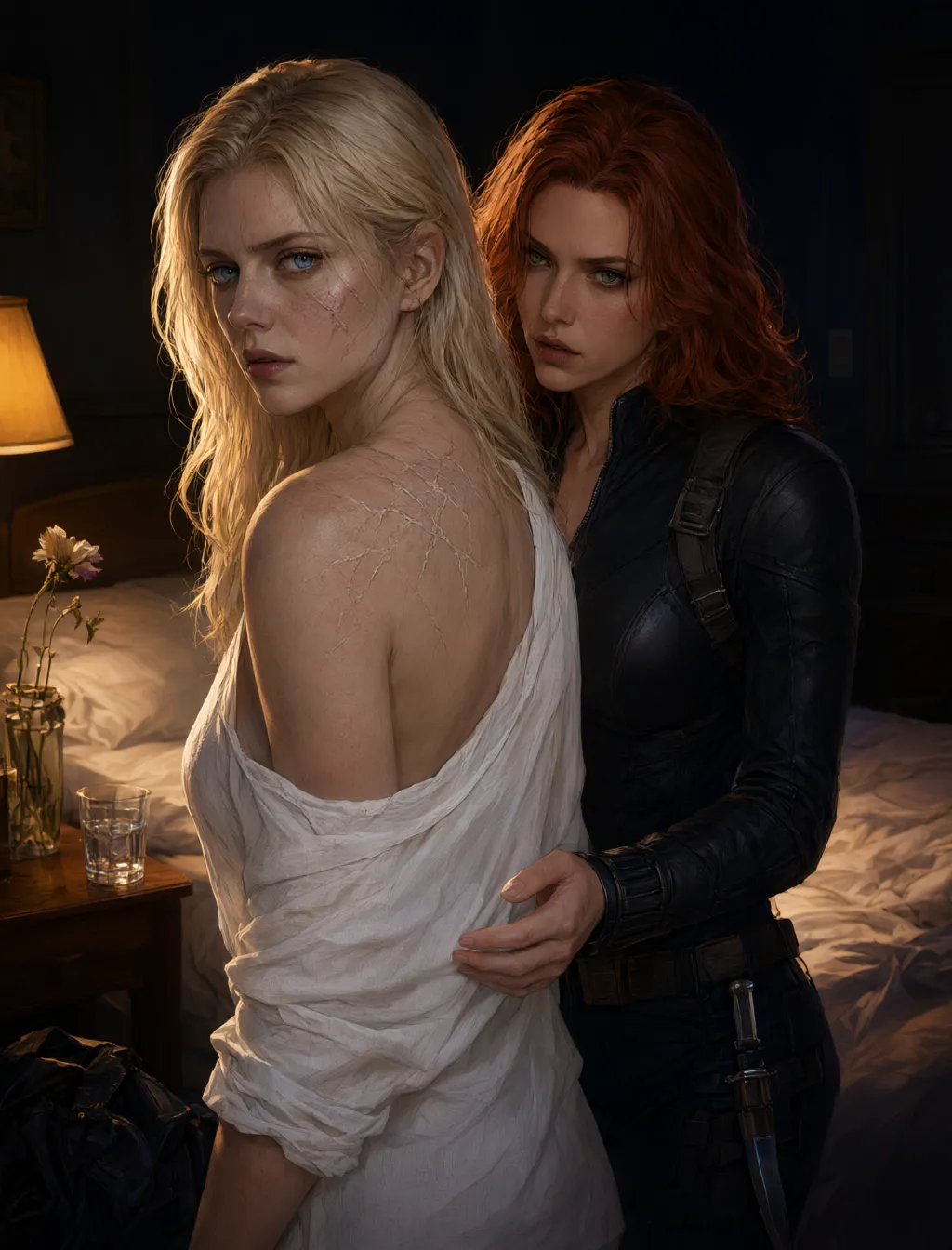
I smell it before I see it. The oil. Hot and sharp, the way it cuts through air when it hits a pan. My feet stop. My body knows something my brain hasn't caught up to yet. The corridor continues ahead of me but I'm not moving anymore, I'm standing in a doorway that frames a kitchen I've never seen, and the smell is crawling under my skin.
Behind me, Natasha's footsteps stop too. She doesn't ask. Not yet. She's learning the shape of my silences.
I can see the stove from here. A woman stands at it — dark hair, broad shoulders, a vibranium arm glinting under the fluorescent lights. She's at the counter, her back to me, cracking eggs into a bowl with one hand. The burner is lit beneath a skillet. Blue flames. Small. Steady. The oil shimmers as it heats, and my hand finds the doorframe before I tell it to.
The wood groans under my fingers.
I don't mean to press that hard. I don't mean to do a lot of things my body does now. My grip tightens and I hear the frame complain, a low creak that travels through my palm and up my arm, and I still can't make myself let go.
Blue flames. A woman in a lab coat. A room with no windows and a drain in the floor.
We need to test the upper threshold. Hold still.
—
"Sigrun."
Natasha's voice is quiet. Close. She's beside me now, not touching, but present. A wall of heat at my side that I could lean into if I trusted myself not to shatter.
"You don't have to go in." She says it like it's a fact. Simple. No pressure. "We can go somewhere else. Find food later."
I should say yes. I should turn around and walk back down that white corridor and find a room with no smells and no flames and no memories pressing against the inside of my skull like they're trying to split it open.
But my stomach is hollow. Not the hunger of a missed meal — the deep, bone-aching emptiness of a body that's been running on adrenaline and survival for hours, and now the adrenaline is fading and there's nothing left underneath.
And Natasha's hands were gentle with the whisk. I saw that. Through the doorway, before the smell hit me, I saw the way she handled the bowl, the careful, circular motion of her wrist, the way she tilted her head to keep hair out of her face. Like she was making something, not just assembling fuel.
I want to stay. The wanting surprises me.
"It's just Bucky," Natasha says, her voice dropping lower. "He's — he's not gonna crowd you. He knows what it's like to come out of a cage."
I don't ask how she knows that. I don't ask how Bucky knows that. I don't ask what cages mean to either of them, because the answer is in the way Natasha stands beside me — close enough to catch me, far enough to let me breathe.
"I know," I manage.
The word comes out rough, scraped from a throat that doesn't remember how to make small talk. My hand is still on the doorframe. The wood has stopped groaning. I ease my grip, finger by finger, until my palm is flat against the surface instead of clawed into it.
I can leave. Natasha said I could walk out of any situation, and I believe her. I believe her the way I haven't believed anyone since I was twenty-two years old and walking across a campus I'd never see again.
But I want to stay. I want to prove to myself that I can stand in a room with a hot stove and a stranger and not come apart.
I take a breath. The air tastes like oil and eggs and something warm — spices, maybe, or garlic. Not antiseptic. Not blood. Not the chemical sting of a cleaning agent they used to mop the floors after each session.
The man at the counter — Bucky — hasn't turned around. I don't know if he heard the wood creak. I don't know if he's ignoring me on purpose or if he's just that focused on the eggs. Either way, I'm grateful. The not-looking feels like a gift I didn't know how to ask for.
I step over the threshold.
My boots land on tile. The kitchen is bigger than I expected — white counters, stainless steel appliances, a block of knives by the sink that I look at and then look away from because I don't want to know what I'm cataloguing them for. There's a table by the window, small, with two chairs. A pot of something green on the windowsill. A coffee mug with a lipstick stain on the rim.
Normal things. Things from a life I don't know how to touch yet.
The stove clicks — the burner adjusts, lower now — and Bucky reaches for the whisk without looking at me. "The eggs are almost done. There's bread in the toaster. Natasha said you were hungry."
His voice is low. A little rough. Like he doesn't use it more than he has to.
I don't know what to say to that. Thank you feels too small. I didn't ask for this feels too sharp. So I stand in the middle of the kitchen, my arms at my sides, and I watch the blue flame under the skillet and I try to remember how to be in a room that isn't trying to hurt me.
Natasha moves past me, slow, telegraphing her path like she's approaching a wounded animal. She reaches the counter and picks up a spatula, sliding it between the eggs and the pan with a practiced flick. "Bucky makes better omelettes than I do. I burn the cheese."
"You burn everything," Bucky says, without rancor.
"I burn everything," Natasha agrees. She glances at me — just a flicker of green, a half-smile that doesn't ask for anything in return. "But I make good coffee."
I don't drink coffee. I don't know if I've ever drunk coffee. The last four years and eight months have erased every preference I used to have, and I'm discovering them the way you discover furniture in a dark room — by walking into them.
"Water," I say. My voice is steadier now. "I'll take water."
Natasha nods, sets down the spatula, and crosses to the refrigerator. She pulls out a glass bottle, unscrews the cap, and pours it into a clean glass. No ice. She brings it to me, extending it handle-first, and waits until my fingers close around it before letting go.
She's so careful with me. I don't know what to do with that.
The glass is cool in my hands. I lift it to my mouth and drink, and the water is clean and cold and it doesn't taste like a metal cup in a concrete room, and I feel something in my chest loosen by half a turn.
"Sit," Natasha says. She pulls out one of the chairs at the small table. It scrapes against the tile and I flinch — the sound is too close to something I don't want to name — but I don't flee. I stand there, holding the water, and I watch Natasha watch me, and I see the moment she realizes what made me flinch because her jaw tightens and she sets the chair down more gently than she pulled it out.
"Sorry," she says. Not apologizing for the scrape — apologizing for not thinking. For not remembering that the world is still full of sounds I can't separate from fear.
I shake my head. It's not her fault. It's not anyone's fault except the people who put me in that room, and they're not here, and I don't know what to do with that either.
I sit down. The chair is solid beneath me. The table is wooden, scarred with the marks of other meals, other lives. I run my thumb over a shallow groove in the surface, and I think about all the people who sat here before me, eating eggs and talking about normal things, and I don't know if I'll ever be one of them but I'm sitting in their chair and that's something.
Bucky slides a plate in front of me. The omelette is golden, folded into a half-moon, with mushrooms and cheese spilling from the edges. Steam rises. The smell is warm and rich and so different from the hot oil that stopped me in the doorway that I almost don't recognize it as food.
I stare at the plate.
There's a fork beside it. Metal. I pick it up and the weight is familiar in a way that makes my stomach turn — not because the fork is wrong, but because I remember holding a fork, in a life that feels like it belonged to someone else. A girl who ate dinner in a dining hall surrounded by laughter. A girl who didn't know what a tolerance test was.
"You don't have to eat it all," Bucky says. He's leaning against the counter now, his own plate in hand, not watching me. Looking anywhere else. Giving me space I didn't ask for and desperately need. "Take your time."
Natasha sits across from me. Her plate is smaller, her omelette folded less neatly, and she picks at it without urgency. She's not rushing me. She's not watching me wait for me to perform normalcy.
I cut a piece of the omelette with the edge of my fork. It separates easily — soft, cooked through, the cheese stretching in a thin thread before it breaks. I lift it to my mouth, and I eat.
The taste hits me. Eggs, butter, salt. Mushrooms, earthy and rich. Cheese that melts on my tongue. It's so much flavor after so long of nothing — nutrient paste and protein slurry and water that tasted like metal — that my eyes sting and I have to blink hard and fast to keep the tears from falling.
I take another bite. And another. I eat like I'm afraid the plate will vanish, like someone will remember I'm not supposed to have nice things and take them away, and I can't stop myself. The hunger is a hole inside me, and I'm stuffing it full of omelette and bread and the first real food I've had in years, and I can't tell if I'm eating or if I'm crying or both.
Natasha doesn't say anything. She just pushes the butter dish closer to me, and refills my water when the glass runs low, and sits with me in the quiet while I piece myself back together one bite at a time.
When the plate is clean, I set down my fork. The metal clinks against ceramic. My hands are trembling, but I'm not sure when that started.
I look at Natasha. She's watching me now, her green eyes soft, her mouth curved into something that isn't quite a smile. She looks like someone who's been where I am — not in this kitchen, not with these scars, but in the aftermath of being unmade. She looks like someone who knows that the first meal after the cage is both a victory and a wound.
"Good?" she asks.
I nod. My voice isn't working right now.
She holds my gaze for a long moment. Then she pushes her chair back, takes my empty plate, and carries it to the sink. Bucky is already washing his own dishes, and they move around each other without colliding, two people who have learned to share space without words.
I sit at the table and I watch them, and I think about how different this is from every meal I've had in the last four years and eight months. I ate alone in a concrete cell, or I ate strapped to a table while they took notes, or I didn't eat at all because they were testing how long I could go before my body started to fail.
This is the first meal I've shared with someone who didn't want something from me.
The realization settles into my chest, heavy and warm, and I don't know what to do with it. I don't know how to hold a gift this big.
"Thank you," I say. The words come out rough, scraped, but they're mine.
Bucky glances over his shoulder. He nods — once, quick — and turns back to the sink.
Natasha dries her hands on a dish towel and crosses back to the table. She doesn't sit. She stands beside my chair, close enough that I can smell her — clean soap, a hint of something floral, the faint metallic tang of the compound's water. She's not touching me. She's waiting.
"I have a room," she says. "Guest room down the hall from mine. You can stay there tonight. No one will bother you."
I should say yes. I should take the room and close the door and sleep for the first time in a bed with sheets that don't smell like antiseptic.
I let out a breath I didn't know I was holding. My shoulders drop. My hands stop trembling.
I'm still not safe. I'm still learning how to be in a world that doesn't hurt me. But I'm not alone, and Natasha's hand brushes mine as she leads me out of the kitchen — not grabbing, not holding, just a touch that says I'm here, I'm real, I'll walk with you — and I think that might be enough for tonight.