
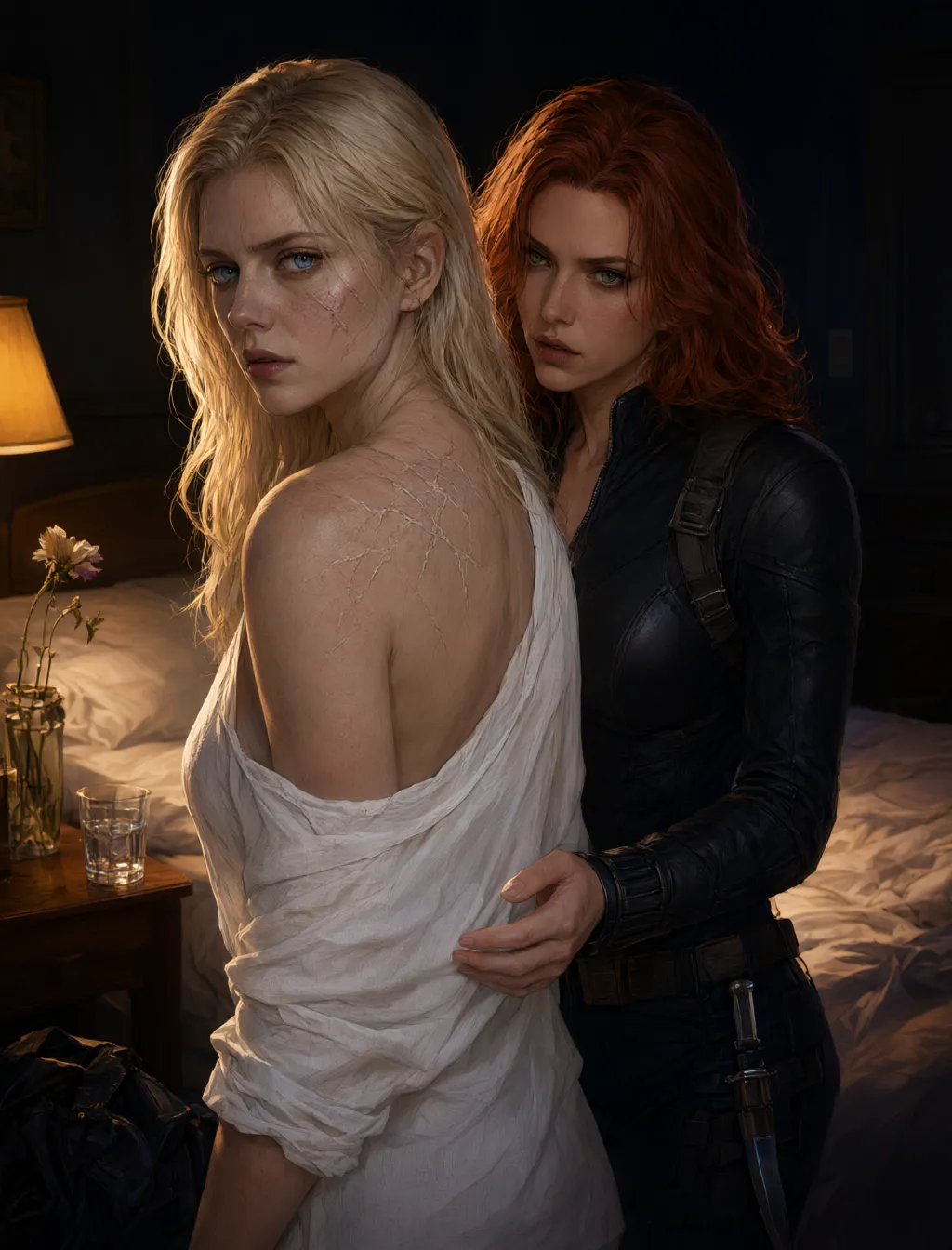
The quinjet's engines whine to life, a rising pitch that scrapes against something inside my skull. My hands find the edge of the jump seat before I know they've moved, fingers curling into the webbing until the fabric creaks. The sound—that specific hydraulic hiss as the ramp begins to lift—sends a spike through my spine so sharp I feel it in my teeth.
I've heard that sound before.
Right before the lights went out. Right before the needles came. Right before the cold metal table and the restraints that bit into my wrists and the white-hot fire that poured through my veins like molten lead, reshaping me into something that wasn't quite human anymore.
My chest locks. My lungs forget how to move.
The ramp seals shut with a thud that vibrates through the floor, and suddenly I'm in a box. A metal box. Flying. With no way out.
I force air in through my nose. Hold it. Let it out through my mouth. The serum won't let me pass out—it never does—so I have to ride this out conscious, every second of it, the way I rode out every session.
Natasha is across from me. She hasn't moved. Hasn't spoken. She sits with her back to the cockpit bulkhead, legs apart, elbows resting on her knees, hands loose and open. The posture of someone who isn't ready to fight. The posture of someone who wants you to see that they're not a threat.
I don't trust it. But I don't have the strength to mistrust it either.
She watches me. Not staring—watching. Staring is a demand. Watching is a waiting. She's waiting to see what I need before she offers it.
The engines deepen as we lift off, and my stomach drops. I've been in the air before. Once. The day they took me. The day the van doors closed and the floor tilted and I never saw sunlight again until four hours ago.
"The door stays unlocked the whole flight."
Her voice cuts through the spiral. Low. Even. No honey in it—just fact.
I blink at her. My jaw is clenched so tight my teeth ache.
"You can stand by it if you need to," she adds. "Put your hand on the release. Feel that it opens. You don't have to sit here with me."
The words land somewhere behind my ribs. A key turning in a lock I didn't know had a keyhole.
I don't move. Can't. My body is still locked in the memory of the sound, the hiss, the dark. But the words are there now, a small warm thing in my chest, and I hold onto them like a lifeline.
The quinjet levels out. The vibration settles into something almost steady. Through the small window beside me, I can see clouds—actual clouds, white and soft and impossibly distant. I haven't seen clouds in four years and eight months. Haven't felt wind on my face. Haven't stood under an open sky.
I don't know how to hold that much beauty. It hurts to look at.
"We have about forty minutes to the compound," Natasha says. She's not looking at me now, which helps. She's looking at her hands, turning a small piece of metal between her fingers—a coin, maybe, or a washer. Something to do with her hands. "You can sleep if you want. There's a blanket in the compartment behind you. Water in the cooler by my foot."
I don't want to sleep. Sleep is where the needles find me again.
But I'm thirsty. The water she gave me in the hallway is gone, and my throat feels like paper.
I look at the cooler. It's close to her. I'd have to reach past her space to get it.
She follows my gaze and doesn't move. Doesn't offer to get it for me. Just waits.
The choice is mine. That's what she's giving me. Not the water—the choice.
I uncurl my fingers from the webbing. My hands are shaking. I can't stop them. But I lean forward, one inch, then another, until I can reach the cooler. My fingers close around a bottle of water. I pull it back to my seat.
The cap is sealed. I have to twist it open. It takes three tries because my hands won't stop trembling.
I drink. The water is cold and clean and it hurts going down, like my throat forgot how to swallow. But I get it down. One sip. Another. I stop before I finish it—some old instinct from the facility, never finish what you're given because you don't know when the next will come.
I cap the bottle and hold it in my lap. Both hands wrapped around it. Something solid.
"Good," Natasha says quietly. Not a reward. Just an acknowledgment. "You did good."
I don't know what to do with that either.
The silence stretches. It's not uncomfortable. It's the kind of silence that has room in it—room for me to breathe, to think, to not have to perform anything for anyone.
I watch her hands. The way she rolls the coin across her knuckles, a fluid motion that speaks of years of practice. The way her eyes track the movements of the cockpit crew through the open door without seeming to. She's alert without being tense. Ready without being afraid.
I used to know how to do that. Before.
"What happens when we land?" The words come out rough, scraped raw by disuse. I haven't asked a question in four years. Haven't had a reason to.
Her fingers stop moving. She looks up at me, and there's something in her eyes that I can't quite name. Not pity. Something else.
"Medical evaluation," she says. "Basic vitals, blood work, a physical exam. Then a room. Food. Clothes that fit." She pauses. "You'll be asked questions. About the facility. About what they did. About what you can do."
I feel my spine stiffen. The questions. The questions are always the beginning of the needles.
She must see something in my face, because she adds, "You don't have to answer anything you don't want to. Not today. Not tomorrow. Not ever, if that's what you choose. But they'll ask."
"And if I don't answer?"
"Then you don't answer." She shrugs, a small economical movement. "I'll be there. I'll make sure they don't push."
The promise lands hard. I don't know if I believe it—I don't know how to believe anything anyone says anymore—but the fact that she offered it, unprompted, without me having to ask or beg or barter...
I look down at the bottle in my hands. My knuckles are white. The silver scars on my wrists catch the light, raised and pale against my skin. I used to try to hide them. Now I don't have the energy.
"The medical exam," I say. My voice is barely a whisper. "Will there be needles?"
The silence that follows is heavy. I can feel her looking at me, but I can't meet her eyes. Can't let her see what that word does to me.
"Not if you don't want them." Her voice is careful. "I'll make sure they use non-invasive methods wherever possible. And if they need blood, they'll explain why, and you'll say yes or no, and no one will hold you down."
No one will hold you down.
I don't realize I've stopped breathing until my lungs burn. I force air in. Out. In.
"I mean it, Sigrun." Her voice drops, softer now, almost intimate. "I gave you my word in that hallway. No one touches you without your permission. That includes doctors. That includes needles. That includes me."
I look up at her then. Really look. At the red hair pulled back from her face. At the green eyes that have seen too much—I can see it in them, the weight of things done and things witnessed. At the set of her jaw, which holds no softness, no pity, just a hard, quiet certainty.
She means it. I don't know how I know, but I do. She means every word.
The knot in my chest loosens a fraction. Not enough to let me breathe easy. But enough to let me breathe at all.
"Okay," I say. The word feels strange in my mouth. A word of agreement. A word of trust. I haven't spoken it in years.
She nods once. Then she goes back to rolling the coin across her knuckles, giving me space, giving me time.
I turn to look out the window again. The clouds are thinning. Below them, I can see the earth—green and brown and blue, patches of forest and fields and water, all of it real and solid and alive. I press my palm against the cold glass and feel the vibration of the engines through my fingertips.
I'm above the world. I'm free. I'm flying.
The thought should be exhilarating. Instead it's terrifying, because freedom means choices, and I've forgotten how to make them. But maybe—maybe I can learn again. One choice at a time.
The bottle of water in my lap. The unlocked door. The woman across from me who hasn't touched me once, but hasn't left me alone either.
I take another sip. The water is still cold. Still clean. I finish the bottle and set it on the floor beside me, empty.
Twenty minutes later, the quinjet begins its descent. The engines shift pitch, and my body remembers the sensation of falling before we're actually falling, and I grip the webbing again. But this time, I don't lock up. This time, I breathe through it.
Natasha stands as the landing gear deploys, moving to the cockpit door to speak to the pilot. She's steady on her feet, compensating for the tilt without thinking about it. I watch her balance, the way her body knows how to move in a moving space.
I used to have that. Coordination. Grace. The surety of a body that knew its limits. Hydra took that too—not the ability, but the confidence. I don't know anymore what my body can do without breaking.
She looks back at me. "We're landing. Stay seated until the ramp opens, then follow me. I'll take you to medical myself."
I nod. The gesture feels mechanical, but it's enough.
The quinjet touches down with a jolt that rattles through my spine. The engines reverse, screaming, and then slowly wind down to a hum. The ramp hisses—I flinch, hard, but catch myself—and begins to lower, letting in light and air and the smell of something green and alive.
I stand on legs that don't want to hold me. My knees lock. My hands find the wall. But I stand.
Natasha is at the top of the ramp, waiting. She doesn't reach for me. Doesn't hurry me. She just stands there, silhouette against the afternoon sun, and waits.
I take a step. Then another. My boots hit the metal ramp, and then I'm at the edge, looking out at a compound of glass and steel and concrete, set against a backdrop of trees and hills and sky.
The air hits me—real air, moving air, carrying the smell of grass and dirt and something floral I can't name. It's overwhelming. I breathe it in until my chest aches.
Natasha is a few feet ahead, walking backward, watching me. She's not smiling. But there's something soft at the edges of her eyes, a crack in the assassin's facade, and it's the most human thing I've seen in years.
"Welcome to the Avengers compound," she says. "It's not much. But it's safe."
Safe. I don't know what that word means anymore. But I want to learn.
I step off the ramp onto solid ground, and the weight of everything I've survived settles behind me like a shadow I can't quite shake. But I'm standing. I'm breathing. I'm here.
And for the first time in four years and eight months, I think I might want to stay.