
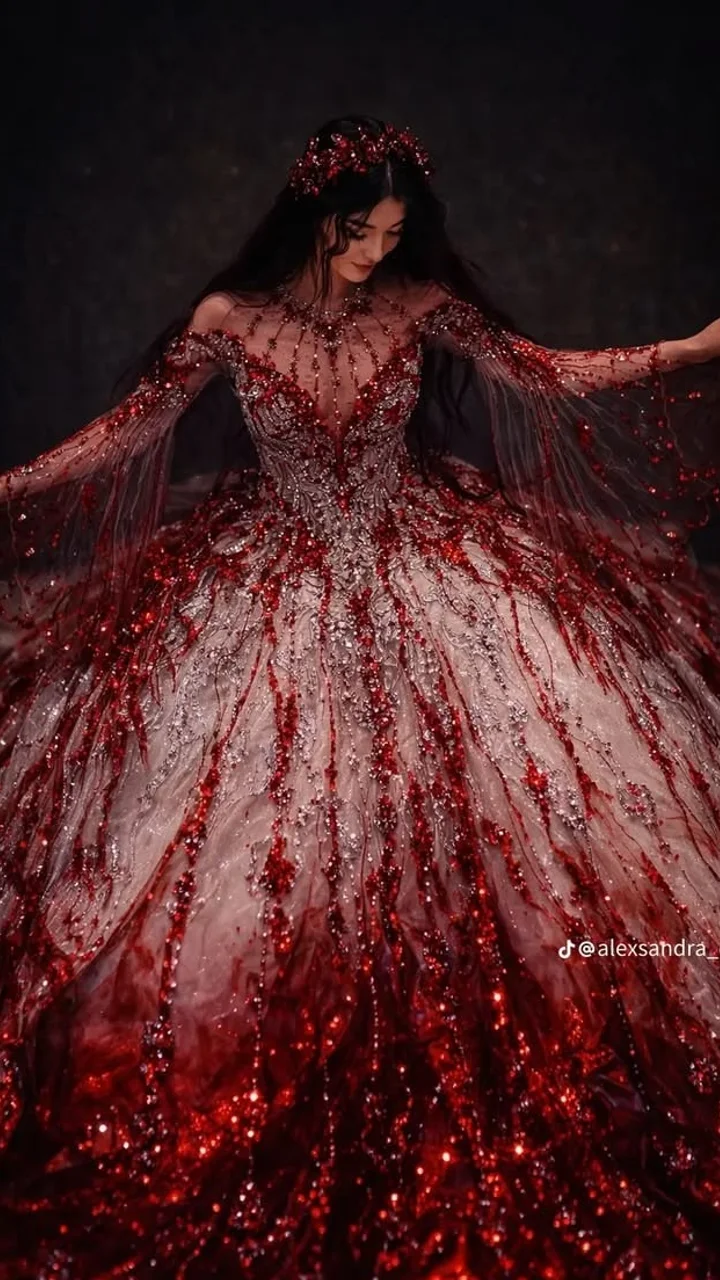
The garden stretched in disciplined rows, each bed a study in contrast. Black roses climbed a wrought-iron trellis, their petals so dark they absorbed the afternoon light instead of reflecting it. White lilies stood in perfect formation beside them, and red camellias bled color into the gravel paths like spilled wine. Ophelia ran her fingers along a rose as she passed, felt the velvet give way to thorn, and pulled her hand back before the skin broke.
"Talk about monochrome," she muttered, stepping around a topiary shaped like something that might have been a wolf or might have been a dragon—it was hard to tell with the light filtering through the canopy. The sun didn't reach here the way it should. The trees overhead were old, their branches woven into a lattice that turned noon into dusk.
A bench sat at the center of the garden, carved from white stone and half-swamped by climbing jasmine. She settled onto it, the fabric of her blue gown pooling around her thighs, and let herself look. The estate had seemed endless when she'd first stepped into the hallway—corridors that branched into more corridors, doors that led to rooms she hadn't opened, staircases that spiraled into darkness. But the garden was different. It felt deliberate. Every flower placed, every path curved for a reason.
A soft sound behind her. Not footsteps—more like fabric brushing against stone.
Ophelia turned.
The woman stood at the edge of the path, half in shadow, half in a shaft of light that turned her platinum bob to spun silver. Lilac eyes, sharp and amused, studied Ophelia with the patience of someone who had centuries to spend on observation.
"You're the human wife," the woman said. Not a question.
"I'm Ophelia." She offered a smile, the sweet one. "And you're the one who's been watching me from the window for the last ten minutes."
The woman's lips curved. "Perceptive." She stepped forward, her flowing silk robes whispering against the gravel. "I'm Seraphine. I advise your father-in-law on matters he finds too tedious to handle himself."
"So you're the one who actually runs things."
Seraphine's laugh was low, dry. "Careful. Say that in front of Caspian and he'll offer you a position." She settled onto the bench beside Ophelia, close enough that the scent of old paper and something floral drifted over. "I wanted to meet you properly. The household has been buzzing."
"Buzzing?" Ophelia raised an eyebrow. "I thought vampires didn't gossip."
"We don't. We observe, catalog, and discuss with clinical precision." Seraphine's eyes glinted. "It's gossip, but we refuse to call it that."
Ophelia laughed, and the sound surprised her. It felt easy, natural—the first time she'd laughed like that since arriving. "So what have you observed?"
"That the little prince is unbearably sulky." Seraphine examined her nails. "That he hasn't fed properly in three days. That he follows you with his eyes when he thinks no one is watching, and that he looked genuinely devastated when you left the room an hour ago." She paused. "I've known Eryth for two hundred years. I have never seen him look devastated about anything."
"He's not a fan of humans."
"He's not a fan of anything that doesn't serve his reflection." Seraphine's voice softened, just a fraction. "But he followed you into that garden. He's standing at the window right now, pretending he isn't watching you talk to me."
Ophelia didn't turn around. She kept her eyes on Seraphine, but her chest did something complicated—a flutter she refused to name. "He's addicted to my blood. That's not the same as caring."
"Isn't it?" Seraphine tilted her head. "I've seen vampires addicted to blood before. They don't lie still on beds and let their wives walk away. They don't say goodnight. They don't hesitate." She stood, brushing invisible dust from her robes. "You're good for him, Ophelia. Whatever game you're playing—keep playing it."
She was gone before Ophelia could respond, swallowed by the shadow between two topiaries, leaving only the scent of old paper and the faint rustle of silk.
Ophelia sat for a long moment, her fingers tracing the edge of the stone bench. Then she stood, smoothed her gown, and walked back toward the estate.
—
The room was dark when she pushed the door open. Dusk had settled while she was in the garden, painting the walls in shades of violet and grey. And Eryth was exactly where she'd left him—on the bed, still in his wedding clothes, still lying like a corpse posed for a portrait. His eyes were open, fixed on the ceiling, his chest so still she might have thought him dead if she didn't know better.
She clicked on the lamp. He didn't blink.
"You're so boring," she announced, crossing to the wardrobe. Inside hung two dresses, both delivered while she was exploring—the white minidress with its flared skirt and innocent silhouette, and the long pink sundress that hugged every curve without revealing a thing. She pulled them out, one in each hand, and turned to face him.
"Choose my outfit."
Eryth's gaze slid from the ceiling to her face, then to the dresses. His expression didn't change.
"It's at night," he said.
She shrugged. "The dinner's at seven. That's still technically night. And I can't show up in this." She gestured at the blue gown, wrinkled from a day of exploration.
"I don't like either."
She sighed, letting the weight of it fill the room. "That's not a choice, Eryth. That's a complaint. Pick one."
He pushed himself up on his elbows, the first real movement she'd gotten from him since morning. His crimson eyes traveled over the dresses with deliberate disinterest, then back to her face.
"The white one makes you look like bait."
"Bait?" She held it up, examining the modest cut. "It's a minidress. It's practically Victorian."
"White," he said flatly, "is the color virgins wear to attract predators. It's signaling. In a room full of vampires, you'll look like the only lamb at a wolf convention."
She blinked. That was... actually a valid point. "And the pink one?"
"Makes you look edible." His voice dropped, rough at the edges. "Like something you'd want to sink your teeth into."
Her pulse kicked. She ignored it. "So which one should I wear?"
He stared at her. She stared back.
"Neither," he said finally, and lay back down.
Ophelia groaned, tossing both dresses onto the armchair. "You're impossible. I'm going to the dinner in my gown and I'm going to tell your father you refused to help me dress appropriately."
"He won't care. He likes you."
"He does?"
"He said you had spine." Eryth's voice was muffled, half into the pillow. "Whatever that means."
She walked to the bed, stood over him, looking down at his sprawled form. He looked carved from marble—too still, too pale, too beautiful for someone so infuriating. "Why won't you get up? Change? Eat? Have breakfast? Anything?"
Silence.
"I fed three days ago," he said finally, and there was something raw beneath the flatness. "Your blood. Nothing else matters."
The words landed in her chest, heavy and warm. She sat on the edge of the bed, close enough that his shoulder brushed her thigh. "You could have other blood. The kitchen—"
"I don't want other blood."
She looked at him. He was still staring at the ceiling, but his jaw was tight, his hands fisted at his sides. He looked like a man bracing for impact.
"Then ask me."
His eyes snapped to hers.
"You want it," she said softly. "Ask."
The silence stretched. A clock ticked somewhere in the hall. Outside, the last light bled out of the sky.
"Please," he said, and the word cost him—she could see it in the way his throat moved, the way his hands clenched tighter. "Please, Ophelia."
She reached out, slow, and touched his cheek. His skin was cool, smooth, and he leaned into her palm like a starving thing finding heat.
"After the dinner," she said. "Behave. Don't embarrass me. And I'll give you a taste."
He closed his eyes. Nodded once.
She stood, leaving him there, crossed to the wardrobe, and pulled out the pink sundress. If she was going to a vampire dinner party, she might as well look like something they couldn't have.
"I'm wearing this one," she said. "You're going to tell me I look good."
Eryth opened his eyes. Watched her hold the dress against her body. And for just a second, the mask cracked—something hungry and reverent flickering in the crimson depths.
"You'll look good," he said. And it sounded like a confession.