

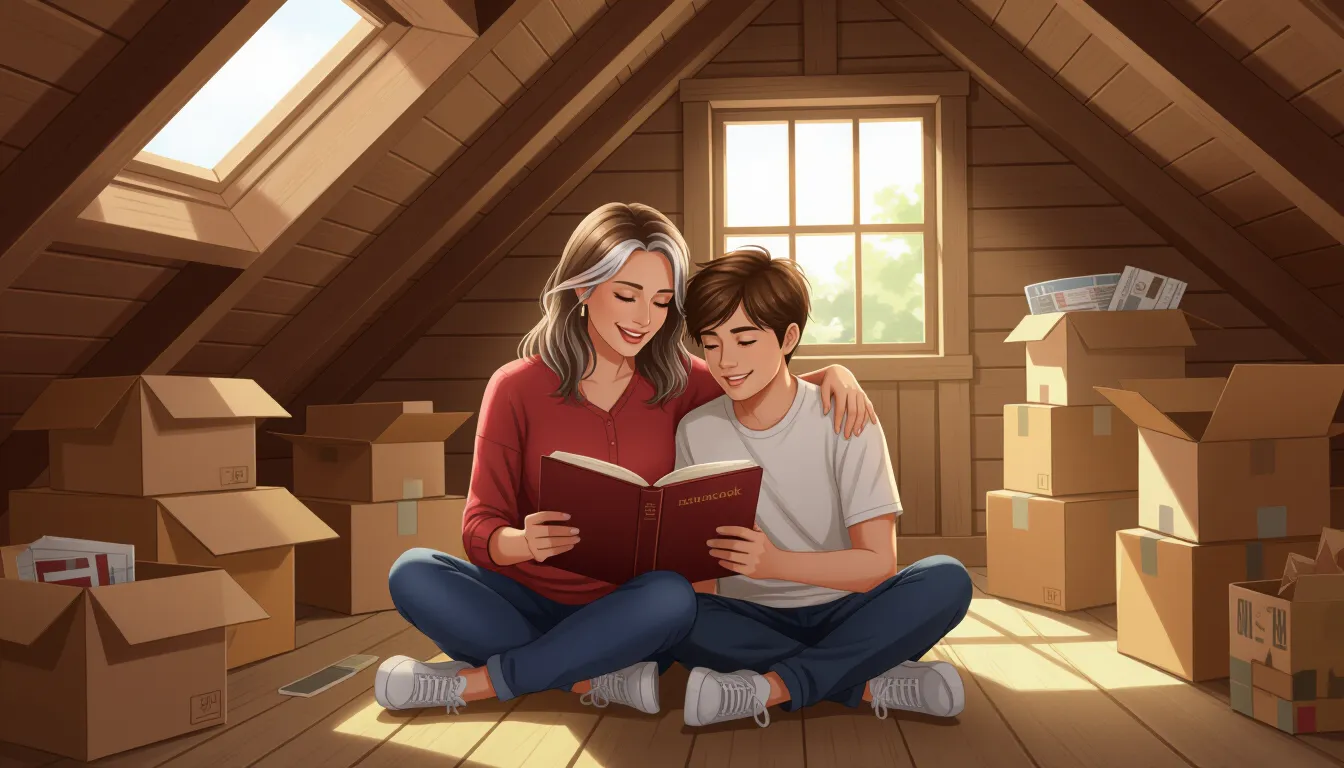
The dust motes swirled in the slanted afternoon light, catching in Jeff’s throat. He wiped the leather cover with his palm, leaving a smeared, clean streak across the maroon. The girl in the photograph had his mother’s smile, but wider, unchecked. Her hair was a riot of curls, half-tamed behind her ears, and she leaned against a brick wall with a confidence that felt like a challenge. “Claire Evans,” he read aloud, the name unfamiliar on his tongue.
Across the attic, the humming stopped. “What’d you find?” Claire asked, not looking up from the box she was sealing.
“Your yearbook.” He opened it. The spine crackled in protest. Inside, the pages were thick and smelled of old paper and something sweet, like forgotten perfume. He found her senior portrait again. The caption read, ‘Most Likely to Start a Revolution.’ He let out a soft, disbelieving laugh. “No way.”
“Oh, God.” Tape dispenser clattering to the floor, she was beside him in a few quick steps. His mom peered over his shoulder, her warmth a familiar presence. Her finger, dusty and tipped with a short, practical nail, tapped the photo. “That was a joke. I was just good at arguing with the principal about the dress code.” Her voice was light, but he heard the faintest edge of something else—embarrassment, or pride.
He turned the page. A candid shot: Claire Evans, mid-laugh, head thrown back, arm slung around a friend. The sunlight caught her in profile. Jeff stared. The woman beside him, smelling of dust and laundry detergent, was in the lines of that girl’s face, in the curve of her jaw. But the girl’s eyes held a wild, untamed light he’d never seen. For a second, the overlap was perfect, and the attic air went still and thick with more than dust.
Claire took the book from his hands, her touch lingering on the cover. She didn’t look at him. Her thumb traced the embossed lettering. “Everyone does,” she said, her voice softer now, almost lost in the vast, quiet space of their nearly empty past. “It’s just what time does.” But she kept holding the yearbook, her gaze fixed on that laughing girl, as if trying to remember the sound.
Her finger, still resting on the cover, slid to a smaller photo tucked in the activities section. It showed her in a paint-splattered smock, standing before a huge, chaotic canvas. “That,” she said, a real laugh breaking through the reflective quiet. “That was Mr. Henderson’s advanced art class. I was convinced I was the next Georgia O’Keeffe. It’s just a bunch of angry red swirls.”
Jeff leaned in, his shoulder brushing hers. He could smell the dust on her sweatshirt, the faint trace of her shampoo. “What’s it supposed to be?”
“Heartbreak,” Claire said, the word simple and stark in the attic air. She glanced at him, her smile turning wry. “His name was Tim. He had a motorcycle and terrible taste in music. I thought the painting was profound. Now it just looks like a mess.” She said it lightly, but her thumb smoothed over the photo’s glossy surface, a small, tender gesture that felt like an apology to the girl she’d been.
He watched her face, the way her eyes softened at the memory. This was a new map of her, one he’d never been given. The mom who packed his lunches and reminded him about sunscreen had once worn a smock and mixed red paint for a boy on a motorcycle. The overlap was disorienting. He felt a sudden, fierce need to protect both versions of her—the defiant girl in the picture and the woman quietly tracing her outline.
“Does it feel weird?” he asked, his voice lower. “Seeing her?”
Claire closed the yearbook with a soft thump, holding it against her chest like a shield. She looked at him, really looked, and for a second he saw that wild light flicker in her hazel eyes, not as a memory, but as a living, buried thing. “It feels like looking at a stranger who knows all your secrets,” she said. Then she turned and placed the book carefully into a keep box, nestling it between his baby blankets and his father’s old fishing lures. “Come on, revolutionary. One more box to go.”
The last box was tucked under the eaves, smaller than the others, its cardboard softened with age. Jeff dragged it into the slanted light, the tape yielding with a tired sigh. Inside, layered under a yellowed sheet of tissue paper, lay a small stack of his own childhood drawings—crayon suns with smiling faces, a lopsided house, a family of stick figures with exaggerated smiles. On top rested a faded blue baby blanket, its satin edge frayed.
Claire sank down beside him, her knee bumping his. She picked up the blanket, her fingers finding the worn trim automatically. “You wouldn’t sleep without this,” she said, her voice a murmur. “You’d rub the edge between your thumb and finger until you drifted off. We called it your ‘thinking spot.’” She demonstrated, the gesture so precise and familiar it sent a jolt through him—a memory he felt in his bones, not his mind.
He lifted a drawing. It was a chaotic green scribble with a brown blob in the corner. “What’s this one?”
“That,” she said, leaning in to see, “is the world’s most ambitious rendering of the backyard oak. You were four. You worked on it for a week, furious every time the green crayon broke.” She took it from her son, holding it gently by the edges. “You told me the brown part was the ‘heart of the tree,’ and it needed to be strong so the birds wouldn’t fall.” She looked from the paper to him, her hazel eyes soft. “You’ve always had a protective streak.”
Jeff ran a hand through his hair, the dust and the sentiment sticking in his throat. He sifted deeper, past his own artifacts, and his fingers closed around something cool and metallic. He pulled out a small, tarnished trophy—a figure mid-dive. “Second place, regional finals, age ten,” he read from the plaque, a laugh escaping him. “I forgot about this.”
“You cried,” Claire said simply. She wasn’t looking at the trophy. She was looking at his profile, at the young man he was now, her expression unreadable. “Not because you lost. Because you thought you’d let the team down. Your coach had to explain that silver was still something to be proud of.” She reached out and brushed a smudge of attic dust from his cheekbone, her thumb lingering for a second on the sun-warmed skin. “My serious boy.”
The attic was silent then, save for the distant hum of the neighborhood. In the space between them, filled with crayon trees and second-place finishes, Jeff felt the vast, quiet distance of the week collapsing. He wasn’t just clearing out an attic. He was packing up her son. He looked from the box, this final archive of his becoming, to his mother’s face, and saw the girl from the yearbook looking back—not as a stranger, but as the very person who had saved these things, who had known the heart of the tree needed to be strong. The overlap was no longer disorienting. It was whole.
Claire closed the flaps of the final box, sealing the last of the past with a strip of packing tape. She pressed it down with a firm, final swipe of her palm. “Well,” she said, brushing her hands on her jeans. “I’d better go start thinking about dinner.”
Jeff stretched, his spine giving a satisfying series of pops. The attic heat had settled into his muscles, a deep, dusty fatigue. “I’m gonna go crash for a bit. Take a nap.”
Claire stood, offering him a hand up. Her grip was strong, pulling him to his feet with ease. A grin broke across her face, those laugh lines deepening. “A nap? Honey, old people like me are the ones who are supposed to need their naps. You’re eighteen. You’re supposed to have boundless energy.”
“I just spent a week hauling your entire youth up and down a ladder,” he said, bumping his shoulder against hers as they moved toward the pull-down stairs. The familiar, affectionate protest was automatic, but his mind was still back in the boxes, with the girl in the paint-splattered smock. “That’s bound to tire a guy out.”
She descended first, her footsteps sure on the wooden rungs. At the bottom, she looked up, her face framed by the attic opening. The afternoon light from the hall window caught the silver in her hair, turning it luminous. For a second, she was just a silhouette—the mother he knew—and then she spoke, her voice softened by the space between them. “Get some rest, my serious boy. You’ve earned it.” She turned to go, then paused, glancing back. Her expression was tender, a little wistful. “Thank you. For all of it.”
The attic heat clung to Jeff's skin as he stretched out on his bed, the dust from the final box a phantom grit in the sheets. He closed his eyes, and the silence of the house folded over him. Then, a bassline thumped through the floorboards. Not the distant neighborhood hum, but close, visceral. The smell of dust vanished, replaced by stale beer, cigarette smoke, and a sweet, cloying perfume. He opened his eyes. He was standing in a crowded, wood-paneled basement, the air hazy and pulsing with a synth-pop beat he didn'tt recognize. A girl with big hair and a neon scrunchie laughed as she bumped past him, her shoulder brushing his. This was a dream. It had to be.