
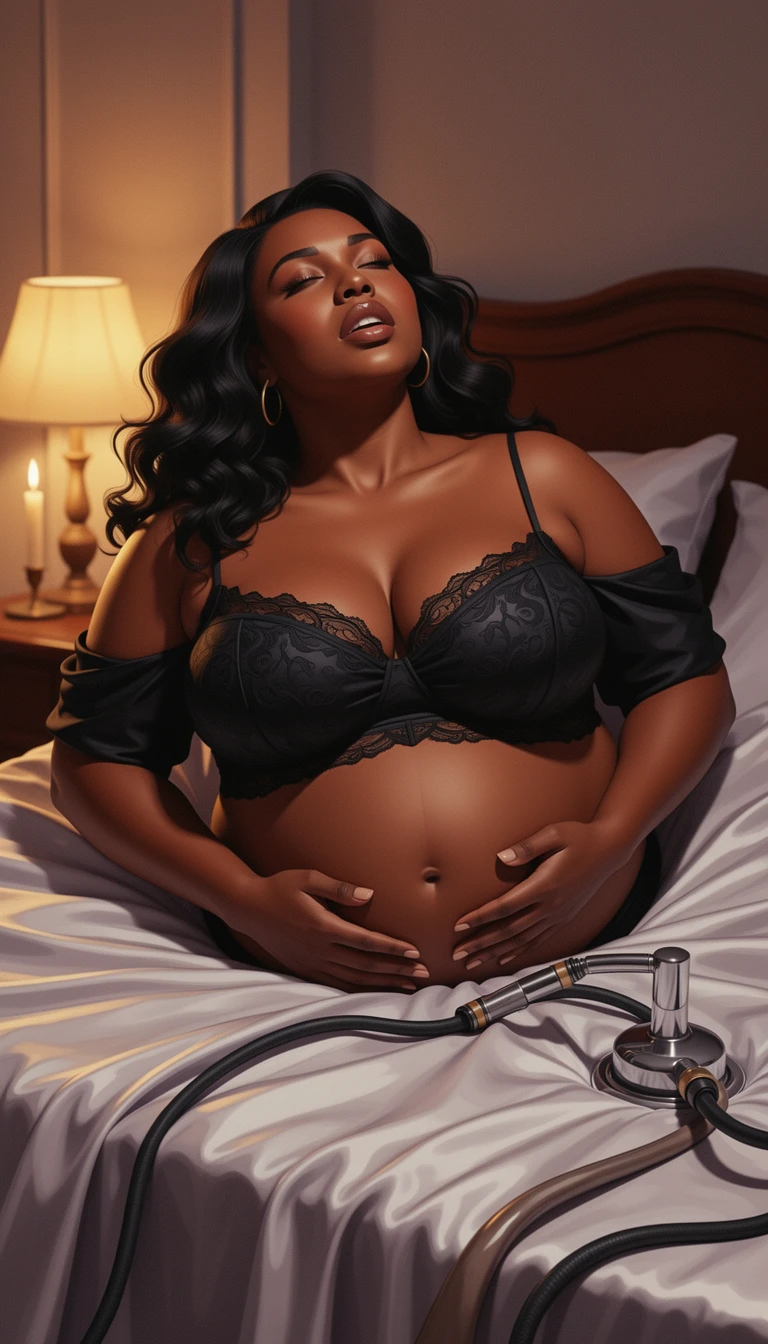
Late afternoon light fell through the bedroom window in long amber slabs, catching dust motes that drifted lazy and slow. Margot stood in front of the full-length mirror in nothing but her underwear—a plain black cotton set that had fit differently a month ago. She turned, watching her profile shift, and let her hand settle on her belly.
Softer. Definitely softer. The curve that had been there before—the permanent gift from the twins, the little pooch she'd learned to love—had rounded into something fuller. Something that pushed against the waistband of her underwear in a way that felt almost new. She pressed her palm flat against it, feeling the warmth of her own skin, the give of flesh that hadn't been there before.
Her hips looked wider too. Or maybe that was just the angle, the way the light carved shadows. She shifted her weight, watching the shape change, and traced her fingers along the edge of her hip bone. Less prominent now. Buried under a new softness that felt strange and familiar all at once.
The kitchen still smelled like vanilla and milk. The last cake shake had been three hours ago—a yellow cake mix blended with whole milk, thick enough to coat the glass, sweet enough to make her eyes roll back. Henry had watched her drink it, leaning against the counter with that quiet smile he got when he was pleased with himself. She'd felt it settle in her stomach, heavy and warm, and then the slow expansion had started. Not dramatic like the inflations. Not the sharp pressure of gas or the urgent fullness of water. Just a gradual, patient swelling, like bread rising in a warm oven.
She'd gone about her afternoon. Loaded the dishwasher. Folded laundry. Checked her phone—three new messages on the forum, a notification about a subscription renewal. Normal things. But through all of it, she'd been aware of her own body in a way that hummed beneath everything else. The slow distension. The way her clothes had started to feel tighter by the hour. The gentle pressure of her belly against her waistband.
And now, in the mirror, she could see the result. Not dramatically bigger—nothing that would make a stranger stare. But she could see it. The accumulated weight of weeks of cake shakes, of cream and batter and the constant fullness Henry encouraged. She turned again, watching the light move across her skin, and pressed her fingers into the soft curve just below her navel.
It gave. Yielded. And then slowly pushed back when she released it.
She heard him before she saw him. The soft creak of the doorframe taking his weight. She didn't turn around.
"You've been standing there for five minutes," Henry said.
His voice was low, unhurried. The same voice he used when he was watching her and knew she knew it.
"Just looking," she said.
"I can see that." A pause. She heard him shift, the fabric of his shirt rustling. "What do you see?"
She let her hand rest on her belly again, palm flat, fingers spread. "I see—" She stopped. Shook her head slightly. "I don't know. Changes."
"Good changes?"
She didn't answer right away. Her eyes traced her own reflection—the curve of her hips, the softness at her waist, the way her belly pushed forward just a little more than it had two weeks ago. She looked at the shape she'd become, the shape she was still becoming, and tried to feel what she felt about it.
Pride. That was there. A quiet, humming pride in what her body could do, how it could change, how it could grow. Henry had given her that—the space to let go, to eat without apology, to fill herself and watch what happened. She'd never had that before. She'd spent so many years managing her body, controlling it, keeping it in lines that other people approved of. And now she was soft in ways she'd never allowed herself to be, and she liked it more than she knew how to say.
But there was something else too. A small, sharp thread of unease that ran beneath the pride. A voice that whispered about hips getting wider, about bras fitting tighter, about the number on the scale climbing in a direction she'd spent her twenties fighting. The voice sounded like her mother. It sounded like every magazine she'd ever read. It sounded like the part of her that still believed a woman's body was supposed to shrink, not grow.
She pressed her hand harder into her belly, feeling the warmth of it, the solid reality.
"I see more of me," she said finally.
Behind her, Henry smiled. She could hear it in his voice. "That's the best thing you could have said."
She almost laughed. Almost deflected. But she held still, watching her reflection, watching his reflection behind her in the mirror. He was leaning against the doorframe, arms crossed, wearing that loose gray t-shirt that she'd bought him three summers ago. His eyes were on her—not just her belly, but her whole body, a slow, deliberate attention that made her skin warm.
"You look good," he said. Not a question. A statement.
She met his eyes in the mirror. "I look bigger."
"Yeah." He said it like it was obvious. Like it was the whole point. "You do. And you look good."
She turned her hand on her belly, fingers curling slightly, feeling the soft give of her own flesh. "Doesn't it bother you? That I'm getting—" She searched for the word. "Softer."
He uncrossed his arms and walked toward her, slow, his footsteps quiet on the hardwood floor. He stopped a foot behind her, close enough that she could feel the heat of his body without touching, and met her gaze in the mirror.
"You know what I like," he said. "You know what I've always liked."
She did. She knew exactly what he liked. He'd shown her, week after week, filling her with cream and cake mix and air and water, watching her swell with that quiet, focused attention that made her feel like the most beautiful thing in the world. He'd never flinched. Not once. Not even when she was so full she could barely breathe, her belly stretched taut and veined and enormous. He'd touched her then with the same reverence he touched her now, his hands warm and patient, telling her she was beautiful in that low, steady voice.
"I know," she said.
"Then why are you asking?"
She let out a breath she hadn't realized she was holding. "Because sometimes I don't know if I trust what I see."
He stepped closer, his chest brushing her back, and his hands came up to rest on her hips. Gentle. Warm. His thumbs pressed into the softness at her waist, and she felt the touch all the way through her body.
"Then look at what I see," he said, his voice low against her ear.
He guided her hands back to her belly, covering them with his own. His palms were warm and broad, pressing her fingers into the soft curve, and he held them there while she watched their reflections in the mirror—his hands over hers, her belly filling the space between them.
"I see a woman who knows what she wants," he said. "Who isn't afraid to let her body show it. Who eats what she craves and grows because of it, and that's not a flaw, Margot. That's a gift."
She swallowed. Her throat was tight. "It feels like a lot."
"It is a lot. That's the point." His thumbs traced small circles on her belly, pressing gently into the softness. "You're becoming more. Not less. Every cake shake, every can of cream, every time I fill you—you're not losing yourself. You're finding more of yourself to be."
She closed her eyes. Just for a moment. Let his words settle into her chest, warm and heavy and true.
"I used to think I'd stop," she said, her voice quieter now. "After the twins. After I found the inflation. I thought it would be a phase, something I'd outgrow."
"And now?"
She opened her eyes, watching the woman in the mirror—the woman with the softer belly and the wider hips and the hands of a man she trusted pressed over her own. The woman who had let herself become more because she'd finally stopped fighting the wanting.
"Now I don't think it's a phase," she said. "I think it's just who I am."
He pressed a kiss to her shoulder. Barely there. A brush of lips against skin that made her shiver.
"Good," he said. "Because I'm not done with you yet."
She let out a sound that was half laugh, half breath. "I know."
His hands moved on her belly, tracing the curve, mapping the new softness. She watched his fingers press into the give of her flesh, watched the way her body yielded and then held its shape when he moved on. There was something hypnotic about it. Something that made her feel seen in a way she hadn't known she needed.
"You're not worried?" she asked. "That I'll get too big? That it'll go too far?"
He met her eyes in the mirror. "Are you?"
She considered the question. Turned it over in her mind, feeling the weight of it. The old voice—the one that sounded like her mother, like the magazines, like every message she'd ever received about what a woman's body should be—whispered yes. Yes, you should be worried. This is too much. You're going too far.
But the voice felt smaller now. Distant. Like something she'd outgrown.
"No," she said. And meant it.
His hands tightened on hers, a brief squeeze that said everything. Then he released her, stepping back, and she felt the absence of his heat like a small loss.
"Good," he said. "Because the next cake shake is ready whenever you are."
She laughed, a real laugh this time, and turned to face him. He was smiling that quiet smile, his hands in his pockets, his eyes warm and patient.
"You're trying to make me bigger," she said.
"I'm trying to make you happy. The bigger is a bonus."
She rolled her eyes, but she was smiling. She turned back to the mirror, looking at herself one more time. The late afternoon light had shifted, casting longer shadows across the room, and her reflection seemed softer somehow. Warmer. She ran her hand over her belly, feeling the curve of it, the weight of it, the reality of the body she was building.
She thought about the weeks ahead. More cake shakes. More fillings. More experiments with gas and cream and water, pushing her limits further than she'd ever gone before. She thought about her following growing, the messages piling up, the money trickling in. She thought about Henry's hands on her belly, his voice in her ear, the way he looked at her like she was exactly what he'd always wanted.
She thought about becoming more.
And she met Henry's eyes in the mirror, and something in her chest unlocked.
"I think I'm starting to see what you see," she said.
The words hung in the air between them, delicate and true. She held his gaze in the mirror, the room quiet except for her breathing, steady and full.
His smile deepened. Just slightly. Just enough.
She held his gaze and let herself be seen.
She turned away from the mirror and faced him.
The room changed shape when she did it. The light that had been behind her was on her now, falling across her collarbone, the front of her belly, the soft inner curve of her thighs. Henry's eyes dropped—not fast, not shy, the way he always looked at her, like he was cataloging something he intended to keep.
"Is it really waiting," she said.
"It's really waiting."
"Or is it waiting the way the donuts were waiting. The way the coffee was waiting."
He laughed. Low, real, the laugh that made the corners of his eyes go soft. "That was a different kind of waiting."
She crossed her arms. It pushed her breasts up, and she watched him notice, and she didn't pretend she didn't. "So what kind is this one."
"The kind where you come to the kitchen and find out."
She didn't move. She stood there in her plain black cotton, bare feet on the hardwood, and looked at him the way she looked at a plate of food she hadn't decided about yet. He was leaning against the doorframe again, arms crossed like hers, matching her posture without seeming to know he was doing it. Gray t-shirt. Sweatpants. Bare feet. His hair a little long at the temples, the gray coming in at the edges like it had been for the last year.
He looked like a man who had nowhere to be.
"You're doing that thing," she said.
"What thing."
"Standing in the doorway looking patient. Like you've got all night."
"I do have all night."
"The kids."
"Your mother has them until Sunday. You told me that twice." He said it without accusation. Just a fact, laid down. "So I have all night, Margot. The question is whether you're going to spend it standing in front of that mirror."
She felt the words land somewhere low in her stomach. Not anger. Something warmer than anger.
She walked toward him.
Not fast. She let her hips do what they did—the sway she'd had since before the first baby, the one that had made her college boyfriend follow her around like a dog. She watched Henry's face while she did it, watched his jaw shift, watched his arms come uncrossed and drop to his sides. By the time she was close enough to touch, he was standing straight.
She stopped a foot away.
"Show me," she said.
"Show you what."
"The cake shake." She tipped her chin up at him. "You said it's ready. So show me."
He didn't move for a second. Just looked down at her, the way he did when he was deciding something, and she could feel the decision happening behind his eyes. Then he reached out and took her hand—his palm dry and warm, fingers lacing through hers—and turned toward the hallway.
She followed.
The house was quiet in the way a house gets when there are no children in it. The hallway was dim, the amber from the bedroom dying behind them, and the kitchen light at the end of the hall was the bright kind—overhead, unforgiving, the kind that showed you everything. She heard the refrigerator humming before she saw it. She heard something else too, a low mechanical sound, and she couldn't place it until they were through the doorway.
The blender was on the counter. Not running. But plugged in, the pitcher sitting in its base, and beside it—she stopped walking.
On the counter, lined up like soldiers: a two-liter bottle of whole milk. A quart of heavy cream. A box of yellow cake mix, open, the paper bag inside slit along the top. A tub of vanilla ice cream, sweating, already softening. A jar of malt powder with a scoop sticking out. And next to all of it, a tall glass—the big one, the twenty-ounce one she used for iced tea in the summer—sitting empty on a folded paper towel like it had been set there with care.
"That's not one shake," she said.
"No."
She looked at him. He was watching the counter, not her, his expression mild. Almost bored. It was the face he wore when he'd done something and wanted her to find it herself.
"Henry."
"Mm."
"How much is in there."
He let go of her hand and walked to the counter. He picked up the cake mix box and turned it so she could see the side—the little panel with the nutrition information, the serving count, the calories she never read. Then he set it down and picked up the cream instead, and held it up.
"Two quarts," he said. "Not one."
"Two—" She did the math in her head and stopped doing it. "That's a lot of cream."
"That's the point."
She walked to the counter and stood beside him, looking down at the arrangement. The ice cream had already started to melt at the edges, pooling in the tub's corners. The malt powder smelled sweet and dusty. She picked up the cake mix box and turned it over, and read the words on the front the way she'd read them a hundred times— Moist. Delicious. Family Favorite —and felt something turn over in her chest.
"You set this up," she said. "Before I even came in here."
"While you were in the bedroom."
"Standing in the doorway watching me."
"I set it up first. Then I came to watch you." He said it simply, the way he said everything, and she felt the heat of it move up her neck. "You took longer than I expected. The ice cream's melting."
She set the box down. "You're not going to tell me how much you want me to drink."
"No."
"You're going to make me decide."
"I'm going to make you pour it." He leaned back against the counter, arms crossed again, and looked at the blender. "You decide how much goes in the glass. You decide how much you drink. I just—" He shrugged. "I just made sure there was enough."
She looked at the counter again. Two quarts of cream. A whole box of cake mix. A two-liter of milk. The ice cream. The malt. She did the math this time, all the way through, and it came out to something she couldn't hold in her head. Something that would fill the pitcher twice over.
She reached for the pitcher.
Her hand hovered over it. She could feel him watching—not her face, but her hands, the way she moved. She picked up the pitcher and set it on the counter beside the blender base, and then she reached for the milk and unscrewed the cap.
She poured. Not all of it. Half. The milk hit the bottom of the pitcher and foamed up white, and she watched the level rise past the one-cup line, past the two-cup line, and kept going until it was nearly to the top of the pitcher's widest part. Then she stopped and set the bottle down.
"That's a start," Henry said.
She picked up the cake mix and tipped the paper bag over the pitcher. The powder came out in a slow yellow avalanche, dusting the surface of the milk, and she had to stop and stir it with the handle of a wooden spoon to keep it from clumping. The smell of it—sweet, artificial vanilla, the smell of every birthday cake she'd ever made for her kids—rose up and filled the kitchen.
She added the cream. Not the whole quart. Most of it. The pitcher was getting heavy now, and she had to brace it against her belly to keep it steady, and she felt the cold of it through the thin cotton of her underwear, and she shivered.
"Cold?" Henry asked.
"A little."
"It'll warm up."
She added the ice cream last. Scooped it in with the wooden spoon, three big soft scoops, and the pitcher was so full now that stirring it made the whole thing slosh against the sides. She fitted the lid on, pressed it down, and looked at the blender base.
Then she looked at him.
"You're sure," she said.
"I'm sure."
"Because this is more than the last one. This is—" She gestured at the pitcher, at the counter, at the debris of the ingredients scattered around it. "This is a lot."
"You said that already."
"I know." She pressed the lid down harder. "I'm saying it again."
He uncrossed his arms and stepped close to her. Close enough that she could smell him—soap, and underneath it the warm skin smell of a man who'd been in the sun earlier. He put one hand on the counter beside the blender and the other on her hip, and he turned her just slightly so she was facing him, and he looked down at her with that patient look that she was starting to understand wasn't patience at all.
"You can pour it out," he said. "Right now. Dump the whole pitcher in the sink and I won't say a word."
"You would say a word."
"I would think a word." He almost smiled. "But I wouldn't stop you."
She held his eyes. Her hip was warm under his hand. Her belly was pressed against the cold pitcher, and she could feel the milk and cream and cake mix waiting inside it, and she could feel the other thing too—the low, humming thing that had been building in her since she'd stood in front of the mirror, the thing that had nothing to do with hunger and everything to do with wanting to know how much she could hold.
She put her hand on the blender lid.
"Turn it on," she said.
The blender caught on the first press—a dry click, nothing—and she pushed the button again, harder, and the motor woke with a shudder that traveled up through the counter and into the heel of her hand.
The blade disappeared under the surface and then the surface was gone. Milk, cream, cake mix, ice cream, all of it folding into itself, going from separate things to one thing, the color of weak coffee with too much milk in it. She watched the chunks of ice cream break apart against the glass, and the sound filled the kitchen the way a sound fills a room when there's nothing else in it—the kids gone, the house gone quiet, just the motor and the two of them and the smell of vanilla powder rising up off the pitcher's open vent.
Henry hadn't moved. His hand was still on her hip, thumb pressing a slow circle into the cotton, and he was watching the pitcher, not her.
"That's the smell," he said. "That's what I remember from last time."
"What, cake mix?"
"The whole thing. The sweetness. It gets into the back of your throat before you even drink it."
The motor changed pitch as the last of the ice cream dissolved, and she let it run another ten seconds past that, because she liked the sound, because she liked standing there with her hand on the lid and his hand on her hip and the whole kitchen belonging to the two of them. Then she killed it.
The silence came back slow. The refrigerator hum. Somewhere in the house, a clock she never wound ticking anyway.
She lifted the pitcher off the base. It was heavier than she expected—heavier than the last one, heavier than her wrist wanted, and she had to set it down on the counter beside the glass with both hands and a small grunt she didn't bother to hide.
"There it is," Henry said.
"There what is."
"The sound you make when you lift something you shouldn't be lifting."
She looked at him. He wasn't smiling, exactly, but the corners of his mouth had that soft set they got when he was pleased with something he'd built and didn't need to say so. She picked up the glass—the twenty-ounce one, the one she used for iced tea in July—and set it beside the pitcher, and then she just stood there with both hands on the counter and looked at the two of them together.
The pitcher held more than the glass. She could see it. Two glasses, maybe two and a half, the pale beige liquid sitting in there with a thin skin of foam on top, and the glass sitting next to it empty, waiting.
She poured the first glass slow. The liquid came out thick, the way a shake does when there's real ice cream in it, and it coated the inside of the glass in a way that made her think of the cake shakes from before, the ones that had put the softness on her hips that she'd started to think of as hers. The glass filled to the rim and she stopped. The foam crested over the edge and ran down the side in a thin white line. She wiped it with her thumb without thinking and licked the thumb.
Sweet. Cold. The malt powder sat on the back of her tongue, dusty and dark.
"You made a face," Henry said.
"It's good."
"You made a face anyway."
"It's cold." She picked up the glass. It was cold enough to ache in her palm. "You want me to drink this standing up in the kitchen like a person who's late for work, or do you want me to sit down."
He looked at her for a second. Then he walked around her—hand trailing across her lower back as he went, light, unhurried—and pulled out one of the kitchen chairs. Not the chair. The chair. The one she'd sat in at the lake house with the rope at her ankles and the hose taped against her skin and Ronnie beside her making that high, surprised sound she'd made when the coffee first went in.
He held the chair steady with one hand and didn't say anything.
She sat.
The wood was cool against the backs of her thighs. Her belly settled into her lap the way it always did when she sat—soft, heavy, taking up more room than it had a year ago—and she set the glass down on the table in front of her and looked at it, and then she looked up at him, and he was standing behind the chair now, one hand resting on its back, close enough that she could feel the heat of him along her shoulder.
"This is the part," she said, "where you tell me how much you want me to drink."
"No."
"No?"
"You drink the glass." His hand came down on her shoulder, fingers spread, thumb finding the knot of muscle at the base of her neck and pressing into it until something in her let go that she hadn't known was holding. "And then you decide about the second one."
"And the pitcher's got more than two in it."
"It does."
She picked up the glass.
The first swallow went down easy—sweet, cold, the malt giving it a bitter edge at the end that made her want the next swallow before she'd finished the first. She drank half the glass without setting it down, and when she did set it down, there was a ring of condensation on the wood and her hand was cold and her stomach had that first, unfamiliar weight in it, the weight of something that had been put there on purpose.
Henry's thumb kept working the muscle at her neck.
"How's the belly," he said.
She put her hand on it. Flat, low, the way she did when she was checking. It was the same. Not swollen yet. Just the soft round of it under her palm, warm from the inside, and the small tightness at the top of it where the shake was already sitting.
"Same," she said.
"Give it ten minutes."
She picked the glass back up and finished it. The last of it was mostly foam, and she had to tip her head back to get it, and when she set the glass down empty she felt it land in her stomach with the rest of it—a solid, cool, full feeling that made her want to sit very still for a second and let it figure out where it was going to go.
He took the empty glass from the table. Just took it, no ceremony, and set it in the sink, and then he came back and stood behind her again with his hand on her shoulder, and she looked at the pitcher still sitting on the counter, still more than half full, and she understood that the decision was sitting there in front of her the way it had been sitting in front of her all night.
She turned in the chair.
It took more than she expected—the shake was in her now, and turning meant moving it—and she had to brace one hand on the table to do it. She came around slow, and then she was facing him, her knees almost touching his, her belly between them, and she had to tip her head back to find his eyes.
"Henry," she said.
"Mm."
"Is there really another one after this."
He looked down at her. That patient face. The one she'd learned to read.
"There's the rest of the pitcher," he said. "And there's more milk in the fridge, and there's another whole box of cake mix in the pantry, because I bought two."
"You bought two."
"I bought two."
She sat with that. The shake cold in her stomach. His hand still on her shoulder, thumb still working, and the kitchen light overhead showing her everything—the flour dust on the counter, the open box, the wooden spoon she'd left in the pitcher, the sweat starting to bead along her hairline from the warmth of the room and the cold of the drink and the thing humming low and slow in her chest that had nothing to do with any of it.
She reached up and covered his hand with hers. Not to move it. Just to hold it there.
"Show me the second one," she said.