

Charlie's POV:
I wake up Saturday morning knowing three things.
One: my mother is getting married tomorrow.
Two: I have a headache despite only having two glasses of champagne, which feels like a betrayal of basic math.
Three: Vivi is four doors down.
The third thing is the least useful.
It’s also the first thing I think about, before the wedding, before the headache, before I’ve even opened my eyes properly.
I lie there in the hotel dark with the blinds doing their best and my brain already running a count of the hallway: my door, then three more, then hers. Like I’m checking that the math still works. Like it might have changed overnight.
My phone buzzes on the nightstand.
I don’t even look at the name first.
I just know.
Vivi: Coffee. Lobby. Ten minutes. Don’t make me come up there.
I smile at the ceiling before I can stop myself, which is a thing I’m going to have to deal with at some point.
Not today.
Today I have a rehearsal to survive.
I get up. I brush my teeth, drag a hairbrush through the mess on my head, and pull on the same jeans I wore yesterday because the hotel closet is a graveyard of dresses I brought for exactly this weekend and can’t be bothered to face yet.
The hallway carpet eats the sound of my footsteps.
One door.
Two.
Three.
Four.
I don’t stop at hers.
I keep walking, because stopping at her door would require a reason, and I don’t have one I’m willing to say out loud.
The lobby at eight in the morning is all marble and polite lighting and one enormous floral arrangement that costs more than my first car.
Vivi is already at a table by the window, two cups in front of her, one pushed to the opposite side like she’s been guarding it.
She doesn’t look up when I sit down.
She just slides the cup across the table, and I catch it before it tips.
“Cream. No sugar,” she says. “The barista tried to give me oat milk.”
“Tragic.”
“I corrected her.”
“Heroically.”
“I saved your morning.”
I take a sip.
It’s exactly right.
It’s been exactly right every morning for two weeks, and I’ve stopped noticing that I notice.
“You could’ve waited for me to order.”
“You take eleven minutes to decide and then order the same thing every time.”
She finally looks up, and there’s the faintest flick of a smile at the corner of her mouth, gone before it lands.
“I saved us eleven minutes.”
“Efficiency.”
“Efficiency,” she agrees.
It’s such a ridiculous thing to feel warm about that I have to look out the window at the parking lot to hide my face.
This is the problem with Vivi.
She’s made a whole ritual out of me without asking, and the worst part is how much I’ve let her.
Two weeks ago I didn’t know her coffee order.
Now I know she drinks it black, hates the word brew, and holds the cup with both hands like it might get away from her.
“You slept badly,” she says.
“You can tell?”
“You have a dent in your cheek from the pillow.” She says it like a weather report. “And you’re wearing yesterday’s jeans.”
I open my mouth to say something clever and instead just—
Look at her.
She’s in a cream sweater, hair down, no makeup, and she looks softer than she does at home, like the hotel has sanded an edge off her.
It occurs to me that I’ve now seen Vivienne Ashford with bed hair, and that this is information I’m keeping, filed somewhere I don’t examine.
“My dad gets in this morning,” I say instead of any of that.
Vivi’s hands still on the cup.
“I know. Your mother mentioned it at breakfast.” A pause. “She’s been up since six, by the way. She’s had the florist on speakerphone twice.”
“Sounds right.”
I turn the cup a quarter turn on its saucer.
“He texted me last night. ‘Landing at nine, can’t wait to see my girl.’”
I do a passable impression of him—the low, warm, slightly distracted voice.
“He’s said some version of that to me for twenty-one years. It’s always true. It’s just also always—”
I stop.
“Late.”
Vivi doesn’t say anything.
She doesn’t fill the silence the way most people do. Doesn’t rush to reassure me that he’ll be on time or that it doesn’t matter.
She just sits with it.
And me.
And the coffee.
Somehow that’s the thing that makes me able to keep talking.
“He’s not a bad guy,” I say. “I want to be clear about that. He loves me. He just loves me from a distance, on a schedule, and I’ve spent my whole life being fine with it.”
“Are you fine with it?”
“Sure.”
I drink.
The coffee’s already going cold.
“Ask me again tomorrow.”
She nods, slow, like she’s filing it somewhere.
Then she stands.
For one second I think she’s leaving, and something in my chest does a small, stupid drop—
but she’s just reaching for her cup and mine, stacking them.
“Rehearsal’s at three,” she says. “You’ll want to eat something before. The hotel restaurant is terrible but the eggs are survivable.”
“You’re managing me.”
“I’m managing the day.”
She walks the cups to the busing station.
I watch her go.
The straight line of her back.
The cream sweater.
The hair she hasn’t bothered to control yet.
And I think—not for the first time and definitely not for the last—that she could have just left me at the table.
She didn’t.
She never does.
I don’t know what to do with a person who keeps choosing to stay in the room.
So I don’t do anything.
I just follow her.
My father arrives at ten-forty, forty minutes after he said he’d be here, and I’m sitting in the lobby pretending to read a magazine I’ve been holding upside down for ten minutes.
I see him before he sees me.
He comes through the revolving door with a garment bag over one shoulder and his phone against his ear, still finishing a call, still mid-sentence about a deal that doesn’t matter to anyone in this building.
He’s tan.
He’s been somewhere warm without me.
He always has.
Then he turns.
He sees me.
The call ends so fast I hear the other person get cut off mid-word.
His whole face opens.
That’s the thing about Jonathan Whitmore.
He’s late, he’s distracted, he’s half somewhere else—
and then he looks at you like you’re the only appointment he’s ever kept.
“There’s my girl.”
I stand up.
The magazine slides off my lap and I don’t pick it up.
He crosses the lobby in four long strides and folds me into a hug that smells like airplane and cedar and the cologne he’s worn since before I was born.
For the length of that hug, I’m eight years old and he’s home from a trip and everything is fine.
“I told you I’d make it,” he says into my hair.
“Eventually.”
He pulls back.
Holds me at arm’s length.
There it is—the flinch.
Small and quick.
Gone before most people would catch it.
I catch it.
“Yeah,” he says, quieter. “I deserved that.”
“You’re forty minutes late to a wedding you flew in for.”
“I’m forty minutes late to a rehearsal. The wedding’s tomorrow.” He grins. “I’ll be early tomorrow.”
I raise an eyebrow.
“I’m turning over a new leaf,” he says. “You’ll see.”
He won’t.
We both know he won’t.
But he means it right now, and meaning it is a thing he does beautifully, and I decided a long time ago that meaning it counts for something even when the follow-through doesn’t come.
I’m not sure if that’s forgiveness or just the shape my heart got trained into.
Across the lobby, near the elevators, Vivi is standing with her father.
She has a leather folder under one arm and she’s nodding at something Alex is saying, but her eyes are on me.
Just for a second.
Long enough that I know she saw the whole thing.
The hug.
The flinch.
The word eventually.
She doesn’t come over.
She doesn’t wave.
She just gives me the smallest nod, the kind you give someone across a room when you’re saying I see you, I’m not going to make it worse, and turns back to her father.
I don’t know why that’s the thing that gets me.
It’s not the hug.
It’s that she knew not to come over.
The rehearsal is at three, in the hotel’s conservatory—a glass room with a marble floor and a string quartet doing a sound check that sounds like a cat trying to escape a violin.
The chairs are set in two neat arcs, and there’s a runner down the middle that Cate keeps straightening every time a hotel employee walks past it.
Cate is in her element.
She’s wearing a cream silk blouse and a smile that could power the building, and she’s directing traffic—the officiant, the planner, the florist, a woman whose only job seems to be carrying a clipboard and looking worried.
Alex stands beside her with his hands clasped behind his back, the calm center of her storm, and every so often Cate reaches over and squeezes his forearm without looking.
He covers her hand with his for a second.
Then they both go back to work.
They’ve been married before.
Both of them.
More than once.
And they still touch each other like this is the first time anyone has ever held their hand.
I’m standing by the door watching when Vivi appears at my shoulder.
“Your mother moved the runner three inches to the left,” she says. “The planner has adjusted it back twice. It’s a war of attrition.”
“Who’s winning?”
“Your mother. She’s got the look.”
“The look?”
“The one that says she’s about to be reasonable at someone until they agree with her.” Vivi folds her arms. “My father’s immune to it. I’ve never seen him immune to anything else.”
I laugh before I can stop it.
It comes out louder than the room expects.
Cate turns around and beams at us both.
I feel Vivi go very still beside me, the way she does when she’s been caught in something she didn’t authorize.
“Girls!” Cate calls across the conservatory. “Come stand here, I want to see the two of you together.”
We go.
We don’t have a choice.
We stand where she points, side by side at the head of the runner, and Cate tilts her head and looks at us like she’s fitting us into a frame.
I feel Vivi’s shoulder an inch from mine.
Not touching.
I’m aware of that inch the way you’re aware of a step you haven’t taken.
“Perfect,” Cate says. “You two. Tomorrow you’ll walk in together, after the parents. Just walk down, stand here, smile.”
She looks at us.
“You’ll be the daughters.”
The daughters.
The officiant is a thin, kind-faced woman named Diane who has done a hundred of these and has the cadence of someone who’s learned to make the same words feel new.
She walks us through it—the vows, the rings, the moment where she’ll say the line about two families becoming one—and everyone nods along, and Alex corrects her pronunciation of Ashford, and Cate corrects Alex, and everyone laughs.
It’s light.
It’s funny.
It’s going fine.
And then Diane says it, just trying the wording out loud, offhand, mid-sentence:
“And then tomorrow, at four, these two families become one.”
I don’t know why it lands the way it does.
It’s a sentence.
It’s a sentence I’ve heard a hundred times in the last two weeks.
But standing at the head of the runner with my mother beside Alex at the back of the room and Vivi’s shoulder an inch from mine, it stops being a sentence and becomes a fact with a time on it.
Tomorrow at four, Vivi becomes my stepsister.
Nothing about her changes at four o’clock tomorrow.
Same face.
Same hands.
Same terrifying opinions about coffee.
Same habit of standing exactly where I need her to stand without being asked.
Only the word changes.
And I hate that the word feels bigger than the thing.
That a piece of paper and a sentence can put a fence around something that was never a room.
I look at her.
She’s already looking at me.
She’s been looking at me, I realize, since the word families left Diane’s mouth.
There’s something careful in her face.
Like she’s holding a door shut from the inside.
I look away first.
After rehearsal, my father finds me on the terrace.
He’s got two glasses of champagne, which means he’s already been to the restaurant bar and charmed someone into serving him before five, and he hands me one without asking if I want it.
“So,” he says.
We lean on the railing.
Below us the hotel’s lawn rolls out green and manicured toward a hedge maze, and somewhere out there a groundskeeper is doing something with a leaf blower and losing the argument.
“Are you really okay with this? Your mother marrying again?”
“Are you asking as her ex-husband or my father?”
He laughs, caught.
“Your father.”
“Then yes.”
I drink the champagne.
It’s too sweet.
“She’s happy. He’s decent. He makes her laugh at the breakfast table, which none of the others did.”
“She looks happy.”
“She always looks happy before a wedding.”
“Not like this.”
He says it simply.
No drama.
And because he knew her before the second husband, and the third, and every reinvention that came after their marriage, I believe him.
“I was the first one, remember,” he says, with a crooked smile. “Front-row seat.”
“Unfortunately.”
“I’d know the difference.”
I look down into my glass.
“Are you okay with it?”
“I’m not the one who has to be.”
He turns and looks at me properly.
“I haven’t always been easy to wait for, Charlotte.”
I don’t say anything.
The leaf blower stops.
It gets very quiet on the terrace.
“I know that,” he says. “I’m not going to pretend I don’t. I’ve spent your whole life being the guy who shows up forty minutes late with a good reason and a better hug, and I know what that does to a kid.”
“Dad.”
“You stop asking at some point,” he says. “You stop putting the good chair out.”
“Dad.”
“I’m proud of you.”
He says it fast, like he’s getting it in before I can deflect.
“I don’t say it enough. You’ve got your mother’s face and my stubbornness and neither of those is a gift, and you’ve made something better out of the combination than either of us managed.”
My throat tightens.
Absolutely not.
“I’m proud of you,” he says again. “That’s all.”
I open my mouth.
What comes out is:
“That’s a lot of words for a man who forgot my sixteenth birthday.”
He grins.
He knows what I’m doing.
He lets me do it.
“I didn’t forget it. I was late to it.”
“You were two days late to it.”
“I was two days late to it,” he agrees.
We both drink.
The sun goes down over the hedge maze.
I don’t tell him the thing I’m actually feeling because I don’t have the words for it yet.
That’s the problem with a father who’s always eventually there.
He never gives you a clean wound to point at.
Just a long, patient ache you learn to carry like a habit.
The rehearsal dinner is at six-thirty in the hotel’s dining room, which has been dressed up with candles and white linen and a seating chart Cate redid four times.
I wear the burgundy silk from the fitting.
The one Vivi admitted looked good.
I don’t admit to myself that I choose it for that reason.
I just put it on and look at myself in the mirror and decide it’s the right dress for the night.
That’s all.
Vivi is wearing black.
I clock her the second I walk in.
She’s standing by the bar with a glass of something clear and a face that could negotiate a ceasefire, and the dress is black and long and cut in a way that makes the room rearrange itself around her.
This is rude.
There are other colors.
Several of them.
I spend an unreasonable amount of time deciding that this is a deliberate choice and that I am not going to let it work.
It works.
I catch her eye across the room.
She holds it.
I mouth one word, small, just for her.
Coward.
The corner of her mouth does something almost imperceptible.
She takes a sip of her drink and looks away.
I feel the small, mean, satisfying warmth of having landed a hit on Vivienne Ashford in front of a room full of people who have no idea what just happened.
The toasts start after the second course.
Alex’s brother goes first—brief, dry, funny, gets a real laugh.
Then it’s my father’s turn.
The room turns to look at him.
I feel my mother’s eyes on him from across the table with something in them I can’t name.
He stands.
He’s good at this.
He’s always been good at this.
“Catherine has always believed in beginning again,” he says. “It was one of the things I admired about her when we were young, and it’s one of the things I admire about her now.”
He raises his glass to Alex.
“Take care of her.”
“I intend to,” Alex says.
“And let her take care of you. She’ll insist.”
The room laughs.
My mother cries.
One tear.
Perfectly timed.
She dabs it with a napkin like she’s been rehearsing for this her whole life, which she has.
Alex puts his hand over hers on the tablecloth.
And I—
I don’t know what happens.
I look at the two of them.
Then at my father.
Then at Vivi across the table.
Something in my throat gets tight and stupid.
I have to look at the ceiling for a second.
A napkin slides into my line of sight.
Vivi’s hand.
Setting it down next to my plate.
Not looking at me.
“Don’t,” I say under my breath.
“I didn’t say anything.”
“Your napkin is judgmental.”
“My napkin is a napkin.”
I take it anyway.
I don’t use it.
I just hold it in my lap, folded.
I don’t look at her.
I don’t cry.
The moment passes.
Then Cate stands up.
The room settles, because when my mother stands up, the room always settles.
“When Alex and I started this,” she says, “I was worried about the girls. I’ll be honest about that. Two grown daughters, two grown lives, one enormous house—I thought we were asking a lot of them.”
She looks at Vivi.
Then at me.
Her face does something I’ve rarely seen it do in a room full of people.
Stops performing.
“Somewhere along the way, without any help from us, they became friends.”
The room makes the soft, pleased sound a room makes.
I look at Vivi.
She’s looking at her wine glass, and the candlelight is doing something unfair to her cheekbones.
I think:
Friends.
Friends feels better than sisters.
Still not quite right.
“Tomorrow we officially become a family,” Cate says, “but I think we’ve been becoming one for a while.”
She raises her glass.
“To my girls.”
“To my girls,” the room echoes.
I drink.
The champagne is still too sweet.
Vivi’s eyes come up over her glass and find mine.
Neither of us looks away fast enough.
After dessert I slip out.
I don’t say anything to anyone.
I just stand.
The room is loud enough that no one notices, and I walk through the dining room doors, past the lobby, and out to the little terrace off the side entrance where the smokers go.
I stand there in the cold with my arms crossed and my burgundy silk doing absolutely nothing against the wind.
I hear her before I see her.
The click of the side door.
The particular rhythm of Vivi’s heels on stone.
She doesn’t ask what’s wrong.
She just stands next to me at the railing and looks out at the same hedge maze.
After a minute she says:
“That was a good toast.”
“My dad gave my mom away to another man tonight and somehow managed to make it classy.”
“Your family is very strange.”
“You’re marrying into it.”
A pause.
Long enough that I feel it.
“My father is,” she says.
“Right.”
It stings.
It shouldn’t.
It’s just accuracy.
It’s the most Vivi sentence there is.
But it stings, and I don’t know why, and I don’t look at her.
I keep my eyes on the dark shape of the maze.
“He always comes,” I say after a while. “My father. He’s always late, but he always comes.”
“Eventually.”
I turn and look at her.
She’s not smiling.
She’s just standing there with her hands in the pockets of a coat she must have grabbed on the way out.
She said it like it was nothing.
Like it was a word anyone might have used.
“You remembered.”
“I remember most things you tell me.”
She says it to the maze, not to me.
That’s the only reason I can stand there and take it.
If she’d looked at me I would have had to make a joke.
She doesn’t.
So I don’t.
I just stand there with my heart doing something complicated and my mouth shut.
“I hate that I’m happy he came,” I say finally. “I’m twenty-one. I shouldn’t still care whether my father shows up.”
“Why not?”
“Because it’s pathetic.”
“It’s not.”
She turns her head then.
Just a little.
“You don’t age out of wanting people to choose you.”
The wind moves through the hedge maze.
Somewhere inside the hotel, someone laughs at something, muffled through the glass.
I don’t say anything.
There’s nothing to say.
She just said the truest thing anyone has said to me in a year, and she said it like a weather report.
Like it was obvious.
Like it was nothing.
We don’t touch.
I’m aware of that.
I’m aware of the two feet of cold stone between us and the fact that neither of us closes it.
I’m aware that this feels like a decision we’re making together without discussing it.
“I should go in,” I say.
“You should.”
Neither of us moves.
Eventually I do.
I go because someone has to, and it isn’t going to be her.
I walk back through the side door and down the corridor past the dining room where the party is still going, my father’s laugh rising over the music.
I take the elevator up to my floor.
Let myself into my room.
Close the door.
Stand in the dark with my back against it.
I take the dress off.
Hang it up.
Put on the hotel robe and lie on the bed with the TV off and the blinds doing their best.
I run the night back.
My father on the terrace.
The napkin.
Friends.
Vivi in black.
Eventually.
I remember most things you tell me.
You don’t age out of wanting people to choose you.
Vivi is four doors away.
My thumb hovers over her name in my phone.
I type:
are you awake
Delete it.
i can’t sleep
Delete it.
thank you
I stare at that one for a full minute.
Delete it too.
Thank you for what, exactly?
I don’t want to find out.
I put the phone face-down on the nightstand.
I stare at the ceiling.
The ceiling has nothing to offer.
I get up.
I put the jeans back on.
Pull a sweater over my head.
Grab my key card.
Go downstairs because I need one more drink and I’ve run out of ways to lie to myself about why.
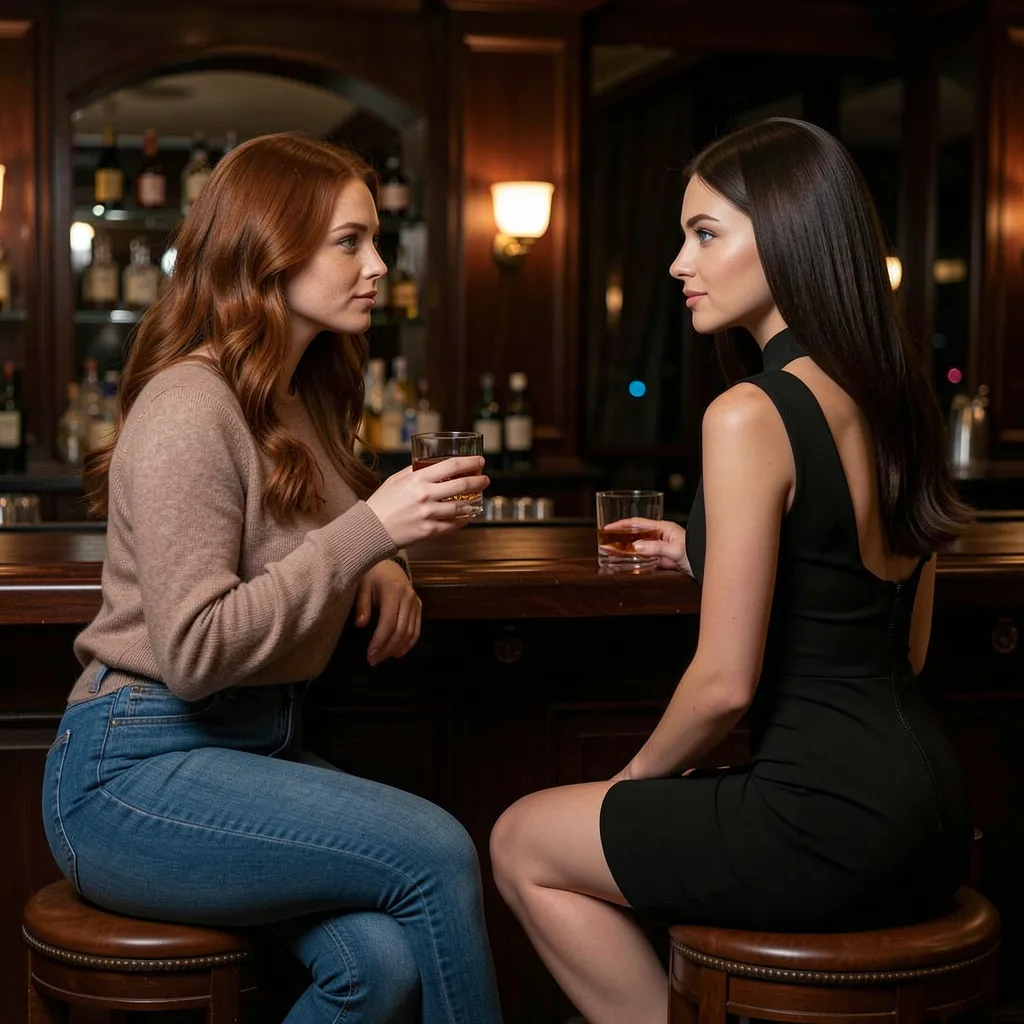
The hotel bar is near midnight and near empty.
Dark wood.
Low amber light.
One bartender polishing glasses nobody’s using.
A couple in the far corner having the kind of quiet, serious conversation that ends in a car ride.
I take a stool at the bar and order a whiskey.
I don’t like whiskey.
That’s the point.
I want something that tastes like a decision.
The bartender sets it down.
I turn on the stool to look at the room.
Vivi is already here.
She’s at the far end of the bar, four stools away, a glass of something dark in front of her, her coat still on like she came down and couldn’t decide whether she was staying.
She’s looking at me.
She’s been looking at me.
Of course she has.
Of course she’s here.
Of course I came down.
Of course the two of us are the only people in this hotel who can’t sleep.
I don’t sit next to her.
I sit two stools down from her.
Not beside.
Not across.
The exact wrong distance.
Close enough to talk.
Far enough to pretend I chose it.
I pick up the whiskey and take a sip.
Make a face I can’t help.
“You’re drinking whiskey,” Vivi says.
“I contain multitudes.”
“You hate whiskey.”
“I contain poor decisions.”
She almost smiles.
Almost.
She turns on her stool so she’s facing me properly, one elbow on the bar.
The light catches the line of her jaw.
I have to look at my glass.
“Couldn’t sleep either,” she says.
Not a question.
“The mattress is a crime.”
“It’s a Four Seasons.”
“A crime of luxury.”
I drink the whiskey.
It burns going down.
That’s what I wanted.
“You?”
“I don’t sleep well in hotels.”
“You don’t sleep well anywhere. You’re up before the sun every day like a Victorian ghost.”
“I have a routine.”
“You have a constitution.”
She takes a sip of her drink.
Whiskey.
Neat.
I don’t know if she likes whiskey.
I realize I know how she takes her coffee, what music she listens to in the car, how she holds a tennis racket, what her face does when she’s annoyed, and when she last canceled a Sunday court reservation.
I do not know if she likes whiskey.
For some reason, this feels like a problem.
We sit with that for a minute.
The two of us and our glasses.
The bartender wipes something that is already clean and pretends not to listen.
“Your father’s toast was good,” she says eventually.
“Everyone’s toast was good. It’s a wedding. Everyone’s on their best behavior.”
“Yours wasn’t.”
“I didn’t give a toast.”
“You didn’t have to.”
She looks at me over the rim of her glass.
“You sat there like you were doing math the whole dinner.”
I don’t have a comeback for that.
I hate that.
I drink instead.
“Margot’s been watching you all night,” I say, because it’s the meanest thing I can think of and I want to change the subject.
Vivi’s expression doesn’t move.
“Margot watches everyone. It’s her only hobby.”
“She watches you specifically.”
“She’s a friend.” A pause. “You’ve met her. You know what she’s like.”
“I know what she’s like.”
I turn my glass a quarter turn on the bar.
“She kissed you once.”
“At nineteen. Once.”
Vivi’s voice is even, but her fingers have gone still around her glass.
“You keep bringing that up.”
“I keep forgetting it.”
“You don’t forget anything.”
“I forget lots of things.”
I look at her.
“I can’t remember what Tess’s perfume smells like. I’ve been trying for a week.”
Vivi goes very still.
It’s a small thing, a stillness.
But I’ve learned her stillness the way I’ve learned her laugh.
This is the version she does when something lands somewhere she didn’t expect.
“Tess,” she says.
Neutral.
Too neutral.
“The woman from the reception. I told you about the kiss.”
“I remember.”
She sets her glass down.
“You said it was easy.”
“It was.”
“Then why are you trying to remember her perfume?”
I don’t have an answer for that either.
The whiskey is making my tongue loose and my chest warm and I’m aware that I’m walking toward something.
I should turn around.
I keep walking.
“Everyone kept calling us sisters tonight,” I say.
“Everyone keeps being wrong.”
“Tomorrow you’re going to be my sister.”
“Stepsister.”
“That’s worse somehow.”
“More accurate.”
“You love accuracy.”
“Someone has to.”
“Do you ever wish you didn’t?”
The question comes out before I’ve decided to ask it.
It sits on the bar between us.
Vivi doesn’t answer.
She looks at me for a long moment.
Something shifts behind her face.
Not a crack exactly.
More like the light changing in a room where the door has just been opened a fraction.
“This is a bad idea,” she says.
She’s looking at my glass.
Not at me.
“Which part?”
Her eyes lift to mine.
She doesn’t answer.
Neither of us leaves.