
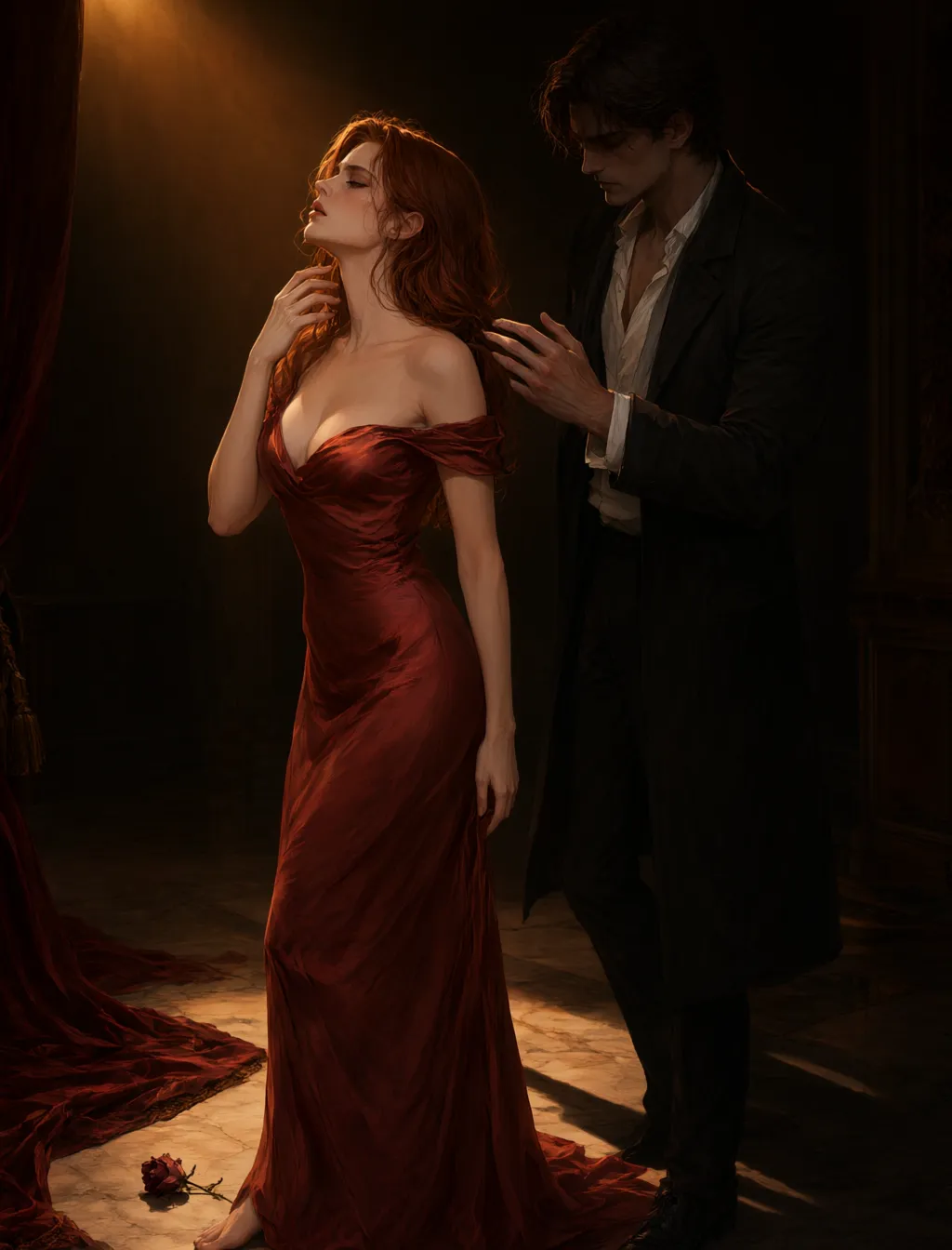
Rain needled Evelyn's skin as she fled the hospital, the prognosis a cold stone in her throat. A man stood under her apartment awning, water dripping from his dark hair. He didn't move to get out of the downpour. 'Elara,' he breathed as she approached. The old name, from her recurring dream, hit her like a physical touch. Her keys slipped from her fingers. He caught them before they clattered, his hand a blur of impossible speed.
She stared at the keys, now held perfectly still in his pale palm. The movement hadn't been fast. It had been absent. As if the space between her hand and the concrete had simply ceased to exist for a moment. Her eyes traveled up the line of his dark coat sleeve to his face. He was looking at her not with a stranger's curiosity, but with a recognition so profound it felt like a violation. It was the way you looked at a ghost you'd been waiting for. "You're in my way," she said, her voice thin, frayed by the long walk and the heavier truth she carried.
He didn't move. The rain sheeted down around them, a curtain isolating the space under the iron awning. His eyes were black, and they drank her in—the damp auburn hair plastered to her forehead, the hospital ID bracelet she'd forgotten to cut off, the faint tremor in her hands that had nothing to do with the cold. "I am," he said, the words a low, graveled ache. "I have been for a very long time."
Evelyn wrapped her arms around herself, the scent of ink and old books on her wool coat mingling with the sterile lemon of hospital antiseptic. He smelled of night air and cold stone. Of something ancient and deeply out of place on her city street. "I don't know you." It was a statement, but it sounded like a question.
"You do," he said, and the certainty in that baritone was more terrifying than the speed of his hand. He extended her keys, not dropping them into her palm, but offering them back as if returning a sacred relic. His fingers did not touch her skin. They trembled, just slightly. "You are dying, Evelyn Reed."
The stone in her throat turned to ice. She took the keys, the metal warm from his grasp. "Everyone is dying," she whispered, the dry, wistful humor a last brittle defense. "Some of us just have a more specific itinerary." She watched his face, the devastation that crossed it, raw and unchecked. It was not pity. It was grief. A personal, consuming grief that mirrored the one she carried alone in the dark. Her own breath caught, tight in her chest.
"How do you know that name?" The words tore from Evelyn’s throat, sharp and ragged. The prognosis, the rain, the impossible speed—it all condensed into this single, burning point. Elara. The name from the dream where she always drowned.
Damien’s gaze didn’t waver. He lifted a hand, not toward her, but to his own chest, his fingers brushing a spot over his heart. The gesture was intimate, worn smooth by repetition. “You gave it to me. In a garden filled with white roses, under a moon you said looked like a silver coin.” His voice was softer now, the gravel worn down to pure ache. “You were wearing a blue dress. The left strap kept slipping from your shoulder. You laughed and said it was the garden’s fault for being too distracting.”
Evelyn’s breath hitched. She could smell the roses. Not a memory, but a phantom sensation, layered over the wet wool and city rain. She had dreamed that, too—the slip of silk, the cool night air on her bare skin, the feeling of a laugh so light it felt foreign in her chest now. “That’s… a very specific dream,” she managed, but the denial was hollow, crumbling from the inside.
“It is not a dream.” The certainty was back, an immovable stone in the stream of her disbelief. He finally moved, taking one slow step closer. The space under the awning shrank. She felt the chill radiating from him, a coolness that had nothing to do with the rain. “It is a memory. One of hundreds. Fragments you carry because your soul is tired of forgetting.” He looked down at her hospital bracelet, the plastic stark against her wrist. His black eyes glinted with a sheen of moisture that wasn’t rainwater. “I have watched you remember, and I have watched you die, cycle after cycle. This time… this time I am not watching.”
Evelyn traced the lines on her palm, a nervous habit, mapping a destiny she could no longer read. The keys dug into her other hand. “You’re saying you’re from my… past life?” The term felt absurd on her tongue, the stuff of cheap paperbacks and late-night television. Yet the scent of roses wouldn’t fade. The detail of the strap—the specific, mundane annoyance of it—felt truer than the doctor’s clinical voice had hours ago.
“I am from all of them,” he said. He lifted his hand again, this time hesitating in the air between them, as if touching a pane of glass. “And I am here now to offer you a choice you have never had. But first, you must believe you are more than this single, fading breath.” The raw need in his voice was a live wire. It didn’t ask for her trust. It demanded her hunger—the furious, unspoken kind she hid beneath her catalog of sunsets. The rain drummed its endless rhythm, a countdown she could finally hear.
"Prove it," Evelyn whispered, the words tearing through the curtain of rain. Her heart hammered against the cold stone in her throat. "Show me another one. One I haven't dreamed."
Damien's hovering hand stilled. The raw need in his black eyes sharpened, focused. He closed his eyes, not in refusal, but in concentration. A tremor ran through his fingers. When he opened them again, he was looking at her, but through her—at some distant point in the dark behind her eyes. "Constantinople," he breathed, the word an artifact. "The plague year. You were a scribe's daughter with ink-stained fingers. You hid a fever for three days because you were copying a psalm you thought would save your father. It didn't."
Evelyn felt the phantom weight of a quill in her hand. The smell hit her first—not roses, but pungent herbs boiling in a clay pot, the sour scent of fear-sweat on wool blankets, and beneath it, the metallic tang of blood at the back of her own throat. She saw her hands, younger, slimmer, stained blue-black. She felt the burning in her lungs, the terrible, rattling need to draw breath. "The window," she gasped, the memory unfolding like a poisoned flower. "There was a narrow window... I kept looking at the cypress tree outside, wishing I could taste the rain."
"You did," Damien said, his voice stripped bare. "I climbed the wall. I held a cup of rainwater to your lips. You were so thin. The light from the window cut across your face like a blade." His gaze dropped to her mouth, centuries of loss reflected in the sheen of his eyes. "You said it tasted of dust and distance. Then you touched my cheek and said my name. Not Damien. The name I had then. You said, 'Let me go. The tree is waiting.'" A single, dark tear traced a path through the rainwater on his cheek. "I was too late that time, too."
Evelyn's own breath came in short, painful hitches. The memory wasn't a story. It was a bone-deep ache, a cellular mourning. She could feel the coarse wool of the deathbed blanket, the chill of the rainwater, the profound relief in that final surrender. It mirrored her own exhausted resignation from the hospital hours ago. Her hand rose, not to trace her palm, but to her own cheek, where his phantom touch lingered. "Why?" The question was a broken thing. "Why show up just to watch me leave?"
"Because I am a fool who believed the next cycle would be different." He took the final step, erasing the space. The chill radiating from him seeped through her damp coat. He didn't touch her, but his presence was a physical pressure. "And because even a fool's hope is a kind of eternity. This time, Elara... Evelyn. This time I am not asking you to let go of the tree. I am asking you to walk out into the forest with me." His hand remained between them, a silent, trembling offer. The rain drummed its verdict on the awning above. Her disbelief didn't just fracture. It dissolved.