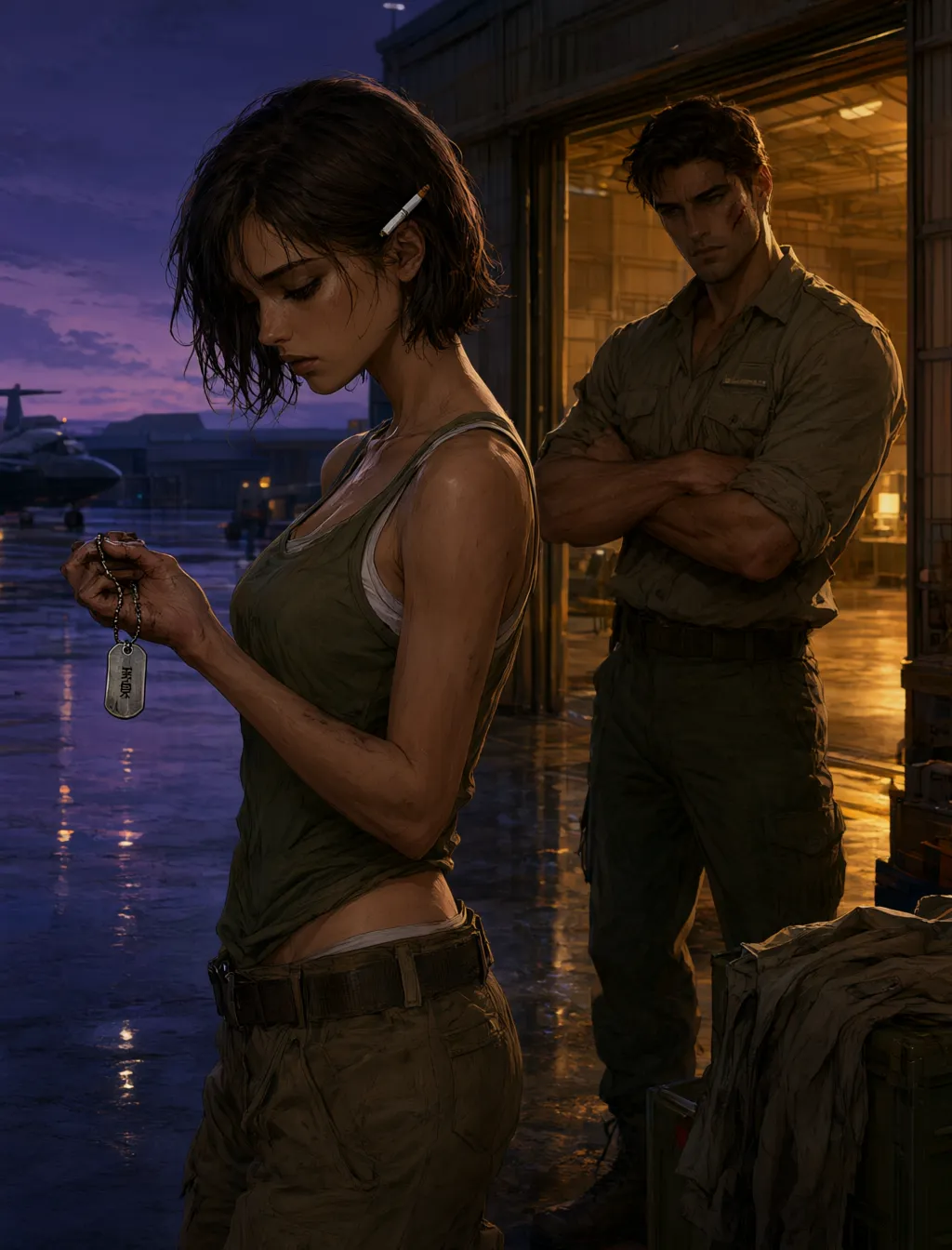
The comms shed hums, a low electrical thrum that vibrates up through the concrete floor. Adrian doesn’t look at the maps or the radio. He looks at her, his gaze dropping to her hands, still curled loosely at her sides. He steps closer, the space between them collapsing into something personal, charged. He doesn’t ask. He simply reaches out and takes her right wrist, his grip firm but not harsh, turning her palm up to the dim, buzzing light.
His own hands are a landscape of war—calluses like ridges of stone, knuckles scarred, nails kept short and clean. His thumb presses into the center of her palm, and Maya feels a jolt that has nothing to do with pain. He traces the raw, angry blister at the base of her thumb, the price of a long morning on the range. Then his touch ghosts over the older, whitened scar that cuts diagonally across her life line. She never explained that one. He doesn’t ask. His thumb just pauses there, as if reading braille.
“You hold a rifle like you’re afraid it’ll bite,” he says, his voice that same low, deliberate calm. But his thumb is moving again, smoothing over the raised flesh. “And you hold your past like it already has.”
She should pull away. This isn’t in any field manual. But his touch is methodical, translating her. He finds the small burn on her index finger, the shallow cut on the pad of her thumb. Each is a sentence in a story she thought was private. Her breath feels tight in her chest. She watches his face, the intense focus in his eyes, the way his jaw works slightly. And then she feels it—the faintest tremor in his fingertips, a vibration against her skin he tries to stifle by pressing harder.
The world narrows to the points of contact: his rough skin on hers, the heat of his palm cradling her hand, the shed’s hum fading into a distant buzz. He turns her hand over, inspecting her knuckles. His touch lingers. This isn’t an inspection for readiness. It’s an excavation. An admission. To see the ghosts, you first have to know the hands that carry them.
He finally meets her eyes, his own dark and unreadable in the shadowed light. His grip loosens, but he doesn’t let go. The tremor is still there, a silent confession trembling between their joined hands. He just holds her there, in the humming twilight, saying nothing.
Maya doesn’t pull her hand free. Instead, her left hand comes up, her own fingers closing around his wrist. She turns his hand over in the dim light, mirroring him. His palm is a map of rough terrain. The calluses are deep, permanent ridges along the base of each finger and the heel of his hand. She traces one with her thumb, feeling the tough, leathery skin.
“Your turn,” she says, her voice quieter than the shed’s hum.
She finds the scars. A pale, slick line along the meat of his thumb—shrapnel, maybe. A nick on his index finger, perfectly straight, from a knife. But it’s the one across his palm that makes her pause. It’s old, jagged, a brutal tear that never healed smooth. She presses her thumb into it gently, feeling the ridge. This isn’t from equipment. This is from holding on to something sharp. Or someone.
Adrian goes very still. His breath catches, just once, a slight hitch she feels in his wrist. He doesn’t stop her. He lets her read him, his own history written in ruined skin. The tremor in his hand becomes more pronounced under her touch, a silent vibration she can’t soothe.
“You hold your ghosts,” she whispers, not looking up from his palm, “like you’re still trying to stop the bleeding.”
He doesn’t answer. His other hand comes up, not to pull away, but to cradle the side of her face, his rough fingers sliding into the short hair at her temple. It’s an anchor. A surrender. His thumb strokes her cheekbone once, a gesture so tender it makes her chest ache. In the green electronic glow, his eyes are dark pools, all his careful distance drowned in them. The world is this shed. This touch. This silent, trembling translation complete.
He lets his forehead come to rest against hers. The contact is solid, warm, a point of pressure in the humming dark. His eyes close. The green glow from the radio panels paints the sharp line of his nose, the stubble along his jaw. Maya feels the exact texture of his skin against her own, the slight dampness there. Her own eyes stay open, watching the way his lashes lie against his cheeks, the deep furrow of concentration between his brows now smoothed into something else—something exhausted and open.
His thumb is still stroking her cheekbone, a slow, repeating pass. Her hand is still wrapped around his wrist, feeling the steady pound of his pulse against her fingers. It’s fast. Hers matches it, a frantic drumbeat in her throat. She can smell him—sweat, dust, the sharp tang of ozone from the equipment, and underneath it, something clean like soap. Her breath hitches, waiting for him to pull back, to reassert the distance, to become Sergeant again.
He doesn’t. He just breathes. The air between them grows hot, shared. “Maya,” he says, her name a low rumble in his chest that she feels more than hears.
She doesn’t know what to say. Any of her usual blunt observations die on her tongue. This silence isn’t empty; it’s full of everything they’ve just translated—the blisters, the scars, the tremor, the ghosts. So she does the only honest thing. She tilts her head just a fraction, increasing the pressure of his hand against her face, a silent plea for him to not let go.
A shudder runs through him. His other hand, the one she’d been holding, comes up to cradle the other side of her face. He’s holding her now, fully, his forehead against hers, his rough palms framing her jaw. His thumbs stroke the high points of her cheeks. It’s an embrace made entirely of faces and hands, more intimate than any hug. It’s a confession. I see you. I’m here.
The comms shed hums on, indifferent. The static crackles. In that electronic twilight, they just stand, anchored. The distance he guards so fiercely is gone, collapsed into this shared breath, this silent admission that some wounds are only readable by another’s hands.