
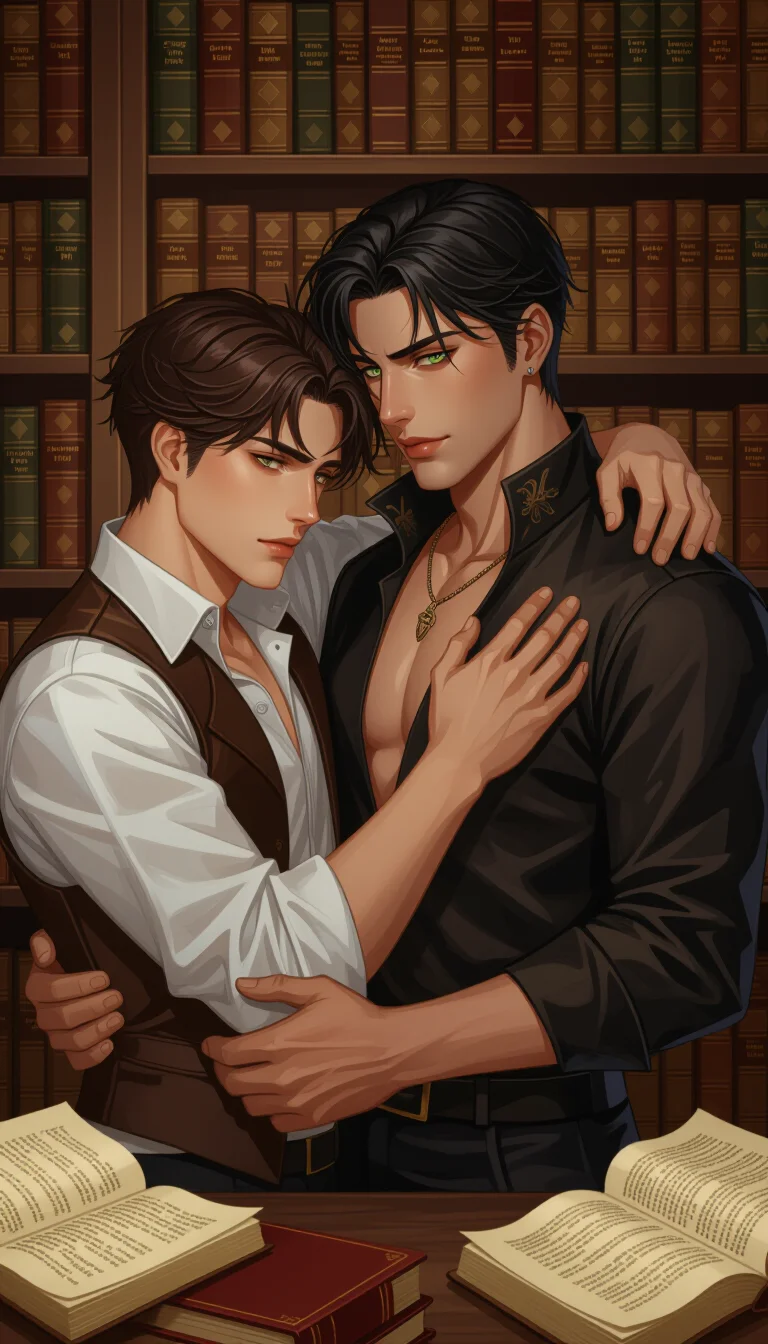
The weeks after the puppet play passed in a blur of ink-stained fingers and stolen hours. Lectures on torts and property law became a droning background hum to the secret rhythm of Kieran’s life—a rhythm set by Devon’s touch, Devon’s whispers in the dark, the heavy, intoxicating scent of him on Kieran’s skin long after he’d left their rooms. The memory of the shed, of the violent lesson and the possessive claiming that followed, was a live wire under Kieran’s ribs, a constant, low-grade heat that made the mundane world feel thin and unreal.
Devon left for Willoughby Hall three days ago. The silence in their shared apartment was a physical presence, thick and watchful. Kieran found himself tracing the spine of the book Devon had been reading before he left, the leather cool under his fingertips. He slept in Devon’s bed, burying his face in the pillow that still held the ghost of his cologne—bergamot and something darker, like turned earth after a storm. The absence was an ache, a hollowed-out craving that no amount of solitary study could fill. It was this restless, seeking emptiness that drove him, on a damp Tuesday afternoon, past the familiar oak carrels of the main library and toward the wrought-iron gate that led to the Restricted Collection.
The gate was unlocked. He pushed it open, the hinges sighing. The air changed instantly, becoming cooler, drier, carrying the scent of aging paper, vellum, and the peculiar, metallic tang of old ink. The light here was dim, provided by green-shaded lamps on long desks, pooling in golden circles that left the high vaulted ceilings in darkness. Rows of shelves, black and towering, receded into the gloom like a petrified forest.
“You’re lost.”
The voice was quiet, factual. It came from a desk nestled between two shelves, where a young woman sat beneath a lamp, a magnifying glass in one hand. Her dark hair was pulled into a severe bun, wire-rimmed spectacles perched on her nose. Her fingers, poised over a fragmented scroll, were stained with faint, peculiar colors—a violet smudge, a streak of ochre.
“I’m not,” Kieran said, his own voice soft in the hushed space. He approached. “I’m looking for something.”
“Aren’t we all.” She didn’t look up, her attention on the crabbed script under her lens. “This section is for post-graduate researchers with specific permissions. Do you have a chit from a professor?”
“No.” He stopped a few feet from her desk. “My name is Kieran Belfrey. I’m reading law.”
That made her glance up. Her eyes, behind the glasses, were a sharp, intelligent brown. They flicked over him, taking in his worn but neat jacket, his too-quiet posture. “Belfrey. You share rooms with Somerset.” It wasn’t a question. A slight tension entered her shoulders, barely perceptible.
“I do.” Kieran felt a familiar prickle, the sense of being assessed, categorized. “You know him?”
“I know who he is. He comes here sometimes. Late. He requests… specific things.” She set the magnifying glass down carefully. “I am Elaina Richards. Archivist’s assistant. What is it you’re looking for, Mr. Belfrey, that you think you’ll find back here?”
Kieran’s mouth was dry. He’d come on an impulse, a need to move, to seek. But now, under her direct gaze, the question that had been coiling in the dark of his mind for weeks surfaced, raw and undeniable. He leaned a hand on the edge of her desk, the wood smooth and cool. “The old myths. Of Rathany. What do they say about warlocks?”
Elaina went very still. The only sound was the faint, eternal hum of the library’s climate enchantments. She slowly removed her spectacles, folded them, and placed them beside the scroll. Her stained fingers trembled, just once, before she stilled them. “Why would you ask that?”
“Academic curiosity.” The lie tasted flat.
She studied him for a long moment, her gaze lingering on his face as if reading a text. “They exist in the tales,” she said finally, her voice lower now, almost a whisper meant for the shadows between the shelves. “The Bargainers. The Shadow-Touched. Men and women who made pacts with entities from beyond the Moor-Wall for knowledge, for power, for revenge. They are figures of tragedy and warning. The stories say their power is bought with a price that corrupts the soul and twists the world around them.”
Kieran’s heart was a hard, rhythmic knock against his ribs. “And what do the stories say is real?”
Elaina gave a short, quiet laugh that held no humor. “Most believe them to be fiction. Pleasant folklore for dark nights. The established academic and theological position is that magic, as the myths describe it, is superstition. That eldritch beings are not real. That the Moor-Wall is a geological feature, not a… boundary.” She paused, her eyes drifting to the darkness at the end of the aisle. “Most believe that.”
“But not you.”
She looked back at him, and the professional mask was gone. In its place was a naked, weary fear. “I catalog the things people try to forget, Mr. Belfrey. I handle fragments of journals from explorers who never returned from the Moors. I preserve trial records from the Purges, where people were condemned for ‘unnatural congress.’ I have seen sketches, made by feverish hands in the last century, of shapes that hurt the eyes to look upon. Do I believe a man can call fire with a word or summon a storm with a gesture? No. That is children’s stories.” She leaned forward, the lamp light carving deep shadows under her eyes. “But do I believe there are older, colder things in the world, and that there are ways, terrible ways, for desperate people to reach them? Yes. I believe that very much.”
The hollow ache in Kieran’s chest widened into a chasm. He thought of Devon’s hands, the way the air grew heavy before he worked his will. The glamour that had shattered Ignatius Thorne’s life. The sorrow that poured from him like a tide, and the thing he served that walked the lonely places. “What would such a pact look like? In reality, not story.”
“Why are you asking me this?” Elaina’s voice was urgent now. “Has he shown you something? Said something?”
Kieran didn’t answer. He couldn’t. His loyalty was a shackle, his fear a gag.
Elaina saw it. Her expression shifted from fear to a grim pity. She stood, her chair scraping softly on the stone floor. “Come with me.”
She led him deeper into the Restricted Collection, past shelves of locked metal boxes and cabinets with crystal knobs. The air grew colder. She stopped at a nondescript door of dark wood, produced a heavy key from a chain at her waist, and unlocked it. The room within was small, more a closet than a room, lined with shallow drawers. She went to one, labeled in faded script: *Accessions – Unverified/Prohibited – Folklore Contaminant.*
With great care, she pulled the drawer open. Inside, on a bed of faded velvet, lay a single object. It was a knife, but unlike any Kieran had seen. The blade was a dull, non-reflective black stone, obsidian or something darker, roughly flaked. The hilt was wrapped in leather that was stained a deep, permanent brown. The shape of it was wrong—it seemed to drink the faint light from the open door.
“This was recovered sixty years ago,” Elaina whispered, not touching it. “Found in a peat bog on the eastern Moors, clutched in the hand of a body that was not entirely… human in its skeletal structure. The coroner’s report listed cause of death as ritual exsanguination. His own knife. They say the blade is cold to the touch, always. That it never warms. They say if you listen very closely in a silent room, you can hear a faint… weeping.”
Kieran stared at the knife. He thought of the spring equinox, approaching like a tide. The tithe in blood. The witness he had promised to be. His stomach turned to ice. “A tool,” he breathed.
“A relic,” Elaina corrected, closing the drawer with a soft, final click. “Evidence of a belief so absolute it demanded a concrete instrument. This is not fantasy, Mr. Belfrey. This is the residue of a terrible truth. If your… friend… is involved with such things, you are in a folktale. And in those stories, the curious companion rarely fares well.”
“He wouldn’t hurt me.” The words were automatic, fragile.
“Perhaps not by intention.” She locked the drawer, her stained fingers firm on the key. “But the things he would traffic with? Their attention is a poison. Their gifts are curses in disguise. I have read the accounts. The Bargainer is always consumed, and everything they love is consumed with them.” She turned to him, her face pale and serious in the gloom. “Leave, Kieran. Before you see something you cannot unsee. Before you are asked to do something you cannot undo.”
He thought of Devon’s mouth on his, a claiming. The whispered words in the dark: *You are my covenant.* The feeling of Devon’s power, vast and terrifying, moving through him, around him. It wasn’t just desire. It was devotion, a terrifying belonging. To leave would be to tear out his own still-beating heart.
“I can’t,” he said, the words a raw scrape in his throat.
Elaina’s shoulders slumped. The pity in her eyes deepened. “Then you are already lost. And I am sorry for it.” She walked past him, back into the main aisle of the Restricted Collection, leaving him alone in the cold, dark closet with the ghost of a weeping knife.
Kieran stood there for a long time, the chill seeping through his jacket. He felt the weight of the unseen world pressing in, no longer a thrilling secret but a dreadful, tangible reality. Elaina’s words echoed, but beneath them, louder, was the memory of Devon’s voice, the heat of his hands, the sanctuary of his bed. The conflict was a physical pain, a tearing within him. He was a man split in two: the scholar who saw the evidence and trembled, and the devotee who craved the dark altar.
He finally walked out, past Elaina’s desk. She did not look up from her scroll, but her posture was rigid, a wall of silent reproach. The wrought-iron gate sighed shut behind him, separating the world of known, cataloged facts from the world of whispering shadows and terrible pacts.
The walk back to his rooms was a blur. The grand corridors of the university, the portraits of stern-faced chancellors, the sound of student laughter from a common room—all of it seemed like a painted backdrop, thin and insubstantial. The only real thing was the cold knot of knowledge in his gut and the aching, empty silence of the apartment that awaited him.
He entered the dark sitting room. The remnants of Devon’s fire were long cold in the grate. He went to Devon’s bedroom, the sanctuary that now felt like a cell. He lay on the bed, fully clothed, and stared at the canopy. The scent of bergamot and dark earth was fainter now, almost gone. He thought of the black knife in its drawer. He thought of the coming equinox. He thought of Devon’s eyes, desperate and possessive in the lamplight. He approached the chest.
It unlatched with a soft, definitive click. Kieran stood before the chest, the one that always sat at the foot of Devon’s bed. He’d seen Devon open it only once, a swift, fluid motion to retrieve a small velvet bag before locking it again. The key had been left, conspicuously, in the center of Devon’s otherwise immaculate desk. An invitation, or a test.
He lifted the lid. The interior smelled of cedar and that faint, cold ozone that clung to Devon’s artifacts. It was empty. Not a void, but a curated absence. A few books lay flat at the bottom—a dense treatise on Rathanian case law, a volume of melancholy poetry, their spines cracked from use. Beside them, a handful of trinkets: a smooth river stone, a tarnished silver compass that didn’t point north, a single black feather. The tools of his craft, the evidence of his other life, were gone. Whatever powered the shadows had traveled with him to Willoughby.
Kieran let the lid fall shut. The click echoed in the silent room. It felt like a dismissal. He was alone with the furniture, with the ghost of a scent, with the mundane leavings of a man who was anything but. The emptiness was more terrifying than any relic. It meant the danger wasn’t contained in objects. It was in Devon himself, and by extension, now, in Kieran.
He needed air that didn’t taste of dust and despair. He left the apartment, his footsteps too loud on the stone stairs, and emerged into the cloistered walkway surrounding the main quad. The afternoon was gray, a damp chill clinging to the ancient stone. Students hurried past, bundles of books under their arms, laughter trailing behind them. He felt like a ghost moving among the living, separated by a pane of glass. He saw Elara Vance crossing the lawn, deep in conversation with a professor. The world had rearranged itself in Devon’s absence, and Kieran no longer knew his place in it.
His feet carried him back to the one place that made sense: the library. Not the Restricted Collection—he couldn’t face Elaina’s pitying silence—but the main reading room, a vast cathedral of knowledge with vaulted ceilings and long oak tables polished to a deep gleam. He took a seat in a secluded alcove, a fortress of books, and opened a volume on contractual jurisprudence. The words blurred. He traced the lines of text with a fingertip, the way he always did when thinking, but no logic coalesced. His mind was a riot of sensation: the memory of the obsidian knife’s cold, the sound of Devon’s breath in the dark, the sticky shame of his own solitary release.
“You look like a man trying to solve a theorem written in smoke.”
He started. Elaina Richards stood beside his table, a stack of folios balanced in her arms. She wore a different, older dress today, the cuffs frayed, and her spectacles were slightly askew. She looked less like an archivist and more like a student who had pulled an all-nighter.
“Elaina. I didn’t… I wasn’t expecting to see you here.”
“The Restricted Collection is closed for cleaning. Pest infestation. Silverfish. They’re terribly fond of seventeenth-century vellum.” She set her burden down on the table with a soft thump, not asking permission to join him. “You’ve been haunting the general stacks for three days. You pick up a book, you stare at it for an hour, you reshelve it incorrectly. You’re disturbing the cataloguing system.”
“I’m sorry.”
“Don’t be sorry. Be coherent.” She adjusted her spectacles, her dark eyes studying him. The pity was still there, but it was edged now with a sharp, professional curiosity. “You asked me about warlocks. I showed you a knife. You said you couldn’t leave. The logical next step is either frantic research or a complete mental collapse. You seem to be attempting both at once.”
A faint, hysterical laugh bubbled in Kieran’s throat. He swallowed it. “The research is… inconclusive.”
“Because you’re looking in the wrong section. Jurisprudence?” She tapped the cover of his book. “You won’t find the rules of a pact here. The law of men and the law of older things share little common ground. One is built on precedent. The other is built on sacrifice.” She leaned forward, her voice dropping. “You want to understand what binds him? Look at what he’s bound *to*. Not the mechanics. The nature.”
“She-Who-Walks-The-Moors,” Kieran whispered. The name felt dangerous on his tongue in the bright, public space.
Elaina gave a tight nod. “A collective grief given form. A vengeance entity. You don’t bargain with a storm for fair weather, Kieran. You bargain to point the storm at someone else. The price is standing in the rain.” She paused, her stained fingers tracing the grain of the oak table. “There are… fragments. In the poetry section, of all places. Lamentations. Elegies from the northern counties, where the moorland myths are strongest. They’re not histories. They’re echoes. But sometimes an echo tells you more about the shape of the cave than a map.”
She stood, gathering her folios. “Dewey Decimal 821. Rathanian Lyric Poetry, sub-section 14B. The carrel by the north window. It’s quiet there.” She looked at him, and for a moment, the wall of reproach cracked. He saw not pity, but a profound, weary recognition. “It’s not an answer. But it might be a mirror.”
He found the carrel. It was a small, wooden niche, the window overlooking a secluded, overgrown garden. The light was the pale gray of a dove’s wing. The volume she’d directed him to was slim, bound in faded green cloth, its title nearly worn away: *Moorland Dirges & Other Sorrows, Collected by J. H. Vale*.
He opened it. The paper was thick, rough at the edges. The poems were not grand epics. They were spare, bleak things. Verses about lost children, about husbands who never returned from the peat bogs, about fields that yielded only stone. Grief upon grief, layered like sediment. Then, nestled between a lament for a drowned village and a widow’s song, he found it. Not a poem, but a fragment of what seemed to be a ritual chant or a prayer.
*She is the sigh in the heather, the tear in the peat,*
*The shape in the mist where the pathways meet.*
*To the wronged who have wept till their wellsprings are dry,*
*She lends her cold hand, and a shadowy eye.*
*But her comfort is sharp, and her justice is feast,*
*For the Bargainer drinks of her sorrow, the least,*
*And the last taste is always his own.*
Kieran’s breath caught. His finger froze on the phrase *the Bargainer*. The page seemed to grow colder under his touch. He read it again. *Her comfort is sharp. Her justice is feast.* The tithes. They weren’t just payments. They were the entity feeding. And the Bargainer… *drinks of her sorrow*. He thought of Devon’s eyes, that bottomless melancholy that seemed both ancient and acutely personal. Was that the poison Elaina spoke of? Not just the acts, but the slow, steady imbibing of a patron’s essence?
*The last taste is always his own.*
A shadow fell across the page. He jerked his head up, heart hammering. It was only a cloud passing over the sun. The garden outside was empty, just dripping ivy and stone. But the feeling of being watched lingered, a prickling on the back of his neck. He slowly closed the book. The silence in the carrel was no longer peaceful. It was listening.
He left the library as the bells tolled for evening chapel. The encounter with the verse had left him unsettled, a new layer of dread over the old fear. He walked the long way back to his rooms, through the less-frequented service corridors, needing the anonymity. As he passed a recessed doorway leading to the cellars, a hand shot out from the shadows and closed around his upper arm.
He gasped, stumbling back. Alistair Finch stepped into the dim light of the corridor wall sconce. His usually prim face was tight with fervor. “Belfrey. A word.”
“Finch. Let go of me.”
Finch’s grip tightened. His eyes were bright, intense. “I saw you. With that archivist. Richards. Deep in conversation. You looked… troubled. Conspiratorial.” He leaned closer, his breath smelling of weak tea and righteousness. “I warned you. After Croft’s lecture. I warned you about the path of moral compromise. Your association with Somerset is noted. It is remarked upon. And now you consort with the keepers of forbidden texts?”
“We were discussing poetry,” Kieran said, his voice flat. He tried to pull his arm free, but Finch was stronger than he looked.
“Do not lie to me. I have a duty. To the university, to the law, to God.” Finch’s voice dropped to a hiss. “Somerset is a corrupting influence. A decadent. His power, his family name—they are a shield for iniquity. And you are letting yourself be used. I see the way you look at him. It is an abomination before heaven and the statutes of Rathany.”
Rage, cold and clear, washed through Kieran’s fear. It was the same rage he’d felt when Thorne had mocked him, but now it was honed, sharpened by everything he’d seen and chosen. He stopped struggling. He met Finch’s gaze, and for the first time, he did not look away. “What do you know of heaven, Finch? Or of statutes? You know words on a page. You know nothing of covenants.”
Finch blinked, taken aback by the steel in Kieran’s tone. “You admit it?”
“I admit nothing to you.” Kieran twisted his arm, a sudden, sharp motion that broke Finch’s grip. He stepped back, smoothing his jacket. “Your duty is to your own self-importance. Leave me alone. And if you value that self-importance, you will stay far away from Devon Somerset. You have no idea what you’re meddling with.”
He turned and walked away, his heart pounding not with terror, but with a fierce, defiant thrill. He had spoken like Devon would. He had wielded the shadow of Devon’s power as a threat. The corruption Elaina feared wasn’t just in drinking sorrow. It was in this—the adoption of the mantle, the taste of dark authority. It was intoxicating.
He reached the apartment. The silence was different now. It wasn’t empty. It was expectant. He went straight to Devon’s bedroom. He didn’t light the lamp. He stood in the center of the room, in the gathering dark, and let the feeling wash over him. The thrill faded, leaving a deeper, more resonant ache. He wanted. Not just the man, but the power. The terrible clarity. The right to tell a righteous fool like Finch to be afraid.
His hand went to his own throat, fingers pressing against his pulse. He imagined Devon’s hand there, not in passion, but in possession. A claim. He unbuttoned his trousers, his movements slow, deliberate. This was not a frantic escape. It was a ritual. He wrapped his hand around his own cock, already half-hard from the adrenaline and the dark turn of his thoughts. He leaned back against the cold poster of the bed, eyes open, staring into the shadows in the corner where they seemed to gather thickest.
He didn’t imagine kisses. He imagined commands, whispered in that low, sure voice. *Mine.* He imagined the crackle of power in the air, the way it raised the hair on his arms. He thought of the verse. *The last taste is always his own.* He stroked himself, a slow, steady rhythm, his breath coming in soft clouds in the cold air. He was the Bargainer, drinking the sorrow, and he was the sacrifice, offering himself up to it. The duality was the point. The surrender was the power.
He pictured Devon returning. Not the hollow son from the Grand Hall, but the warlock from the shed, from the lamplight, eyes full of desperate ownership. He imagined being pushed to his knees, not in submission, but in devotion. The fantasy was so vivid he could almost smell the bergamot and cold earth. His grip tightened, his pace quickening. The pleasure built, a deep, coiling heat, inseparable from the fear, from the longing, from the terrifying poetry. He came with a shuddering gasp, his release hot over his fist, his body sagging against the bedpost.
In the aftermath, he slid down to the floor, his back against the bed. The room was fully dark now. The streetlamp outside cast a faint, jaundiced glow through the window. He was lost. Elaina was right. Finch was right. He was corrupted, willingly, greedily. He had tasted the sorrow and found it sweet. He pulled his knees to his chest, resting his forehead on them. The path was dark. But he was no longer standing at the edge, peering in. He was walking it. And he was counting the hours until the shadow returned to walk it by his side.