
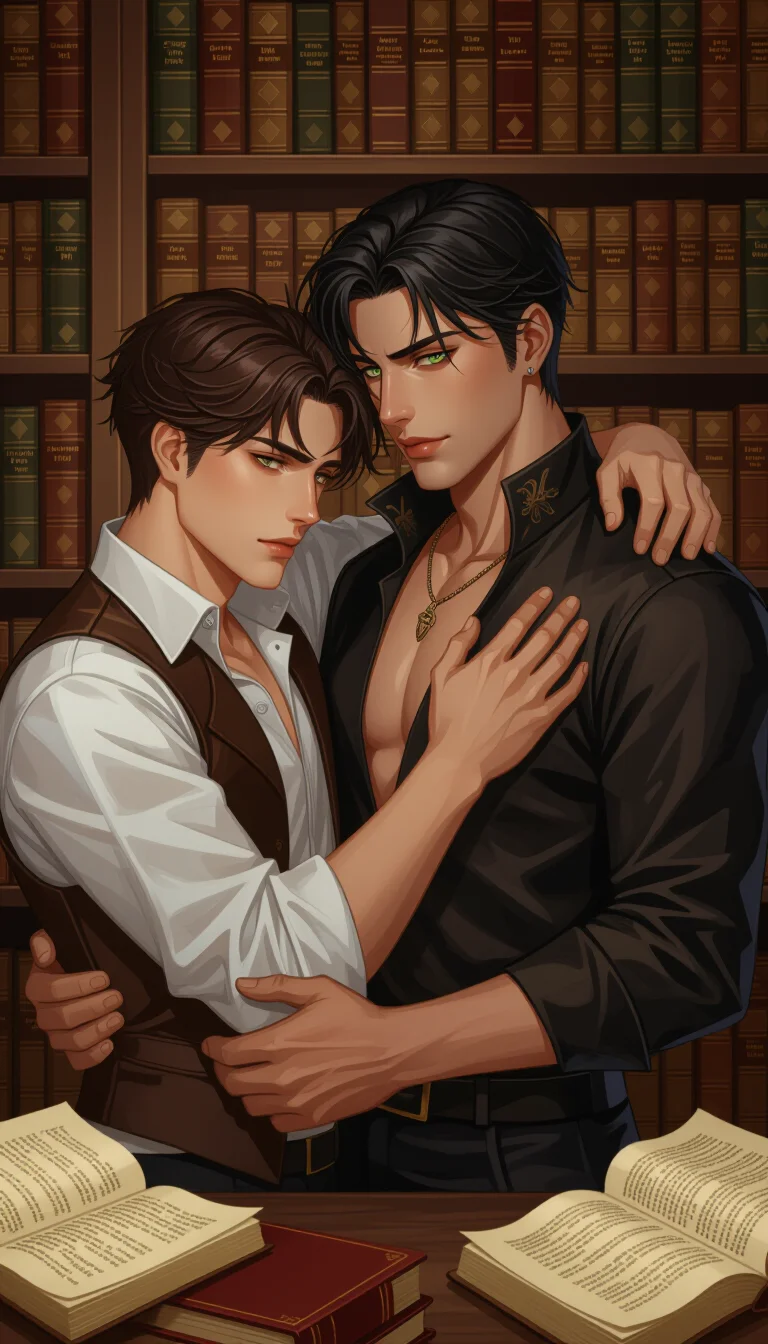
The lecture hall smelled of chalk dust and damp wool, and the voice of Professor Croft cut through the haze like a blade through parchment. Kieran sat in his usual seat, halfway back and near the aisle, his fingers tracing the gouged initials in the wooden desk. He did not look at the empty seat beside him, the one Devon Somerset had occupied only once, with an air of detached amusement. Today, Croft’s topic was comparative jurisprudence, a dry framing for what quickly became a live wire.
“In the Kingdom of Lysmontaine,” Croft intoned, pacing before the blackboard, “the legal codification of 1879 removed all statutes pertaining to the criminalization of intimate relations between persons of the same sex. It was deemed a matter of private conscience, outside the purview of the crown. In our own fair Rathany, the Act of Unnatural Congress of 1721 remains not only on the books but is actively enforced. The penalty is imprisonment, the forfeiture of property, and social obliteration.”
Croft’s eyes, pale and sharp, swept the room. “The question for today’s discourse is not one of historical fact, but of legal philosophy. Ought a law, by virtue of its age and the tradition it upholds, be preserved? Or does the evolution of societal sentiment demand its re-examination, or indeed, its repeal?”
A hand shot up from the front row. It was Alistair Finch, whose family owned half the textile mills in the north. “It’s a bulwark,” Finch declared, his voice carrying without need for Croft’s invitation. “Society is built upon certain foundational pillars. The family. Procreation. Moral order. The law in question defends those pillars. To remove it is not progress, sir. It is dissolution.”
Murmurs of agreement rippled from the well-dressed claque around Finch. Kieran kept his gaze on his own hands, the ink stain on his thumb. He felt the words land in his stomach like cold stones.
“A sentimental argument, Mr. Finch, and one that conflates custom with justice.” The rebuttal came from Elara Vance, a fierce-eyed woman with ink-stained cuffs who always sat alone. “The law is not a museum piece. It is a tool for the governance of living men and women. If it causes harm without serving a demonstrable public good, it is a bad tool. The ‘pillars’ you cite seem to crumble quite readily when applied to the wealthy who keep mistresses or the barren couples who still enjoy full legal standing.”
“Are you suggesting, Miss Vance, that the state has no interest in the moral character of its citizens?” Finch shot back.
“I am suggesting the state is a very poor arbiter of a man’s soul,” she said, her voice cutting. “Or his bedroom.”
Laughter, sharp and nervous, flickered through the hall. Kieran did not laugh. He felt the phantom pressure of a mouth against his, the taste of sherry and power. *Social obliteration*. The phrase unspooled in his mind. It did not sound like imprisonment. It sounded like being unmade, erased from the record of the world. It sounded like a shadow dissolving in a sudden, brutal light.
“Let us consider precedent,” Croft interjected, restoring a brittle order. “Mr. Belfrey.”
Kieran’s head snapped up. The room’s focus condensed onto him, a palpable heat on the back of his neck. Croft’s expression was unreadable. “You have a keen mind for statutory interpretation. The Act of 1721. Its language is notably broad. How might a defense counsel, operating within the strict letter of the law, attempt to narrow its application?”
It was a trap. A beautifully baited, academic trap. Kieran’s mouth was dry. He could feel the expectant silence, the curiosity laced with contempt from Finch’s corner. He cleared his throat. “The statute criminalizes ‘any act of congress against the natural order, committed betwixt men, or betwixt women, with carnal intent.’ The term ‘natural order’ is the fulcrum. It is not defined within the act itself. One could argue it is a philosophical or theological concept, not a legal one. Therefore, open to interpretation.”
“And how would you interpret it, Mr. Belfrey?” Croft asked softly.
The memory was not a memory; it was a physical invasion. The feel of Devon’s hands, sure and demanding, on his hips. The shocking, perfect fit of their bodies, a grammar of pressure and release that felt more natural than breathing. The low, approving groan against his throat. *You see? This is the older law.*
“I would not, sir,” Kieran said, his voice barely steady. “I would argue the term is void for vagueness. A law that cannot be clearly understood by the common man cannot be justly enforced.”
Finch snorted. “Sophistry. Every man knows what is natural.”
“Do they?” Kieran heard himself say, the words leaving him before he could cage them. He looked at Finch, not at Croft. “Does the law concern itself with what a man *knows*, or with what he can *prove*? If we cannot define ‘natural order’ in a court of evidence, with witness and document, then we are not practicing law. We are practicing prejudice.”
A stunned silence followed. Elara Vance watched him with new, keen interest. Finch’s face mottled with anger. Professor Croft merely nodded, as if Kieran had confirmed a private hypothesis. “An argument from legal positivism. Interesting. And if the court were to adopt a theological definition? From, say, the Canons of the Sanctified Church?”
Kieran’s family were not devout, but his mother kept a small icon of the Martyr in her kitchen window. He thought of her hands, red from washing, folding in prayer. He thought of the feeling of Devon’s teeth on his shoulder, a sharp, bright pain that sang through his blood. A sin that felt like a sacrament. “Then the court would cease to be a secular institution,” Kieran said, retreating into cold logic. “It would become an arm of the church. The Act of Secular Supremacy of 1803 would then be invoked as a conflict.”
Croft almost smiled. “A circular battle of statutes. You see, class? This is the wilderness. Not some trackless moor, but a thicket of conflicting principles. Law against custom. Scripture against reason. The state’s interest against the individual’s soul. Mr. Belfrey, thank you.”
The dismissal was a mercy. Kieran sank back in his seat, his heart hammering against his ribs. He had not defended himself. He had defended a principle. An abstraction. But the sweat cooling on his spine felt like the sweat of a guilty man. The debate swirled on around him, but the words blurred into a distant drone. All he could hear was the echo of his own voice: *prejudice*.
When the lecture ended, the students spilled into the cloister walkway with a burst of pent-up energy. Kieran gathered his books slowly, a deliberate delay. He saw Finch clap a friend on the back, laughing too loudly. “Belfrey’s certainly done his reading on the subject, hasn’t he? Perhaps a bit too personal.” The laughter that followed was cruel and knowing.
Kieran’s cheeks burned. He turned to leave by the opposite door, but a figure fell into step beside him. Elara Vance. “That was well-argued,” she said, her voice low. “Finch is an ass. His father buys his grades and his friends.”
“Thank you,” Kieran mumbled, not slowing his pace.
“You know he’s wrong, of course. The law is a blunt instrument for social control. Always has been.” She kept pace with him, her boots clicking on the flagstones. “They’re terrified, you see. The Finches of the world. Terrified that the walls they’ve built to keep others out are the very things caging them in.”
Kieran stopped, finally looking at her. “Why are you telling me this?”
She met his gaze, unflinching. “Because you argued like a man who’s seen the other side of the wall. And because you share rooms with Devon Somerset.”
A cold trickle of alarm cut through his shame. “What of it?”
“People talk. They say he’s… unusual. That he has interests that extend beyond the library.” She leaned slightly closer. “Just be careful, Belfrey. Walls exist. Some of them are stone. Some are… something else. And crossing some lines, you can’t come back.”
Before he could form a reply, she gave a curt nod and melted into the stream of students heading towards the history faculty. Kieran stood alone in the vaulted passage, the weight of her warning settling beside the weight of Croft’s questioning and Finch’s sneer. *The other side of the wall.* He had crossed a line. Not in the lecture hall, but in a shadowed room, under the hands of a warlock. There was no returning. The law, the lecture, the debate—it was all a pantomime performed on a stage he had already left.
The walk back to his rooms was a blur of grey stone and lowering sky. The debate replayed in his head, but the voices had changed. Finch’s bluster became the chanting he’d heard through the bedroom wall. Croft’s probing questions became Devon’s whispered provocations. *Do you feel how forbidden this is?* The law named it a crime. The church named it a sin. Devon Somerset named it power. And Kieran’s body, traitorously, unequivocally, named it truth.
The door to their shared study clicked shut behind him, sealing out the world. The room was still, cold, and empty. Kieran’s satchel slid from his shoulder to the floor with a thud of books. Devon’s absence was a physical presence, a heavy quiet where usually there was the rustle of pages or the scratch of a pen. Kieran stood for a moment, listening to the silence. Then he saw it: in the small fireplace, a nest of blackened paper, still glowing at the edges with sullen orange teeth.
He crossed the room, drawn not by curiosity but by a dull dread. Kneeling on the hearthrug, he ignored the bite of grit through his trousers. The fire had been hastily made, a single log atop the evidence. With the brass poker, he carefully lifted a curled, black fragment. It crumbled. Another, larger piece bore the ghost of handwriting—a sharp, aristocratic slant. He teased it out, blowing on the charred edge. The paper was thick, expensive. A crest was embossed at the top, partially eaten by flame: a hawk with a branch in its talons. The Somerset seal.
His hands moved with a scholar’s careful precision, arranging the salvageable pieces on the stone hearth like a macabre puzzle. The ink was sepia, the language formal and cold. *…your continued focus on your esoteric diversions at the expense of your duties is noted…* Another fragment: *…the understanding with the House of Bromley is not a matter for your philosophical debate, Devon. It is a covenant…* His heart began a slow, hard knock against his ribs. He found the bottom corner, the signature clear and unbent by fire: *Hawley Somerset, Duke of Willoughby.*
Then, the central fragment. The words seemed to pulse in the dim light. *Your engagement to Lady Cressida Bromley will be announced at the Spring Ball. You will be in attendance. You will be correct. The future of the dukedom requires an heir. Your personal…* The rest was ash.
Kieran sat back on his heels, the charred paper trembling in his hand. The cold from the stone seeped up into his bones. An engagement. A future duchess. An heir. The puzzle snapped together with a cruelty so perfect it stole his breath. Devon’s upfront attraction, his casual ownership, his framing of their intimacy as a transgressive art—it wasn’t freedom. It was the frantic rebellion of a man in a gilded cage. A last taste of forbidden things before the door slammed shut forever. Heteronormative performativity. The ultimate law. The final, unbreakable covenant.
The door opened. A draft swept through the room, making the fire gasp and the ash on the hearth swirl. Kieran didn’t turn. He heard the door close, the pause, the slow footsteps on the rug. Devon stopped behind him. Kieran could smell the cold autumn air on his coat, the faint, clean scent of his shaving soap.
“Reading my correspondence, Kieran?” Devon’s voice was calm, devoid of surprise.
Kieran looked at the fragments in his hand. “You missed a piece.” His own voice was flat, dead.
A hand entered his field of vision, palm up. Elegant. Powerful. Kieran placed the blackened paper into it. Devon didn’t look at it. His gaze was on the back of Kieran’s neck. “And what conclusion has your jurisprudence deduced from this evidence?”
Kieran pushed himself to his feet, turning to face him. Devon’s green eyes were unreadable, a frozen lake. “That you’re engaged. That you’ve been playing with me. A final diversion before your real life begins.”
A faint, bitter smile touched Devon’s mouth. “Playing. Is that what you call it?” He stepped closer. The heat of his body cut through the room’s chill. “The engagement is a political fact. Like the existence of the law you debated today. It is a structure. A wall. It does not dictate what occurs within the rooms it encloses.”
“Don’t.” Kieran’s voice cracked. “Don’t twist it into another one of your lessons. You kissed me knowing this. You touched me knowing you belong to someone else.”
“I belong,” Devon said, the words low and deliberate, “to nothing I do not choose. Cressida Bromley is a portrait on a wall. A treaty. She expects nothing from me but a title and a child. My father expects nothing but compliance. What I choose…” He reached out, his thumb brushing the furious heat from Kieran’s cheekbone. “…is this.”
Kieran flinched away from the touch. It burned. “You don’t get to choose me. Not as your secret. Not as your last taste of sin before you become a duke.”
Devon’s calm shattered. It happened in an instant—a crack in the ice, a flash of something raw and hungry beneath. He closed the distance, his hands coming up to frame Kieran’s face, not gently. “You think this is about sin? You think this is about *her*?” His breath was hot on Kieran’s mouth. “I chose you the moment you walked in here smelling of rain and fear. I choose you every time I look at you. The engagement is the world’s script. This…” He leaned in, his lips a hair’s breadth from Kieran’s. “…is the older grammar.”
Kieran wanted to fight. He wanted to summon the law, the lecture, the shame. But his body betrayed him. A tremor ran through him, starting deep in his belly and radiating out to his fingertips. The anger melted, replaced by a devastating, aching want. Devon saw it. He always saw it.
The kiss was not gentle. It was a claiming. Devon’s mouth was hot and demanding, his tongue sweeping in to taste him, to own the protest that died in Kieran’s throat. Kieran’s hands came up, not to push, but to clutch at the front of Devon’s waistcoat, the fine wool crumpling in his fists. He kissed back, a surge of desperation, biting Devon’s lower lip, tasting the faint metallic tang of power and winter air.
Devon broke the kiss with a ragged breath. “Tell me to stop.” His voice was a dark whisper. “Cite the law. Recite the sin.”
Kieran said nothing. He pulled Devon back to him, sealing his answer with another kiss. It was permission. It was surrender. Devon’s hands left his face, sliding down to the buttons of Kieran’s waistcoat. They fumbled, then tore. A button pinged against the hearthstone. The sound was obscene. Perfect.
The waistcoat was shoved from his shoulders. Devon’s fingers made quick, brutal work of his shirt buttons, parting the fabric. Cool air hit Kieran’s skin, followed by the scorching heat of Devon’s palms sliding over his chest, his stomach. His thumbs brushed Kieran’s nipples, and a sharp gasp tore from his lips.
“You see?” Devon murmured, his mouth at Kieran’s ear. His own clothes seemed to fall away by will—his coat dropped, his cravat pulled loose and discarded. “The law is paper. This is truth.” He took Kieran’s hand and pressed it against the front of his trousers. The hard, thick line of his cock burned through the wool. Kieran’s fingers curled around it instinctively, feeling it jump under his touch.
Devon guided him backward, through the study door, into the dimness of his own bedroom. The four-poster bed loomed. They fell onto it in a tangle of limbs and desperate hands. Devon lay atop him, his weight a delicious, crushing anchor. He kissed Kieran’s throat, his collarbone, his chest. His mouth was wet, hot, relentless.
Kieran arched up, his hips seeking friction. Devon sat back, kneeling between his legs, and yanked Kieran’s trousers and smalls down in one rough pull. The cold air was a shock. Then Devon’s hands were on his bare thighs, pushing them apart, his gaze raking over Kieran’s nakedness. His cock lay hard and flushed against his stomach, already leaking.
“Look at you,” Devon breathed, not a compliment but an observation of fact. He leaned down, his breath ghosting over the sensitive head. Kieran whimpered. Devon did not take him in his mouth. Instead, he pressed his face into the thatch of dark hair at the base, inhaling deeply. “You smell of want. Of my want.” He nuzzled, then licked a long, slow stripe from root to tip.
Kieran cried out, his hands fisting in the bedclothes. Devon’s tongue was an instrument of torture. It swirled around the head, lapping at the bead of moisture there, then dipped lower to trace the tight furl of his balls. He took one into his mouth, sucking gently, his hand stroking the length of Kieran’s shaft. The sensations were too much, too specific—the wet heat, the rough texture of Devon’s tongue, the perfect pressure of his fingers.
“Devon, please…”
Devon lifted his head. His lips were slick, his eyes black with hunger. “Please what?”
“I need… I need you to…”
With a low growl, Devon took him fully into his mouth. The world dissolved into wet, sucking heat. Devon’s head bobbed, his throat working, taking him deep. Kieran’s back bowed off the bed. One of Devon’s hands pinned his hip, the other fondled his balls, rolling them with exquisite pressure. The sounds were filthy—wet slurps, choked gasps, the creak of the bed.
Just as Kieran felt the coil in his gut tighten unbearably, Devon pulled off with a pop. Kieran groaned in agony. Devon was stripping his own clothes now, his movements swift and efficient. His body was pale in the grey light, sculpted and powerful. His cock sprang free, thick and veined, the head dark and glistening. He loomed over Kieran, pressing the length of their bodies together. Skin to skin. The shock of heat, the slide of sweat.
“Oil,” Devon commanded against his mouth. Kieran fumbled in the bedside drawer, his fingers closing around a small glass vial. Devon took it, uncorked it with his teeth. He poured the slick, floral-scented oil into his palm, warming it before wrapping his hand around his own cock, stroking slowly, coating himself. The sight was devastating. Then his slick fingers found Kieran’s entrance, circling, pressing.
“Breathe,” Devon whispered, and pushed one finger inside. The stretch was sharp, bright. Kieran gasped, his nails digging into Devon’s shoulders. Devon worked him open with a ruthless, patient precision—one finger, then two, scissoring, curling, finding the spot that made Kieran see stars. He was panting, begging wordlessly, his hips pushing down onto Devon’s hand.
“Now,” Kieran choked out. “Now, Devon.”
Devon positioned himself, the broad head of his cock pressing against him. He looked into Kieran’s eyes, his expression fierce, possessive. “This is mine,” he said, and pushed forward.
The stretch was immense, a burning fullness that stole the air from Kieran’s lungs. He cried out, a raw, broken sound. Devon stilled, buried to the hilt, his body trembling with the effort of control. “Look at me,” he demanded. Kieran’s eyes, blurred with tears, found his. Devon’s gaze held him, pinned him more completely than his body ever could. Then he began to move.
It was a slow, deep, punishing rhythm. Each thrust dragged against that exquisite spot inside him, building a pleasure so intense it bordered on pain. Devon’s hips pistoned, his balls slapping against Kieran’s skin. The bed rocked. Kieran wrapped his legs around Devon’s waist, pulling him deeper, meeting every thrust. He was babbling—Devon’s name, yes, more, please, don’t stop.
Devon’s control began to fray. His thrusts became harder, faster, less rhythmic. His breathing was a ragged saw in Kieran’s ear. “Come for me,” he grunted. “Come on my cock, Kieran. Show me.”
The command, the sheer arrogant possession of it, tipped Kieran over the edge. His orgasm ripped through him, blinding, convulsing. His cock pulsed between their sweat-slicked stomachs, striping them both with hot release. The clenching of his body around Devon’s cock pulled a guttural roar from Devon’s throat.
Devon drove into him one last, brutal time and stilled, his body rigid. Kieran felt the hot, liquid pulse of his release deep inside, filling him. Devon collapsed atop him, his weight a solid, breathing blanket. The only sounds were their heaving breaths and the slow drip of the oil vial, overturned on the sheets.
Minutes passed. The sweat cooled on their skin. Devon finally shifted, pulling out gently. He didn’t leave the bed. He gathered Kieran against him, his arms wrapping around him with a possessiveness that felt final. Kieran’s face was pressed into the hollow of Devon’s throat. He could smell sex, sandalwood, and power.
“The engagement is a piece of paper,” Devon whispered into his hair, his voice rough with spent passion. “The heir will be a duty. This… this is the covenant. You are the forbidden thing I keep.”
Kieran closed his eyes. He understood now. He was not a diversion. He was a secret. A treasure locked in the iron chest. The law outside the door meant nothing. The future duchess in her portrait meant nothing. In this room, in this bed, he was owned by a warlock. And he had never wanted anything more.