
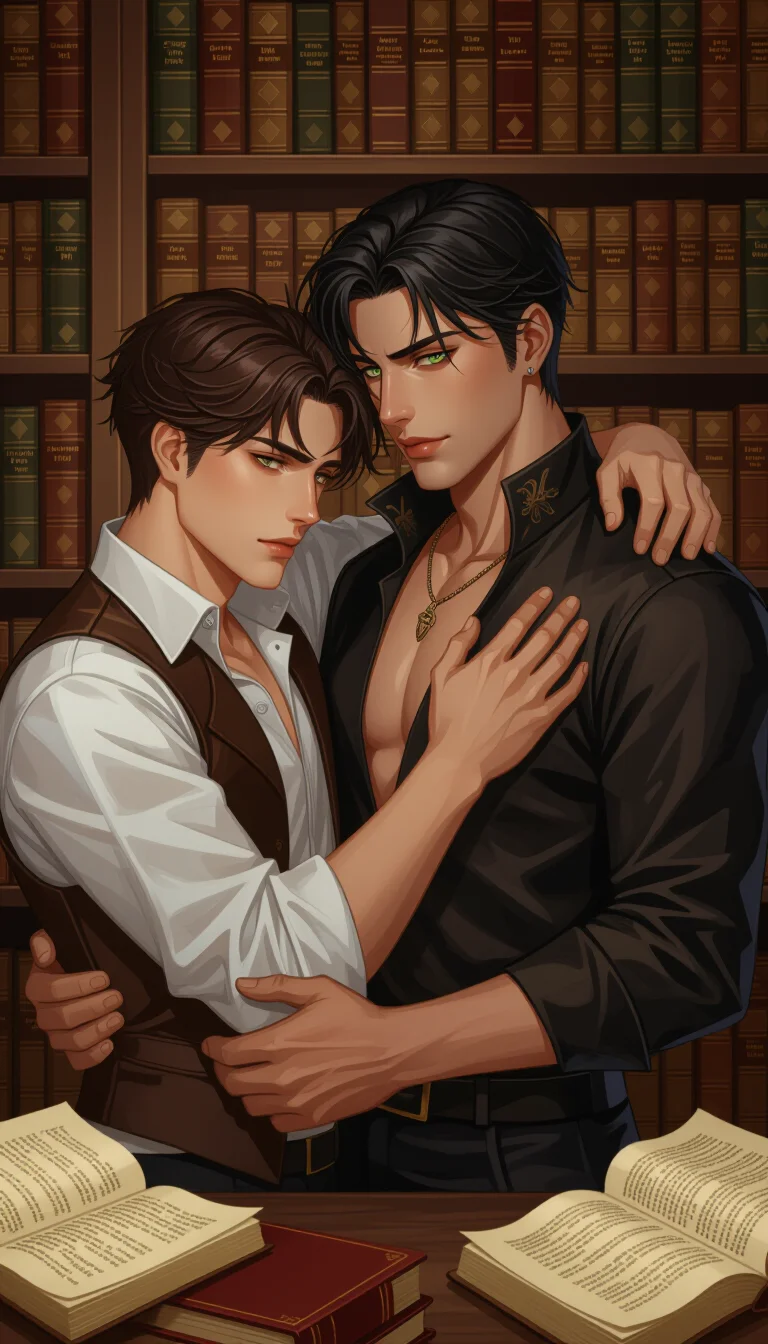
The refectory’s high, vaulted ceiling swallowed the lunchtime clamor, turning it into a distant, echoing sea. Kieran pushed a piece of boiled potato through the thin gravy on his plate, his gaze fixed on the grain of the oak table. Three tables over, the gossip flowed like cheap wine.
“—swear it on my mother’s grave,” a voice carried, rich with theatrical certainty. “Old Magistrate Hale saw him clear as day, sprinting for the coastal coach with that satchel of his. And the girl on his arm! A bosom like a ship’s figurehead, I heard.”
Laughter rippled through the group of final-year law students. It was a sharp, unkind sound. Kieran didn’t look up.
Devon sat across from him, methodically dissecting a roast chicken. His movements were precise, surgical. He brought a piece of white meat to his lips, chewed, swallowed. His green eyes were half-lidded, fixed on the gossiping table as if observing a mildly interesting species of insect. “The collective imagination is a formidable thing,” he said, his voice barely audible above the din. “Give it a seed of scandal and it cultivates an entire garden of plausible fiction.”
“They seem relieved,” Kieran said, finally looking up. His own voice felt thin in his throat.
“They are. Alistair Finch was a pustule on the backside of their social order. Ambitious without pedigree, cruel without charm. His absence isn’t a mystery to them. It’s a deliverance.” Devon’s fork tapped once against his plate. “Listen.”
Another voice, higher, tinged with spite. “He once reported me for a misplaced footnote in a tutorial paper. Called it ‘academic slovenliness’. The prick.”
“He tried to have Elara Vance expelled last term, you know. Before the mock trial. Dug through her family’s records looking for debt or disgrace.”
“Always smelling of that cheap hair tonic. Like a barber’s floor.”
The litany of petty grievances continued, each one layering a new justification atop the story of the barmaid and the coastal flight. The real horror of the man—his rigid, prosecutorial soul, the way he’d looked at Kieran in the mock trial—was being erased, sanded down into a caricature everyone could comfortably despise. His death was becoming a joke.
Kieran’s appetite vanished. He set his fork down. The gravy had congealed around his potato.
Devon watched him. “You wanted him to be mourned?”
“I wanted him to be real. This… makes him a ghost before he’s even a ghost.”
“He is a ghost. We buried his bones.” Devon said it without inflection, a simple statement of fact. He took a sip of water. “The story is cleaner. It leaves no loose ends for anyone to pull. No righteous family seeking answers. Just a coward and a libertine, running from his debts. It’s the kind of end he would have assigned to someone else.”
A figure detached from the gossiping group and approached their table. It was Theo Pendleton, his round face flushed with the pleasure of shared malice. “Somerset. Belfrey. Hearing the news, then?”
Devon leaned back in his chair, the picture of casual elegance. “It’s difficult to avoid, Pendleton.”
“Serves him right, the weasel. Running off like that. Though,” Theo lowered his voice, leaning in conspiratorially, “between us, if that barmaid’s attributes are as described, I might have sprinted for the coast myself.” He chuckled, waiting for complicity.
Kieran felt a cold nausea. He saw the body on the floor. The unnatural angle of the neck. The dark, staring eyes.
Devon’s smile was a thin, polished blade. “Your romantic aspirations are your own business, Theo. We were just finishing.”
The dismissal was absolute. Theo’s chuckle died. He nodded, a little stiffly, and retreated back to his friends.
Silence settled between them again, thicker now. Devon finished the last of his chicken, wiped his mouth with a linen napkin, and placed it neatly beside his plate. He studied Kieran’s untouched food. “You need to eat.”
“I can’t.”
“You will.” It wasn’t a suggestion. Devon signaled a serving boy for two cups of strong black tea. When they arrived, he pushed one toward Kieran. “Drink. The sugar will help.”
Kieran wrapped his hands around the warm china. The heat was a anchor. He took a sip. The tea was bitter, bracing. “Do you feel nothing?” he asked, the question escaping before he could cage it.
Devon’s eyes lifted from his own cup. They were fathomless in the refectory’s grey light. “I feel the absence of a problem. I feel the efficacy of a story well-planted. I feel the entropy of a finished thing. What would you have me feel, Kieran? Remorse?” He said the word as if it were in a foreign language.
“He was a person.”
“He was a gnat,” Devon corrected, his voice dropping to a whisper that cut through the ambient noise. “A buzzing, irritating gnat that landed on a sleeping leviathan. He was vaporized by the mere exhalation. His personhood is irrelevant. The only meaningful thing he ever did was die in our sitting room.” He took a long drink. “You are not mourning him. You are mourning the version of yourself that could sit here and laugh with Theo Pendleton about a barmaid’s bosom.”
The truth of it hit Kieran like a physical blow. He stared into his tea. The version of himself from a month ago, from before the shadows in Devon’s rooms, would have been uncomfortable, yes, but he would have listened. He might even have found a grim satisfaction in Finch’s disgrace. Now, he was on the other side of a glass wall, watching normalcy happen without him. He was an accessory. He had helped wrap the body. He had stood watch while the earth swallowed the evidence.
“They have no idea,” Kieran whispered.
“Of course they don’t. Their world is made of paper and ink and gossip. Ours is made of older things.” Devon’s foot found Kieran’s under the table, a firm, steady pressure. “This is the weight. This is the silence. You chose it.”
“I know.”
“Do you?” Devon’s gaze was relentless. “You keep looking back at the shore. The shore is gone, Kieran. We burned the boats.”
The pressure of Devon’s foot increased, a demand for focus, for presence. Kieran met his eyes. In their green depths, he saw no comfort, only a stark, shared reality. There was no going back to the refectory’s gossip, to the simple certainties of right and wrong. They were in the silence now. Together.
Kieran took another sip of tea. The sugar was a shock on his tongue, a jolt of vitality. He picked up his fork, speared the cold potato, and put it in his mouth. He chewed. He swallowed. It was an act of will. An affirmation.
A faint, approving shadow of a smile touched Devon’s lips. He gave a slight, almost imperceptible nod. “Good.”
They finished their tea in silence as the refectory began to empty around them. The laughter from the other table faded as the students drifted away, back to tutorials and libraries, their minds already moving on to the next scandal, the next examination. The story of Alistair Finch was already settling into university lore, a cautionary tale about ambition and loose women.
Devon stood, collecting his books. Kieran followed suit. As they walked out of the vast hall into the stone cloister, the cool spring air was a relief. The sound of their footsteps echoed sharply in the empty corridor.
“Where now?” Kieran asked.
“The library. I need to consult a grimoire that’s been… misfiled. In the restricted annex.” Devon’s tone was casual, but the meaning was clear. His studies continued. Their work continued.
Kieran fell into step beside him. He didn’t look back at the refectory doors. The weight was still there, a cold stone in his gut, but it had found its place. It was his weight to carry. He walked forward, into the shadowed, silent places, at Devon Somerset’s side.
The grimoire was bound in cracked, black leather, the title stamped in flaking silver: De Exorcismis et Potestatibus Tenebrarum. Kieran watched Devon’s long fingers trace the embossed letters. “A treatise on banishing dark spirits,” Kieran said, his voice low in the sepulchral quiet of the restricted annex. “You’re looking for a way to fight Her.”
Devon didn’t look up. He turned a brittle page, the sound like a dry leaf crumbling. “I have to be prepared for anything. Even my patron turning against me.”
The admission hung in the dusty air. Kieran leaned against a shelf, the scent of decaying paper and old glue filling his nose. He watched the concentration on Devon’s face, the slight furrow between his brows. This wasn’t academic curiosity. This was a man studying the schematics of a trap, for the creature that held his leash.
“Is such a thing even possible?” Kieran asked.
“Theoretically. All pacts have terms. All bindings have seams.” Devon’s green eyes flicked up, catching the dim light from the single electric bulb overhead. “She is entropy given will. To banish her is not to destroy, but to… persuade. To offer a greater dissolution elsewhere. It’s a calculus of despair.”
He said it like a barrister outlining a difficult case. Kieran felt the cold stone in his gut shift, becoming something colder. “You’d need a sacrifice. Greater than a memory.”
“Considerably.” Devon returned to the text, his voice devoid of inflection. “It’s an academic exercise, Kieran. A contingency. I have no intention of provoking a war with my only source of power. But I will not be a gnat she casually swats, either. Alistair proved that.”
The name, spoken here, was a profanity. Kieran’s palms were damp. He wiped them on his trousers. “And if she knows you’re reading this?”
“She knows everything I do.” Devon finally closed the book with a soft thud. “That is the point of the exercise. To let her see the preparation. A subtle reminder that even a gnat can sting.”
He slid the grimoire back into its gap on the shelf, not where it belonged, but somewhere else entirely. Misfiled again. He turned, his form silhouetted against the stacks. “Come. We’re done here.”
They walked back through the labyrinth of the main library. The familiar scent of ink and wood polish did nothing to settle Kieran. Devon’s calm was a performance, but the tension in his shoulders, the precise, almost silent fall of his footsteps, betrayed the reality. Kieran matched his silence, his mind a riot of calculations. A greater sacrifice. What did a warlock have left to offer but his life, or his soul? And what did that mean for the witness who had chosen to stand beside him?
Outside, the afternoon had greyed. A fine, misting rain beaded on the wool of Kieran’s jacket. Devon didn’t turn toward their apartment. Instead, he led them across the quadrangle, through a narrow gate, and into the university’s walled physic garden. It was deserted in the damp, the geometric beds of herbs and medicinal plants a muted tapestry of greens and greys.
Devon stopped beside a stone bench slick with moisture. He didn’t sit. He stared at a tangled knot of wormwood, its silver leaves dripping. “I can feel her attention,” he said, so quietly Kieran almost missed it beneath the patter of rain. “Like a pressure change before a storm. It’s been constant since the woods.”
Kieran stood beside him, the rain catching in his lashes. “What does she want?”
“To see if I flinch. If I regret. If the sight of Finch’s bones keeps me awake.” Devon turned his face into the mist. “It doesn’t. That’s what frightens her. I think… I think she believed taking a witness would soften me. Create a vulnerability she could exploit. Instead, it gave me an anchor.”
The word ‘anchor’ landed in Kieran’s chest, a warm, heavy weight. He looked at Devon’s profile, the rain tracing the line of his jaw. “You’re using me as a shield.”
“No.” Devon looked at him then, his gaze fierce. “I am using you as a compass. You are my fixed point. The one piece of reality she cannot touch, because you are outside the pact. You are the only thing I have that is not part of the transaction.”
The raw honesty of it stole Kieran’s breath. It was more intimate than any touch they’d shared in the chapel. This was the crack in the armor, the truth beneath the warlock’s calculations. Devon Somerset was afraid, and Kieran was his north star.
Kieran reached out. His fingers brushed the back of Devon’s hand where it rested on the wet stone of the bench. The skin was cold. Devon turned his hand, palm up, and Kieran laced their fingers together. The connection was simple, stark. No magic, no pact. Just grip.
“Then I will be your fixed point,” Kieran said. The rain muffled his words, made them something for Devon alone. “I will be the shore you burned the boats to reach.”
Devon’s hand tightened around his. For a long moment, they stood there in the silent, dripping garden, two dark figures in the grey, holding a line against an unseen tide. Then Devon brought their joined hands up, pressing Kieran’s knuckles against his own lips. The kiss was not soft. It was a seal.
“She will test that,” Devon murmured against his skin. “She will try to make you doubt. To make you see a monster when you look at me.”
“I see you,” Kieran said. And he did. The boy from the festival, lost. The man who sacrificed joy for power. The scholar reading banishment rites in a dusty annex. The anchor, clinging to his anchor. “I’m not looking away.”
Devon released his hand. The absence of contact was immediate, a new kind of cold. “Then we proceed.” He straightened his shoulders, the moment of vulnerability folding away behind his eyes, replaced by the familiar, poised calculation. “The next phase requires more than library work. We need to understand the fabric of this city, its leylines. Its wounds. Where entropy naturally pools.”
He began to walk, and Kieran fell into step, the ghost of Devon’s grip still warm on his hand. The mist thickened, blurring the garden walls, swallowing the sound of their footsteps. They walked not back toward the world of gossip and tea, but deeper into the grey, toward the hidden wounds of Alderfaire, two shadows against the gathering dark.